Vacuum-Assisted Metal Printing Requirements
Additive manufacturing of metal parts—particularly electron-beam melting (EBM) and vacuum-assisted laser powder-bed fusion—relies on controlled vacuum environments to eliminate oxidation, improve melt-pool stability, and ensure defect-free microstructures. Build chambers must reach and hold pressures low enough to prevent oxygen and nitrogen pickup while still allowing efficient powder spreading and electron or laser energy delivery. Typical target levels range from 10⁻⁴ Torr (≈1.3×10⁻² Pa) during initial pump-down to a stable 10⁻⁵–10⁻⁶ Torr operating window for high-energy beam processes.
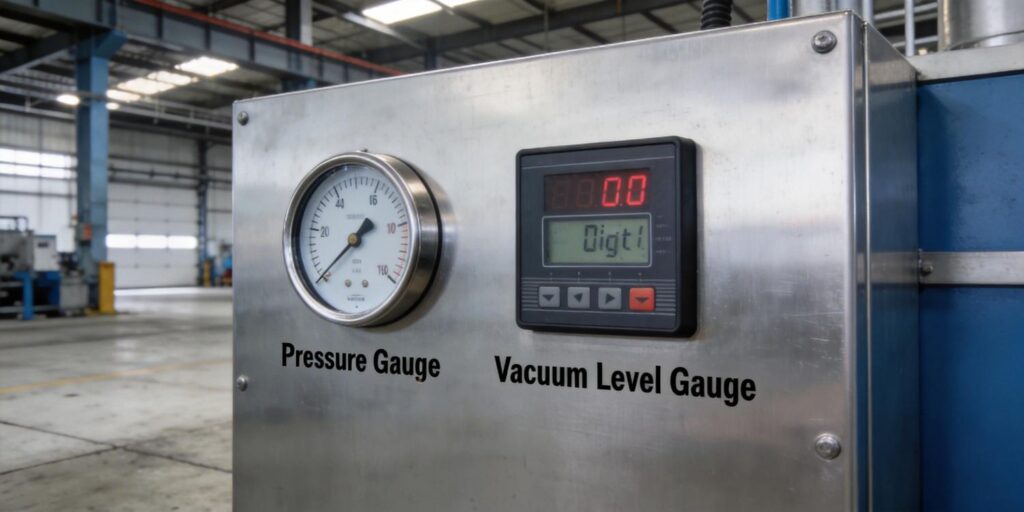
At these pressures, the mean free path of residual gas molecules exceeds chamber dimensions, minimizing beam scattering and enabling the sub-micron spot sizes required for aerospace, medical, and energy components. Without precise vacuum monitoring, even brief excursions above 10⁻³ Torr can introduce porosity, lack-of-fusion defects, or surface oxidation that render parts unusable. Poseidon Scientific’s VG-SP205 Pirani Vacuum Transmitter handles the roughing and mid-vacuum stages (atmosphere to 10⁻³ Torr), while the VG-SM225 Cold Cathode Vacuum Gauge provides reliable coverage from 10⁻³ to 10⁻⁷ Torr—exactly the range needed for modern vacuum-assisted metal AM systems.
Process Stability Window
Successful metal printing demands pressure stability within ±10 % of setpoint throughout the entire build cycle. In EBM systems, for example, the electron beam requires a stable 10⁻⁵ Torr environment to prevent arcing and maintain consistent melt-pool depth. Pressure spikes as small as 5×10⁻⁴ Torr can scatter the beam, reduce penetration, or trigger automatic shutdowns that waste hours of machine time and costly powder.
The VG-SP205 Pirani excels in the initial purge and roughing phases with its fast thermal-response time (<1 s to 90 % of step change) and platinum filament chosen for chemical stability in inert atmospheres. Its linear region (10 Torr to 10⁻² Torr) aligns perfectly with the critical transition zone where most stability issues occur. For deeper vacuum hold, the VG-SM225 Cold Cathode uses a compact positive-magnetron Penning discharge that delivers ion-current readings with <±5 % drift across the full 15 °C–50 °C operating range. Both transmitters feature onboard temperature compensation (circuit + algorithm), ensuring the process stability window remains tight even as chamber heaters cycle during long builds.
Factory calibration traceable to NIST standards and customizable RS232 output allow engineers to set automated interlocks that pause printing if pressure drifts outside the validated window—protecting part quality and machine uptime in high-value production runs.
Sensor Placement in Build Chamber
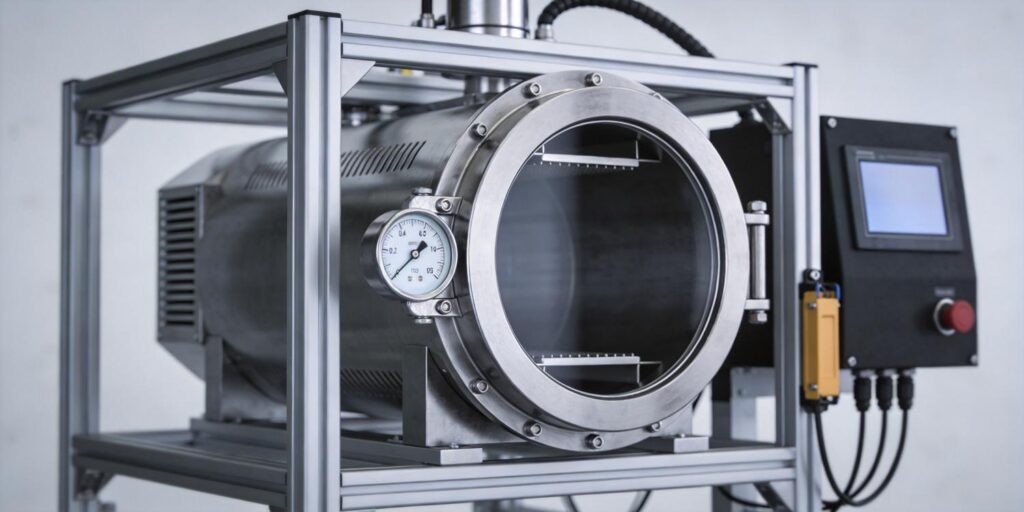
Correct sensor location is critical in powder-laden AM environments. Powder particles and metal vapor can contaminate electrodes or filaments, while beam-line interference must be avoided. Best practice places the gauge on a dedicated side port of the build chamber, using a short KF16 or KF25 tubulation to maintain full gas conductance while keeping the sensor head outside the direct powder-spreading and beam path.
Horizontal or 15°–45° upward orientation lets gravity carry stray powder away from active surfaces. The VG-SM225’s modular sensor head separates without breaking chamber seals, allowing quick electrode inspection or polishing (500-mesh emery paper) between builds if trace vapor deposition occurs. The VG-SP205’s sealed design is inherently maintenance-free and compact enough to fit inside glovebox-integrated airlocks or small desktop AM systems.
Both transmitters tolerate any orientation with no performance loss, but side-port mounting with at least 15 cm clearance from the electron or laser column prevents stray-electron or X-ray interference. Their low leak rate (≤10⁻¹¹ Pa·m³/s) preserves the ultra-clean chamber atmosphere required for titanium, Inconel, and cobalt-chrome alloys.
Redundancy for Critical Builds
Aerospace and medical AM parts often require 100 % traceability and zero tolerance for vacuum excursions. Installing dual gauges—one Pirani for roughing verification and one cold cathode for high-vacuum hold—provides true redundancy without adding significant cost or footprint. The two technologies overlap at 10⁻³ Torr, enabling continuous cross-check: if the cold-cathode reading deviates >10 % from the Pirani during transition, the system automatically aborts the build and alerts the operator.
Poseidon’s low engineered cost (3000–3500 RMB range) makes dual installation practical even on mid-volume machines. Digital RS232 status bits from both units can be logged in the machine’s SCADA system, creating an auditable record for certification bodies. Field data from EBM production lines show that redundant Poseidon pairs reduce scrap rates by >30 % compared with single-gauge legacy systems that fail undetected during long overnight builds.
Automation Integration
Modern AM platforms run 24/7 with centralized PLC or industrial PC control. The VG-SP205 and VG-SM225 deliver both 0–10 V analog (effective 2–8 V span) for direct PLC ADC input and fully customizable RS232 digital output. Protocol customization is available from just 5–10 units, allowing engineers to embed pressure, status, temperature, and error flags in a single twisted-pair cable—eliminating analog noise over the long runs typical in large build chambers.
Integration examples include:
- Real-time PID pressure control for bleed-valve or turbo-pump speed.
- Automated interlocks that pause powder spreading or beam firing if pressure exceeds setpoint.
- Data logging to MES systems for full build traceability.
- Remote monitoring via Modbus conversion when required.
Neither transmitter supports native 4–20 mA, but simple external converters pair easily with legacy DCS platforms. The compact RJ45 interface and optional DB9/DB15 adapters simplify routing through cleanroom penetrations while maintaining positive-pressure integrity.
Conclusion and Next Steps
Vacuum monitoring is no longer an afterthought in additive manufacturing—it is a core enabler of part quality, process repeatability, and machine uptime. Poseidon Scientific’s VG-SP205 Pirani Vacuum Transmitter and VG-SM225 Cold Cathode Vacuum Gauge deliver exactly the performance metal AM systems need: full-range coverage from atmosphere to 10⁻⁷ Torr, temperature-compensated stability, contamination-tolerant design, and seamless automation integration in a compact, low-cost package engineered for OEM budgets.
Whether you run electron-beam melting, vacuum-assisted laser powder-bed fusion, or directed-energy deposition, these transmitters provide the reliable data that protects every layer of your build. Their symmetric geometries, field-serviceable (cold-cathode) or maintenance-free (Pirani) construction, and dual analog/digital outputs make them the practical choice for both research labs and high-volume gigafactories.
Ready to upgrade your vacuum monitoring and reduce scrap in vacuum-assisted metal printing? Explore the VG-SP205 Pirani Vacuum Transmitter for roughing and mid-vacuum control or the VG-SM225 Cold Cathode Vacuum Gauge for high-vacuum stability today. Both support plug-and-play 0–10 V analog, customizable RS232 protocols, and 5–10 unit customization for your exact machine controller.
Contact our applications engineering team for a free chamber-layout review, redundancy configuration guide, or side-by-side comparison with your current gauges. We’re here to help you achieve stable, repeatable vacuum conditions—maximizing yield and minimizing downtime in every metal AM build.