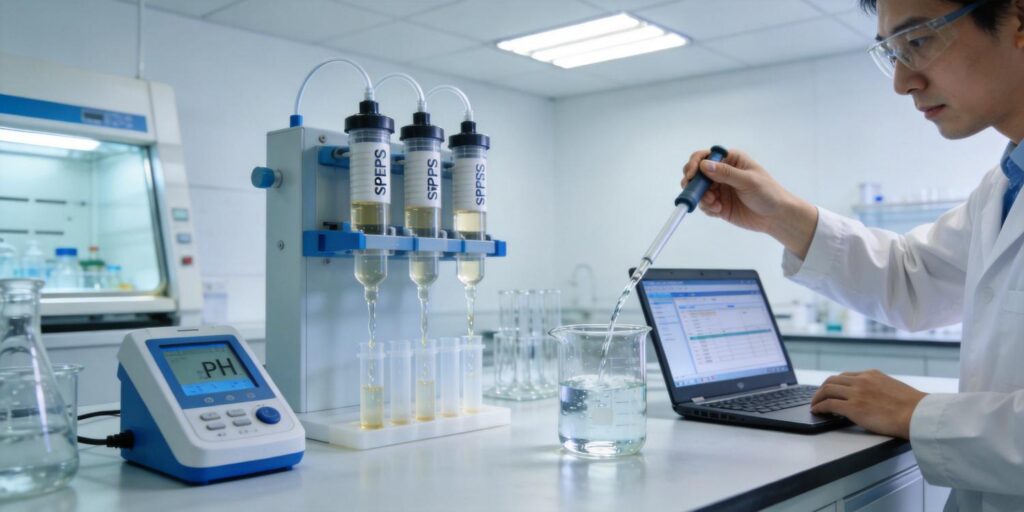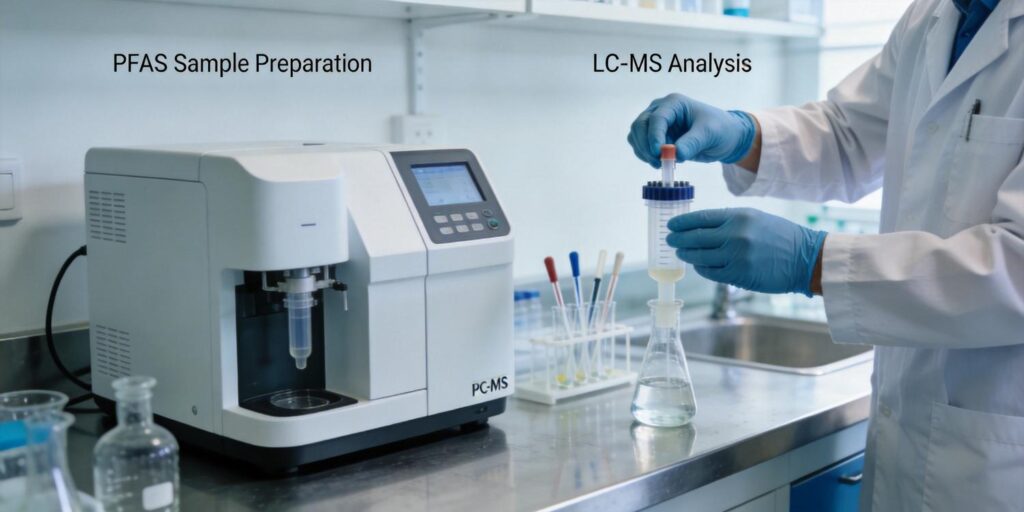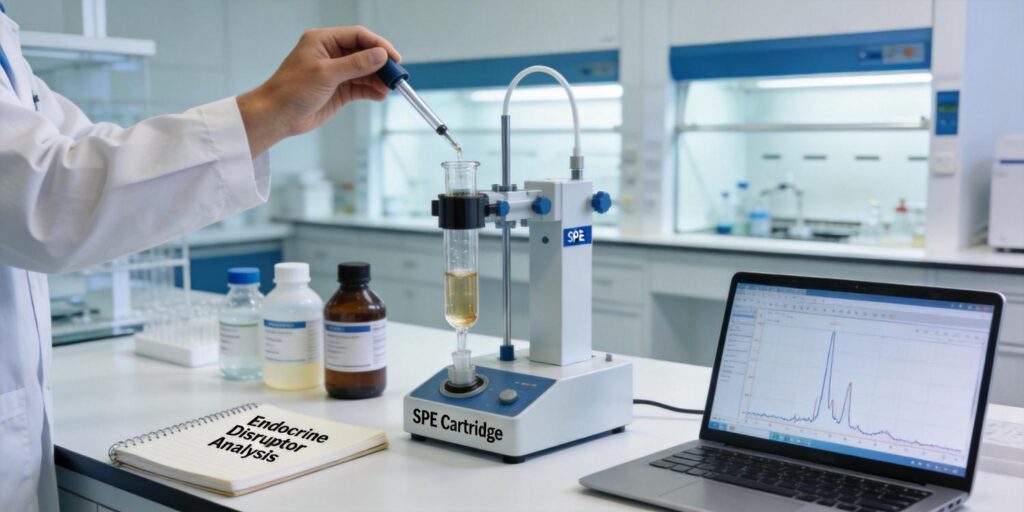
Overview of Endocrine Disrupting Compounds
Endocrine disrupting compounds (EDCs) represent a diverse class of chemical contaminants that interfere with the normal functioning of the endocrine system in humans and wildlife. These compounds mimic, block, or otherwise disrupt hormonal signaling pathways, potentially leading to reproductive abnormalities, developmental disorders, and increased cancer risks. EDCs encompass a wide range of chemical structures including pharmaceuticals, personal care products, industrial chemicals, and pesticides.
From an analytical perspective, EDCs present unique challenges due to their typically low environmental concentrations (often at parts-per-trillion levels), diverse chemical properties, and complex matrix interactions. Common EDCs include bisphenol A (BPA), phthalates, alkylphenols, synthetic hormones, and various pharmaceutical residues. The analytical detection of these compounds requires highly sensitive and selective methods, with solid-phase extraction (SPE) playing a crucial role in sample preparation workflows.
According to Waters Oasis documentation, specialized glass cartridges are specifically designed for trace analysis at parts-per-trillion (PPT) levels, with each lot tested for the presence of bisphenol A and other phenols and phthalates to ensure reliable analysis of endocrine disruptors in water samples. This quality control is essential given the low detection limits required for EDC analysis.
Environmental Matrices Commonly Tested
EDC analysis spans multiple environmental matrices, each presenting unique challenges for sample preparation. The most commonly tested matrices include:
Surface and Groundwater
Surface water (rivers, lakes, streams) and groundwater represent primary matrices for EDC monitoring due to their direct relevance to human exposure through drinking water. These matrices typically contain lower levels of particulate matter compared to wastewater but may contain dissolved organic carbon (DOC) that can interfere with extraction efficiency. Research indicates that DOC poses greater problems as its concentration increases and as the hydrophobicity of the analyte increases. For analytes with log Pow above 4 when using alkyl-bonded silicas, or above 3 when using polystyrene sorbents, DOC can have detrimental effects on SPE efficiency.
Wastewater and Effluents
Wastewater treatment plant effluents contain complex mixtures of EDCs at varying concentrations. These matrices are particularly challenging due to high levels of suspended solids, organic matter, and competing compounds. The presence of humic substances and other dissolved organic matter can significantly affect analyte recovery, necessitating careful method optimization and appropriate blank sample preparation.
Soil and Sediment
Soil and sediment samples require initial extraction to liberate analytes from solid matrices into liquid form before SPE cleanup. As noted in environmental analysis literature, SPE using Florisil cartridge cleanup has historically been used for soil and sludge samples, though additional cleanup steps may be necessary due to the presence of humic and fulvic acids, sulfurous compounds, and other inorganics.
Drinking Water
Drinking water represents the final point of human exposure and requires the most stringent analytical methods. UPLC with on-line SPE technology combines automated sample handling, chromatographic media, and ultra-sensitive detection into an on-line SPE-LC-MS/MS solution, dramatically streamlining the analysis of drinking water samples by providing analyte extraction, concentration, separation, and detection in one turnkey solution.
SPE Extraction Workflow Using HLB Cartridges
Hydrophilic-Lipophilic Balance (HLB) cartridges have become the gold standard for EDC extraction due to their unique polymeric structure that provides both hydrophilic and lipophilic retention properties. The Oasis HLB sorbent, a patented N-vinylpyrrolidone-divinylbenzene copolymer, offers superior performance for a wide range of EDCs with varying polarities.
Fundamental SPE Steps for EDC Analysis
The SPE workflow for EDC analysis follows five fundamental steps:
1. Cartridge Conditioning
HLB cartridges require conditioning with methanol (typically 3-5 mL) followed by water or an appropriate aqueous buffer. This step wets the polymeric surface and prepares the sorbent for sample loading. For trace-level EDC analysis, it’s crucial to use high-purity solvents to prevent contamination.
2. Sample Loading
Environmental samples are typically loaded at a controlled flow rate of 1-3 drops per second to ensure optimal analyte retention. The sample pH may need adjustment depending on the target EDCs. For comprehensive EDC screening, neutral pH is often employed, though specific compound classes may require pH optimization.
3. Washing
A washing step using 5-10% methanol in water removes weakly retained matrix components while retaining target EDCs on the HLB sorbent. This step is critical for reducing matrix effects in subsequent LC-MS analysis.
4. Drying
Cartridges are typically dried under vacuum for 5-10 minutes to remove residual water, which is essential for efficient elution with organic solvents.
5. Elution
EDCs are eluted using appropriate organic solvents, typically methanol, acetonitrile, or mixtures thereof, sometimes with acid or base modifiers depending on the analyte properties.
HLB Cartridge Advantages for EDC Analysis
HLB cartridges offer several advantages specifically relevant to EDC analysis:
- Wide pH Stability: Operates effectively across pH 1-14, allowing flexibility in method development
- High Capacity: Typically 1-3% of cartridge bed weight for both analytes and matrix components
- Water-Wettable: No need for solvent conditioning to maintain wettability
- Low Extractables: Essential for trace-level analysis to prevent false positives
Sample Loading Volume Optimization
Optimizing sample loading volume is critical for achieving adequate sensitivity while maintaining extraction efficiency in EDC analysis. Several factors influence optimal loading volume selection:
Breakthrough Considerations
Breakthrough occurs when the analyte capacity of the sorbent is exceeded, leading to incomplete retention. For HLB cartridges, the capacity for analytes and matrix is typically about 1-3% of cartridge bed weight. Environmental samples with high DOC content may require reduced loading volumes to prevent premature breakthrough.
Concentration Factor Requirements
The required concentration factor depends on the detection limits of the analytical instrument and the expected environmental concentrations. For LC-MS/MS systems with detection limits in the low ng/L range, concentration factors of 100-1000x are typically required, corresponding to sample volumes of 100 mL to 1 L for 1 mL final extracts.
Matrix Effects
Higher sample volumes increase the amount of co-extracted matrix components, potentially leading to ion suppression in LC-MS analysis. A balance must be struck between achieving adequate sensitivity and minimizing matrix effects.
Practical Guidelines
Based on environmental analysis literature and practical experience:
- For 200 mg HLB cartridges: 100-500 mL for surface water, 50-200 mL for wastewater
- For 500 mg HLB cartridges: 250-1000 mL for surface water, 100-500 mL for wastewater
- For 1 g HLB cartridges: 500-2000 mL for surface water, 200-1000 mL for wastewater
Flow rate during loading should be controlled at 5-10 mL/min to ensure optimal mass transfer and retention. Higher flow rates may compromise recovery, particularly for more polar EDCs.
Elution Solvents for LC-MS Analysis
Selection of appropriate elution solvents is crucial for achieving high recovery while maintaining compatibility with LC-MS systems. The choice depends on the chemical properties of target EDCs and the requirements of the analytical method.
Common Elution Solvents for EDCs
Methanol
Methanol is widely used for EDC elution due to its strong elution strength, miscibility with water, and compatibility with reversed-phase LC-MS. It effectively elutes a broad range of EDCs including pharmaceuticals, personal care products, and many industrial chemicals. For improved recovery of more hydrophobic compounds, methanol may be used with acid modifiers (e.g., 0.1% formic acid) to disrupt secondary interactions.
Acetonitrile
Acetonitrile offers stronger elution power than methanol for many compounds and produces lower backpressure in LC systems. It’s particularly effective for eluting highly hydrophobic EDCs such as certain pesticides and industrial chemicals. Acetonitrile:methanol mixtures (e.g., 90:10) are often employed for comprehensive EDC screening.
Ethyl Acetate
While less commonly used for direct LC-MS analysis due to compatibility issues, ethyl acetate can be effective for certain EDC classes, particularly when followed by solvent exchange to a more LC-MS-compatible solvent.
Optimized Elution Strategies
Fractionated Elution
For complex EDC mixtures, fractionated elution using solvents of increasing strength can improve selectivity. A typical sequence might include:
- 5-10% methanol in water (discard or analyze separately)
- 50% methanol in water
- 100% methanol
- Methanol with 2-5% ammonium hydroxide (for basic compounds)
Acid/Base-Modified Elution
For ionizable EDCs, pH-controlled elution can significantly improve recovery and selectivity:
- Acidic EDCs: Elution with methanol containing 2-5% formic acid or acetic acid
- Basic EDCs: Elution with methanol containing 2-5% ammonium hydroxide
- Amphoteric compounds: Sequential elution with acidified and basified methanol
LC-MS Compatibility Considerations
When selecting elution solvents for LC-MS analysis, several factors must be considered:
Ion Suppression
Eluents should be free of non-volatile buffers and salts that can cause ion suppression. Ammonium acetate and formic acid are preferred modifiers due to their volatility.
Solvent Strength
The elution solvent strength should be compatible with the initial mobile phase conditions to ensure proper focusing on the LC column. Typically, the elution solvent should be stronger than the initial mobile phase but not so strong as to cause band broadening.
Evaporation and Reconstitution
For maximum sensitivity, eluates are often evaporated to dryness and reconstituted in initial mobile phase. Methanol and acetonitrile facilitate rapid evaporation, while addition of keeper solvents (e.g., 10% water) can prevent loss of volatile compounds.
Specialized Applications
For specific EDC classes, specialized elution protocols have been developed:
Bisphenol A Analysis
As noted in Waters documentation, specialized kits are available for BPA analysis compliant with ASTM Method D7574-09, including optimized elution protocols using methanol-based solvents.
Perfluorinated Compounds (PFCs)
PFC analysis requires specific elution conditions, often involving methanol with ammonium hydroxide, as detailed in specialized analysis kits for trace-level detection.
Pharmaceutical Residues
Multi-residue methods for pharmaceuticals often employ methanol:acetonitrile mixtures (e.g., 50:50) with 0.1% formic acid for comprehensive elution of diverse compound classes.
In conclusion, successful EDC analysis requires careful optimization of the entire SPE workflow, from cartridge selection and conditioning through sample loading and elution. HLB cartridges provide an excellent platform for comprehensive EDC screening, while proper optimization of loading volumes and elution solvents ensures both high recovery and compatibility with sensitive LC-MS detection. As environmental monitoring requirements become more stringent and the list of target EDCs expands, robust and optimized SPE methods will continue to play a critical role in environmental analytical chemistry.