
Plasma Density Effect on Ionization Gauges
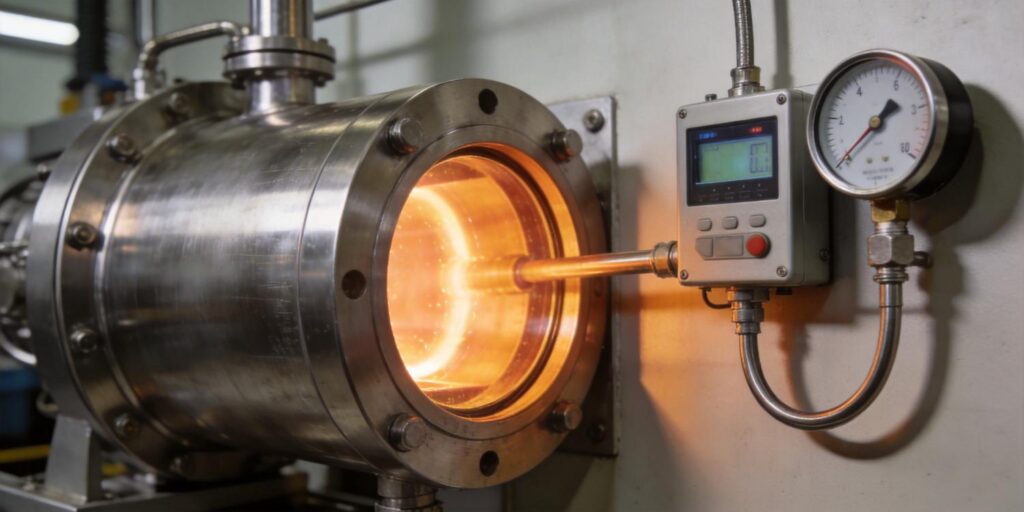
In plasma-enhanced processes such as reactive sputtering, PECVD, and plasma etching, the vacuum chamber contains a dense cloud of ions, electrons, and excited neutrals. This external plasma directly influences ionization-type vacuum gauges because their measurement principle already relies on electron–molecule collisions to generate a measurable ion current.
The VG-SM225 Cold Cathode Vacuum Gauge operates via a self-sustained Penning discharge in a crossed electric-magnetic field. When external plasma electrons or ions enter the gauge volume, they add to the avalanche current. The result is an inflated ion signal that the gauge interprets as higher pressure—often by a factor of 5–10× at typical sputtering densities (10¹⁰–10¹² ions/cm³). Readings may jump from a true 10⁻⁵ Torr to an indicated 10⁻⁴ Torr or worse, triggering false interlocks or ruining process control.
In contrast, the VG-SP205 Pirani Vacuum Transmitter measures heat loss from a platinum filament and is insensitive to charged-particle density. Its thermal conduction signal remains stable even inside active plasma, making it the preferred primary monitor for the mid-vacuum transition zone (10 Torr to 10⁻³ Torr) where most sputtering processes begin. For high-vacuum verification, the VG-SM225 remains essential but must be protected from direct plasma exposure.
This fundamental difference explains why engineers pair the two Poseidon transmitters: the Pirani provides drift-free mid-range data while the shielded cold cathode delivers accurate high-vacuum confirmation without plasma-induced artifacts.
Electromagnetic Interference Risk
RF or DC plasma power supplies generate strong electromagnetic fields—often tens of volts per meter at 13.56 MHz or pulsed high-voltage transients. These fields couple into gauge cabling and electronics, inducing noise on the analog 0–10 V output or corrupting the RS232 digital stream. In severe cases, EMI shifts the apparent pressure by 20–50 % or triggers false over-range alarms.
The VG-SM225’s compact electronics include basic filtering, but unshielded long cable runs (>30 m) common in large coating systems amplify pickup. Plasma ignition spikes can also momentarily saturate the high-voltage supply inside the cold-cathode gauge, extending startup delay or causing temporary discharge extinction. The Pirani, with its lower-voltage circuitry, experiences far less EMI sensitivity yet still benefits from proper grounding to maintain <±5 % stability across the full 15 °C–50 °C range.
Without mitigation, these interference effects lead to process instability, increased scrap rates, and unnecessary downtime—exactly the issues Poseidon transmitters were engineered to avoid through robust design and simple shielding practices.
Shielding Techniques
Effective shielding combines physical geometry, electrical grounding, and optical blocking. The most practical solution for the VG-SM225 is a short KF16 or KF25 tubulation with an inline grounded stainless-steel baffle or perforated Faraday cage sleeve. This blocks line-of-sight plasma particles and RF fields while preserving gas conductance (critical for accurate pressure representation).
Additional techniques include:
- Grounding the gauge body and cable shield at both ends to the chamber potential, eliminating ground loops.
- Wrapping the analog cable in foil tape or using twisted-pair shielded wire for the RS232 link.
- Software filtering in the PLC: average 10–20 consecutive readings and ignore transients flagged by the gauge’s built-in status bits.
Poseidon’s positive-magnetron geometry already incorporates auxiliary cathodes that shunt field-emission and photocurrents to ground, providing inherent protection superior to many legacy inverted-magnetron designs. The modular sensor head allows quick addition of custom shields without breaking vacuum. For the Pirani, no special shielding is normally required beyond standard EMI practices, keeping installation simple and cost-effective.
Recommended Installation Distance
Distance is the simplest and most reliable shield. Mount the gauge on a dedicated side port of the process chamber, at least 20–30 cm away from the plasma volume or target surface. This separation reduces plasma density at the gauge entrance by 1–2 orders of magnitude while the short tubulation ensures the measured pressure matches the substrate location within <5 %.
In electron-beam or magnetron sputtering systems, maintain an additional 15 cm clearance from the beam column or magnet array to avoid interaction with the gauge’s own NdFeB magnets (~100 gauss). Horizontal or slight upward orientation further prevents sputtered material from accumulating on electrodes. Both Poseidon transmitters fit any orientation with no performance loss, but side-port mounting with short conductance path consistently delivers the most representative readings.
These recommendations appear in the respective user manuals and have been validated in production PVD lines worldwide. The compact footprint (KF16/KF25 flanges) makes compliance easy even in space-constrained cluster tools.
Case Example in Sputtering System
A thin-film optics manufacturer experienced erratic pressure readings during reactive sputtering of TiO₂ coatings. The legacy cold-cathode gauge, mounted directly opposite the magnetron target, indicated 2×10⁻⁴ Torr while the process was actually running at 8×10⁻⁶ Torr. Plasma density near the gauge inflated the ion current, causing the PLC to throttle the mass-flow controllers incorrectly and producing absorbing films instead of high-index layers.
Replacement with a Poseidon VG-SM225 installed on a 25 cm side tubulation with a simple grounded baffle eliminated the offset immediately. The companion VG-SP205 Pirani monitored the roughing and transition phases without interference. Digital RS232 output allowed the PLC to cross-check both gauges and log true pressure for traceability. Coating uniformity improved from ±12 % to ±2 %, scrap dropped 35 %, and the system now runs stable 24/7 with only annual electrode polishing on the cold cathode. The total installed cost of the Poseidon pair was less than half the previous gauge plus shielding retrofit.
This real-world case demonstrates how proper understanding of plasma–gauge interaction, combined with Poseidon’s compact, cleanable design, translates directly into higher yield and lower maintenance in production sputtering environments.
Conclusion and Next Steps
Plasma processes introduce two primary influences on vacuum gauge readings—extra ionization that inflates cold-cathode signals and electromagnetic interference that corrupts electronics. The VG-SP205 Pirani Vacuum Transmitter remains unaffected by charged-particle density and serves as the stable mid-range monitor, while the VG-SM225 Cold Cathode provides accurate high-vacuum data once shielded by distance, baffles, and proper grounding. Their combined 0–10 V analog and customizable RS232 outputs, temperature compensation, and contamination-tolerant construction make them ideal for PVD, PECVD, and etching systems worldwide.
Engineers and procurement teams gain reliable, interference-free vacuum monitoring without the filament burnout, X-ray limits, or frequent recalibration of legacy gauges. Compact size, field serviceability (cold cathode), and low engineered cost further reduce total ownership expense in high-volume coating lines.
Ready to eliminate plasma-induced gauge errors in your sputtering or plasma process? Explore the VG-SP205 Pirani Vacuum Transmitter for robust mid-vacuum control or the VG-SM225 Cold Cathode Vacuum Gauge for shielded high-vacuum performance today. Both support 5–10 unit protocol customization and ship with detailed plasma-shielding guidance.
Contact our applications engineering team for a free installation-layout review, shielding-kit recommendations, or side-by-side comparison with your current gauges. We’re here to help you achieve stable, accurate vacuum readings—every plasma run, every time.


