Sources of LC-MS Matrix Effects
Liquid chromatography-mass spectrometry (LC-MS) has revolutionized analytical chemistry with its exceptional sensitivity and specificity, but it remains vulnerable to matrix effects that can compromise analytical accuracy. Matrix effects in LC-MS refer to the suppression or enhancement of analyte ionization caused by co-eluting components from the sample matrix. These effects are particularly problematic in atmospheric pressure ionization (API) techniques like electrospray ionization (ESI), where ionization occurs in the liquid phase before droplet formation.
The primary sources of matrix effects in LC-MS analysis include:
Endogenous Biological Components
Biological samples like plasma, serum, urine, and tissue extracts contain numerous endogenous compounds that can interfere with ionization. As noted in SPE literature, “Biological samples are notoriously dirty; injecting them with minimum cleanup onto very sensitive and expensive instruments makes very little sense.” These samples contain proteins, lipids, carbohydrates, salts, and metabolites that can compete for ionization or alter droplet formation dynamics.
Sample Preparation Reagents
Buffers, salts, ion-pairing agents, and organic modifiers used during sample preparation can persist through the analytical process and affect ionization efficiency. High ionic strength buffers are particularly problematic as they can impede mass transfer and affect ionization.
Chromatographic Mobile Phase Components
Mobile phase additives, even at low concentrations, can significantly impact ionization. Common additives like formic acid, acetic acid, ammonium acetate, and trifluoroacetic acid can either suppress or enhance ionization depending on the analyte properties.
Environmental Contaminants
In environmental analysis, humic acids, fulvic acids, and other natural organic matter can cause significant matrix effects. These complex organic mixtures contain numerous functional groups that can compete for ionization or form adducts with analytes.
Matrix Components Causing Ion Suppression
Ion suppression, the reduction of analyte signal due to matrix components, represents the most common matrix effect in LC-MS analysis. The mechanisms of ion suppression are complex and involve multiple physical and chemical processes:
Competition for Charge
Co-eluting matrix components compete with analytes for available charges during the ionization process. In electrospray ionization, this occurs through competition for protons or other charge carriers in the charged droplets. Highly basic or acidic matrix components are particularly effective at sequestering charges that would otherwise be available to analytes.
Altered Droplet Formation and Evaporation
Matrix components can change the surface tension, viscosity, and conductivity of the electrospray droplets, affecting droplet formation, fission, and solvent evaporation rates. This can alter the efficiency with which analytes are transferred from droplets to gas-phase ions.
Gas-Phase Reactions
Even after ionization, matrix components can participate in gas-phase proton transfer reactions that deprotonate analyte ions. This is particularly problematic when matrix components have higher gas-phase basicity or acidity than the analytes of interest.
Common Suppressing Agents
Research has identified several classes of compounds as particularly potent ion suppressors:
- Phospholipids: These are major contributors to matrix effects in biological samples, especially in positive ion mode
- Proteins and peptides: Even at low concentrations, these can significantly suppress ionization
- Salts and buffers: High concentrations of non-volatile salts are particularly problematic
- Detergents and surfactants: These can dramatically alter droplet formation and evaporation
- Organic acids and bases: Compounds with extreme pKa values can dominate charge competition
As noted in SPE literature, “An undesirable feature of atmospheric pressure ionization-MS analysts is suppression of ionization by co-extracted endogenous interferences from biofluids. To avoid false negatives, selective SPE extraction applications are required.”
SPE Cleanup Strategy
Solid-phase extraction (SPE) represents one of the most effective strategies for reducing matrix effects in LC-MS analysis. SPE cleanup works by selectively removing interfering matrix components while retaining analytes of interest, or conversely, by retaining analytes while washing away interferences. The fundamental SPE strategy comprises “the isolation (and concentration) of the analytes from a complex matrix by adsorption onto an appropriate sorbent, the removal of interfering impurities by washing with a suitable solvent system and then the selective recovery of the retained analytes.”
Selecting the Appropriate SPE Phase
The choice of SPE sorbent is critical for effective matrix effect reduction. Different sorbents offer varying selectivity for different classes of matrix components:
Reversed-Phase Sorbents (C18, C8, HLB)
These are excellent for removing non-polar interferences like lipids and hydrophobic proteins. Hydrophilic-lipophilic balance (HLB) polymers are particularly effective as they “provide high capacity for extremely polar compounds” and are “compatible with solvents pH 0-14.”
Mixed-Mode Sorbents (MCX, MAX, WCX, WAX)
Mixed-mode sorbents combine reversed-phase and ion-exchange mechanisms, offering superior selectivity. As noted in Waters Oasis documentation, mixed-mode sorbents provide “the cleanest extracts” and “best reduction of matrix effects” through “dual retention mechanism” that “provides orthogonality and selectivity.”
Ion-Exchange Sorbents
These are particularly effective for removing ionic interferences that are major contributors to matrix effects. Strong cation exchange (SCX) and strong anion exchange (SAX) sorbents can selectively remove salts and ionic matrix components.
SPE Protocol Optimization
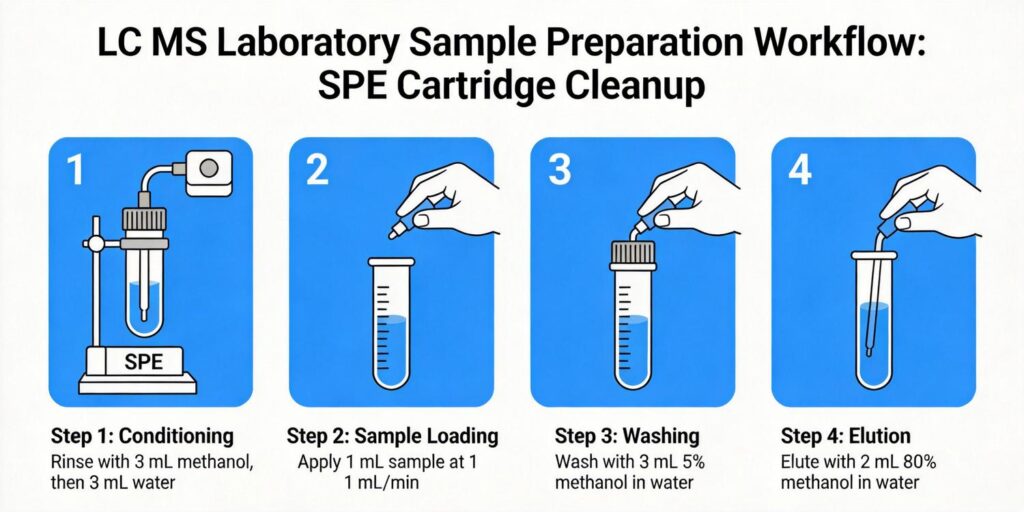
Effective SPE cleanup requires careful optimization of each step:
- Conditioning: Prepares the sorbent for optimal interaction with analytes
- Sample Loading: Should be performed at controlled flow rates to ensure proper retention
- Washing: Critical step for removing matrix components while retaining analytes
- Elution: Should use minimal solvent volume to maximize concentration
The literature emphasizes that “SPE recoveries should exceed 90% absolute recovery. If you don’t get that kind of recovery you are not adjusting other parameters (such as solubility, pH, and solvent strength) correctly.”
Optimization of Wash Solvents
The wash step in SPE is where most matrix components are removed, making it critical for matrix effect reduction. Proper wash solvent optimization requires understanding both the retention mechanism of the analytes and the properties of matrix interferences.
Wash Solvent Selection Principles
For Reversed-Phase SPE
Wash solvents should be sufficiently polar to elute matrix components but not strong enough to elute analytes. Common choices include:
- Water or aqueous buffers (5-20% organic modifier)
- Low-percentage methanol or acetonitrile in water
- Buffered solutions at appropriate pH
The Waters Oasis system recommends washing with “5% CH3OH in H2O” for their HLB and PRiME HLB sorbents, which “reduces matrix effects with more than 95% of common matrix interferences removed.”
For Mixed-Mode SPE
Wash optimization is more complex due to multiple retention mechanisms:
- For MCX (mixed-mode cation exchange): Wash with “2% HCOOH” to remove neutral and acidic interferences while retaining basic analytes
- For MAX (mixed-mode anion exchange): Wash with “5% NH4OH” to remove neutral and basic interferences while retaining acidic analytes
pH Optimization
pH control during washing is essential for effective matrix removal:
- For basic analytes: Use acidic wash conditions to keep analytes ionized and retained on mixed-mode sorbents
- For acidic analytes: Use basic wash conditions for the same purpose
- For neutral analytes: pH is less critical but can affect removal of ionic interferences
Organic Modifier Concentration
The percentage of organic modifier in wash solvents must be carefully optimized:
- Too high: May cause analyte loss
- Too low: Ineffective removal of matrix components
- Optimal range: Typically 5-20% for reversed-phase, but requires empirical determination
Multiple Wash Steps
Sometimes, sequential washes with solvents of increasing strength or different selectivity are necessary:
- Initial wash with aqueous or low-organic solvent to remove polar interferences
- Secondary wash with slightly stronger solvent to remove moderately retained interferences
- Optional tertiary wash for particularly dirty samples
As noted in SPE troubleshooting literature, “Proper pH and ionic strength are important parameters to facilitate mass transfer between the matrix and the sorbent.”
Evaluation Using Post-Column Infusion Tests
Post-column infusion testing is the gold standard for evaluating the effectiveness of SPE cleanup in reducing matrix effects. This technique provides a continuous, real-time assessment of ionization suppression or enhancement throughout the chromatographic run.
Post-Column Infusion Methodology
The basic post-column infusion setup involves:
- Continuous infusion of a standard analyte solution post-column
- Injection of extracted matrix samples (with and without SPE cleanup)
- Monitoring the ion signal of the infused analyte
- Comparing signal profiles between different sample preparations
Interpreting Post-Column Infusion Results
Effective SPE Cleanup
A well-optimized SPE method should show:
- Minimal signal suppression compared to neat solvent injections
- Flat baseline throughout the chromatographic run
- Consistent signal across different matrix lots
Inadequate Cleanup
Poor SPE performance is indicated by:
- Significant signal suppression (>20-30%)
- Variable suppression across the chromatogram
- Peak-shaped suppression regions indicating co-elution of matrix components
Quantitative Assessment
Matrix effects can be quantified using the formula:
Matrix Effect (%) = (Signal in matrix / Signal in neat solvent) × 100
Acceptable matrix effects typically fall within 85-115%, though stricter criteria may be required for regulated bioanalysis.
Comparative Evaluation
Post-column infusion allows direct comparison of:
- Different SPE sorbents and protocols
- Wash solvent compositions
- Elution conditions
- Sample preparation methods (SPE vs. protein precipitation vs. dilute-and-shoot)
Practical Considerations
Analyte Selection for Infusion
The infused analyte should:
- Be representative of the analytes of interest
- Have good ionization efficiency
- Not interfere with endogenous compounds
- Be stable under infusion conditions
Matrix Sample Preparation
For meaningful comparisons:
- Use matrix from multiple sources/lots
- Include both pre- and post-SPE samples
- Consider different concentration levels
- Evaluate across the expected calibration range
Integration with Method Validation
Post-column infusion testing should be integrated into method validation:
- Assess matrix effects across different matrix lots
- Evaluate at low and high concentrations
- Test in presence of likely concomitant medications
- Verify cleanup effectiveness after method changes
As emphasized in SPE literature, the goal is to achieve “cleaner extracts” that give “clearly identifiable signals from the extracted components in the sample” without matrix interference.
Advanced Applications
Modern applications of post-column infusion include:
- High-throughput screening of SPE conditions
- Automated assessment of cleanup effectiveness
- Real-time monitoring during method development
- Quality control for routine analysis
Conclusion
Effective reduction of LC-MS matrix effects through SPE cleanup requires a systematic approach that addresses the sources of interference, selects appropriate cleanup strategies, optimizes wash conditions, and rigorously evaluates results. The integration of selective SPE phases with optimized protocols and comprehensive evaluation using post-column infusion testing represents the most reliable approach to achieving accurate, reproducible LC-MS results.
As demonstrated throughout SPE literature and practice, proper sample preparation is not merely a preliminary step but a critical component of analytical success. By investing time in developing and optimizing SPE cleanup methods, laboratories can significantly improve data quality, extend instrument lifetime, and reduce analytical variability—ultimately leading to more reliable scientific conclusions and better-informed decisions.
For laboratories seeking to implement or improve SPE-based matrix effect reduction, Poseidon Scientific offers a comprehensive range of HLB SPE cartridges, MAX SPE cartridges, MCX SPE cartridges, WAX SPE cartridges, WCX SPE cartridges, and 96-well SPE plates designed to address the specific challenges of LC-MS matrix effects.