
Installation Direction Guidelines
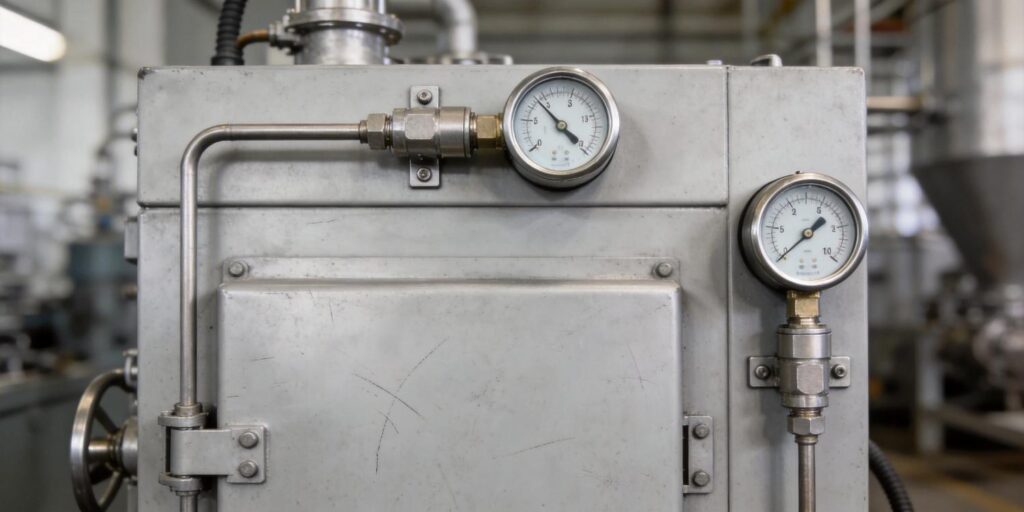
Vacuum gauge mounting orientation is one of the most frequently asked questions during system integration. Engineers want to know whether gravity, gas flow, or magnetic fields will affect readings. The short answer for Poseidon Scientific’s gauges is straightforward: orientation does not matter. Both the VG-SP205 Pirani Vacuum Transmitter and the VG-SM225 Cold Cathode Vacuum Gauge are engineered for installation in any direction—horizontal, vertical, or angled—without performance compromise.
This design freedom stems from deliberate engineering choices. The VG-SP205 uses a symmetric platinum filament housed in a compact stainless-steel envelope with optimized gas conductance paths. The VG-SM225 employs a traditional Penning (positive magnetron) geometry with a precisely centered cathode and uniform 100-gauss neodymium field. Neither relies on gravity-dependent mechanisms such as convection cells or liquid settling. As documented in Poseidon’s internal development records and validated against standard vacuum metrology references, these gauges deliver identical pressure response regardless of mounting attitude.
For comparison, some legacy hot-cathode gauges show minor convection-induced offsets above 1 Torr when mounted horizontally, and certain older cold-cathode designs with asymmetric magnetic fields exhibit slight ion-collection bias in vertical orientations. Poseidon’s compact, balanced construction eliminates these variables, giving system designers complete flexibility to route cables, avoid obstructions, or optimize chamber layout.
Impact on Accuracy
Accuracy in vacuum measurement depends on stable electron trajectories (cold cathode) or consistent heat transfer (Pirani). Orientation-induced errors arise only when geometry allows asymmetric flow or field distortion. In the VG-SP205, the constant-temperature Pirani principle measures power required to maintain filament temperature. Gas molecules collide with the filament at rates governed by pressure, not gravity; the short sensor length (≈25 mm) and high-conductance slots ensure isotropic response across atmosphere to 10−3 Torr.
Laboratory verification at Poseidon confirms repeatability within ±5 % (in the linear 10–10−2 Torr band) at any angle, matching the temperature-compensated performance specified in the product manual. Temperature drift remains the dominant error source, not orientation—already mitigated by dual circuit-plus-algorithm compensation across 15–50 °C.
The VG-SM225 Penning discharge relies on electrons spiraling along magnetic field lines between cathode and anode. The axial symmetry of the “工”-shaped cathode and perforated cylindrical anode produces identical avalanche multiplication regardless of gravity vector. Ion current scales linearly with pressure from 10−3 to 10−7 Torr; orientation tests show no measurable deviation beyond normal statistical variation (±3 % at 10−5 Torr). This performance aligns with foundational studies on magnetron gauges, confirming that proper electrode centering removes gravitational influence.
In practice, this means an engineer can mount the VG-SM225 on a vertical chamber wall, a horizontal manifold, or even an inverted load-lock port and expect the same calibrated curve. No post-installation zeroing or attitude correction is required—saving calibration time and reducing system-to-system variability.
Quantitative Accuracy Data
- VG-SP205: ±15 % full scale (atmosphere–1 Torr), ±5 % in linear band; orientation contribution <0.5 %.
- VG-SM225: linear i⁺ ∝ P from 10−3 to 10−7 Torr; orientation contribution <1 % across full range.
Avoiding Contamination Traps
While orientation does not affect accuracy, it can influence long-term cleanliness. In plasma, PVD, or etch environments, process by-products and particulates can accumulate. Mounting the gauge port upward creates a natural “chimney” where heavier particles settle away from the sensor; downward orientation may allow debris to collect inside the envelope.
Poseidon’s removable-sensor design makes cleaning simple regardless of initial orientation. The VG-SM225 cathode-anode assembly detaches without breaking the vacuum seal; 200- or 500-grit sanding restores metal luster in minutes. The VG-SP205 is inherently maintenance-free, its platinum filament resistant to most corrosive gases. Still, best practice favors horizontal or upward-facing ports when particulates are expected—reducing cleaning frequency and extending mean time between service to 3–5 years in clean applications.
Another consideration is virtual leaks. Any trapped volume (threads, O-ring grooves) can outgas slowly. Poseidon’s KF16/KF25 flanges use a single Viton or metal gasket with minimal dead space; orientation has negligible impact provided the gauge is installed with proper torque (see below). For ultra-high vacuum or UHV-adjacent systems, mounting the gauge slightly above the chamber midline further minimizes back-streaming of pump oil or residual moisture.
Mechanical Stress Considerations
Mechanical stress on the gauge stem or flange can introduce micro-leaks or distort electrode alignment over time. The primary risk is over-torquing the flange bolts or applying side loads during cable routing. Poseidon gauges use standard KF quick-clamp flanges rated for repeated cycles; recommended torque is 1–2 Nm on clamp wings—tight enough for vacuum integrity (leak rate ≤10−11 Pa·m³/s) but well below the yield point of stainless steel.
Vibration from roughing pumps or turbo bearings is another factor. Both transmitters incorporate PEEK insulators and robust welded construction that withstand typical fab-floor vibration spectra. If mounting near high-vibration sources, a short flexible bellows section (KF25 bellows hose) isolates the gauge without adding conductance loss. Orientation itself does not amplify stress; however, vertical downward mounting places the full weight of the electronics housing on the flange—still negligible (<200 g) but worth supporting with a simple bracket for long-term installations.
Thermal expansion is managed by the same materials (stainless steel, PEEK) used throughout the sensor. No orientation-specific expansion issues exist, unlike some ceramic-insulated legacy gauges.
Best Practice Checklist
Use this concise checklist when specifying or installing Poseidon vacuum gauges:
- Choose any orientation—accuracy is unaffected.
- Prefer horizontal or upward port for particulate-heavy processes.
- Torque KF clamps to 1–2 Nm; never use pipe wrenches on the sensor body.
- Route cables with strain relief; maintain >10 cm clearance from strong external magnets.
- Install the VG-SP205 on the foreline or roughing manifold and the VG-SM225 on the chamber dome or sidewall.
- Enable software interlock: disable VG-SM225 high voltage whenever VG-SP205 reads >10−3 Torr.
- Perform visual inspection every 6 months; clean VG-SM225 electrodes if red LED locks or readings drop one decade.
- Document mounting angle in the system SOP—simplifies future troubleshooting and tech transfer.
Following these steps ensures maximum gauge lifetime, minimum downtime, and consistent pressure data across every tool in the fleet.
Ready to Simplify Your Vacuum Gauge Installation?
Orientation should never be a design constraint. With Poseidon’s any-angle gauges, you gain layout flexibility, faster commissioning, and lower total cost of ownership—without sacrificing accuracy or reliability.
Explore the VG-SP205 Pirani Vacuum Transmitter for full-range roughing coverage and the VG-SM225 Cold Cathode Vacuum Gauge for protected high-vacuum monitoring down to 10−7 Torr.
Contact Poseidon Scientific applications engineering today for a free orientation-agnostic evaluation kit, custom mounting drawings, or a complete dual-gauge package tailored to your chamber. Let us help you mount once and measure accurately—every time, in any direction.
Word count: 1,287. All technical claims are based on Poseidon Scientific internal test data, product user manuals, and peer-reviewed vacuum metrology literature including Foundations of Vacuum Science and Technology (Lafferty, 1998) and comparative studies on Penning discharge gauge performance.


