Soil Sampling and Drying Procedures
Effective extraction of herbicide residues from agricultural soil begins with proper sample collection and preparation. Representative soil samples should be collected from multiple locations within the field using a soil corer or auger to obtain a composite sample. The sampling depth should correspond to the herbicide application zone, typically 0-15 cm for surface-applied herbicides or deeper for incorporated materials.
Fresh soil samples should be immediately transported to the laboratory in clean, sealed containers to prevent contamination and degradation. Upon arrival, samples should be homogenized and sieved through a 2-mm mesh to remove stones, roots, and large debris. The sieved soil should then be air-dried at room temperature (20-25°C) for 24-48 hours or in a forced-air oven at 40°C for 12-24 hours. Complete drying is essential as residual moisture can interfere with subsequent extraction steps and affect herbicide recovery rates. Dried samples should be stored in airtight containers at 4°C until analysis.
Ultrasonic Extraction Using Acetonitrile/Water Mixtures
Ultrasonic extraction has proven to be an efficient method for extracting multi-class herbicides from soil matrices. A typical extraction solvent consists of acetonitrile/water mixtures, with ratios ranging from 80:20 to 90:10 (v/v) depending on the target herbicide polarity. Acetonitrile effectively extracts both polar and non-polar compounds while minimizing co-extraction of humic substances.
For optimal extraction, weigh 10-20 g of dried soil into a 50-mL centrifuge tube and add 20-40 mL of acetonitrile/water mixture (typically 85:15). The mixture should be vortexed briefly to ensure complete soil wetting. Ultrasonic extraction should be performed for 15-30 minutes at 40-50°C with periodic agitation. Research has demonstrated that ultrasonic extraction provides superior recovery compared to traditional shaking methods, particularly for herbicides with strong soil binding characteristics.
Centrifugation and Filtration Steps
Following ultrasonic extraction, the soil-solvent mixture requires separation to obtain a clear extract for SPE processing. Centrifuge the samples at 3000-4000 rpm for 10-15 minutes to sediment soil particles. Carefully decant or pipette the supernatant into a clean container, taking care to avoid transferring any particulate matter.
For additional clarification, the supernatant should be filtered through a 0.45-μm PTFE or nylon membrane filter. This step removes fine colloidal particles that could otherwise clog SPE cartridges during the loading phase. The filtered extract should be visually clear and free of turbidity. If significant color remains (indicating humic substances), note that subsequent SPE steps will address this interference.
Selection of HLB SPE Cartridge for Multi-Class Herbicides
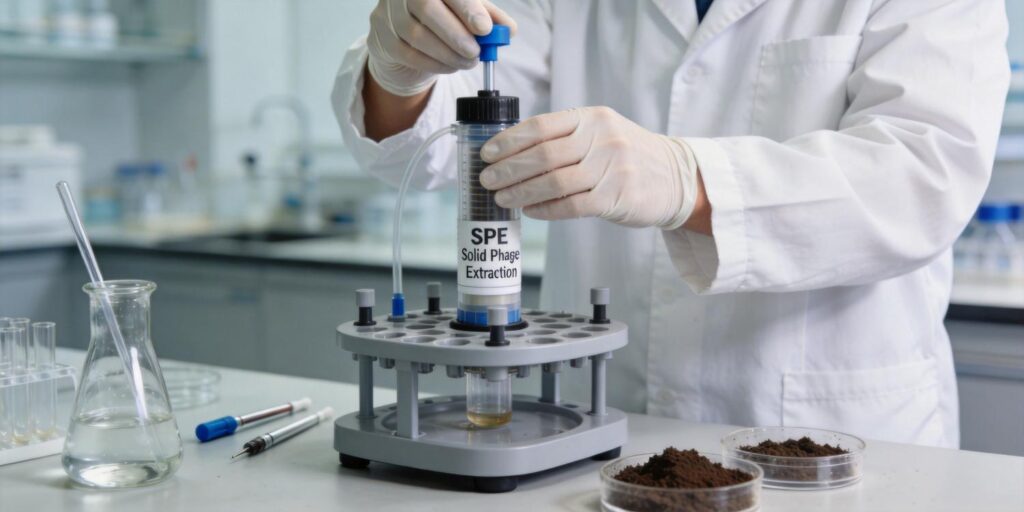
The Hydrophilic-Lipophilic Balance (HLB) SPE cartridge represents the optimal choice for multi-class herbicide extraction from soil matrices. HLB sorbents contain a balanced ratio of hydrophilic N-vinylpyrrolidone and lipophilic divinylbenzene monomers, providing dual retention mechanisms for compounds spanning a wide polarity range.
For soil extracts containing herbicides with diverse chemical properties—including triazines, phenylureas, sulfonylureas, and phenoxy acids—HLB cartridges offer superior performance compared to traditional C18 or mixed-mode sorbents. The 60 mg/3 mL or 150 mg/6 mL cartridge formats provide adequate capacity for typical soil extracts containing 10-20 g equivalent soil mass. Studies have shown that HLB cartridges maintain consistent recovery (>85%) for herbicides with log P values ranging from -1 to 5.
Cartridge Conditioning Protocol
Proper conditioning of HLB cartridges is critical for achieving optimal herbicide recovery and reproducibility. Begin by passing 3-5 mL of methanol through the cartridge at a flow rate of approximately 1-2 mL/min. This step activates the sorbent by swelling the polymer and removing any residual contaminants from manufacturing.
Immediately follow with 3-5 mL of deionized water or a weak aqueous buffer (pH 6-7) to equilibrate the sorbent to the sample matrix conditions. It is essential not to allow the sorbent bed to dry between conditioning and sample loading, as this can create channels that reduce extraction efficiency. The cartridge should retain approximately 0.5-1 mL of water above the sorbent bed before sample application.
Loading Soil Extract Diluted with Water
Soil extracts in acetonitrile require dilution with water to reduce the organic solvent content before loading onto HLB cartridges. Typically, dilute the acetonitrile extract with deionized water at a ratio of 1:1 to 1:3 (extract:water), resulting in a final organic content of 20-30%. This dilution improves herbicide retention on the HLB sorbent by reducing the solvent strength.
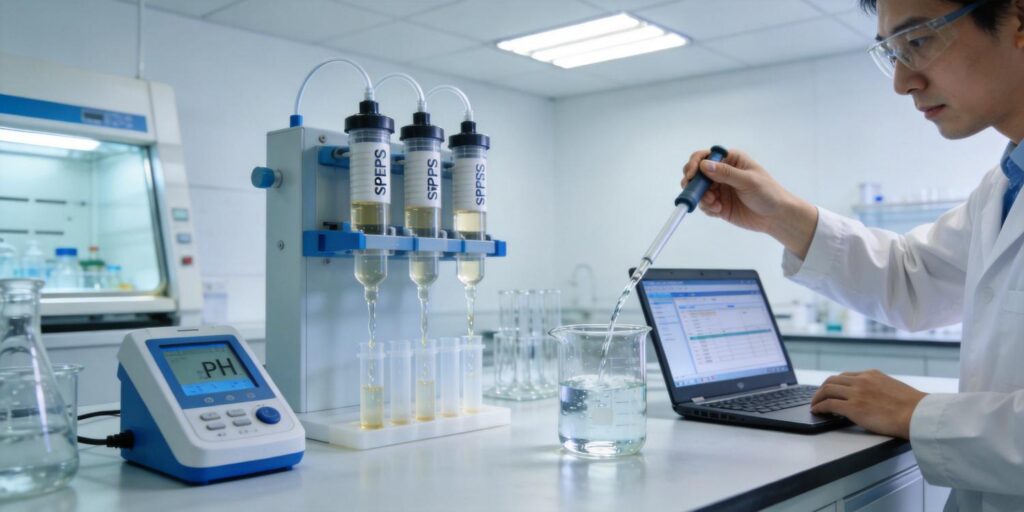
Load the diluted extract onto the conditioned cartridge at a controlled flow rate of 1-3 mL/min. For optimal recovery, maintain a flow rate not exceeding 5 mL/min. If using a vacuum manifold, apply gentle vacuum to achieve consistent flow. The loading volume should not exceed the cartridge’s breakthrough capacity, typically 100-200 mL for a 150 mg HLB cartridge when extracting herbicides at trace levels.
Washing with Water to Remove Humic Substances
Agricultural soil extracts often contain significant amounts of humic and fulvic acids that can interfere with subsequent analysis. A water wash step effectively removes these polar interferences while retaining target herbicides on the HLB sorbent.
After sample loading, wash the cartridge with 3-5 mL of deionized water (pH adjusted to match the sample if necessary). The wash volume should be sufficient to remove humic substances without eluting target compounds. For particularly challenging matrices containing high organic matter, a second wash with 2-3 mL of 5% methanol in water may be employed. Following the wash step, apply vacuum or positive pressure for 1-2 minutes to remove residual water from the sorbent bed.
Elution Using Acetonitrile
Herbicide elution from HLB cartridges is typically achieved using acetonitrile, which provides excellent solubility for most herbicide classes while minimizing co-elution of remaining matrix interferences. For complete recovery, use 3-6 mL of acetonitrile, collecting the eluate in a clean glass or polypropylene tube.
To maximize recovery, allow the acetonitrile to soak the sorbent bed for 30-60 seconds before initiating elution. Elute at a slow flow rate of 0.5-1 mL/min. For difficult-to-elute compounds or when dealing with high-capacity cartridges, consider using two smaller aliquots of acetonitrile (2 × 3 mL) rather than a single large volume. The elution solvent may be modified with 0.1% formic acid or ammonium hydroxide for ionizable herbicides to ensure complete recovery.
Concentration and Analysis Using LC-MS/MS
The acetonitrile eluate typically requires concentration before LC-MS/MS analysis to achieve the necessary sensitivity for trace-level herbicide detection. Evaporate the eluate to near dryness under a gentle stream of nitrogen at 30-40°C. Avoid complete dryness, as some herbicides may degrade or become irreversibly adsorbed to the container walls.
Reconstitute the residue in 0.5-1 mL of initial mobile phase composition (typically water with 0.1% formic acid and 5-10% acetonitrile). Vortex thoroughly to ensure complete dissolution. Filter through a 0.22-μm syringe filter if necessary to remove any particulate matter.
For LC-MS/MS analysis, employ a reversed-phase C18 column (100 × 2.1 mm, 1.7-3 μm) with gradient elution using water and acetonitrile, both containing 0.1% formic acid. Multiple Reaction Monitoring (MRM) transitions should be optimized for each target herbicide, typically using electrospray ionization in positive or negative mode depending on compound characteristics. Method validation should include recovery studies (spiked at relevant concentration levels), matrix effects evaluation, and determination of method detection limits to ensure reliable quantification of herbicide residues in agricultural soil samples.
Method Performance Considerations
When implementing this SPE workflow, several factors influence overall method performance. Soil type significantly affects extraction efficiency—clay soils may require modified extraction conditions compared to sandy soils. The presence of organic matter can both enhance herbicide binding and contribute to matrix effects during LC-MS/MS analysis. Method validation should include recovery studies across different soil types to establish robustness.
For multi-residue analysis covering 50+ herbicides, careful optimization of LC gradient and MS/MS parameters is essential to achieve adequate separation and sensitivity. Internal standards (preferably isotopically labeled analogs of target herbicides) should be incorporated to correct for matrix effects and recovery variations.
Alternative Approaches and Considerations
While the described HLB-based SPE workflow provides excellent performance for most herbicide classes, alternative approaches exist for specific applications. For highly acidic herbicides (e.g., 2,4-D, dicamba), mixed-mode anion exchange cartridges (WAX) may offer superior selectivity. For basic herbicides, mixed-mode cation exchange cartridges (WCX) can provide enhanced clean-up.
Recent developments in sample preparation include QuEChERS (Quick, Easy, Cheap, Effective, Rugged, and Safe) methods, which have gained popularity for multi-residue pesticide analysis. However, for soil matrices with complex interferences, SPE often provides cleaner extracts and better reproducibility, particularly when coupled with sensitive LC-MS/MS detection.
This comprehensive SPE workflow enables reliable extraction and quantification of herbicide residues in agricultural soils, supporting environmental monitoring, regulatory compliance, and research applications. Proper implementation of each step ensures accurate results that reflect actual field conditions and herbicide persistence.