
Thermal Conductivity Differences: Why Gas Type Matters
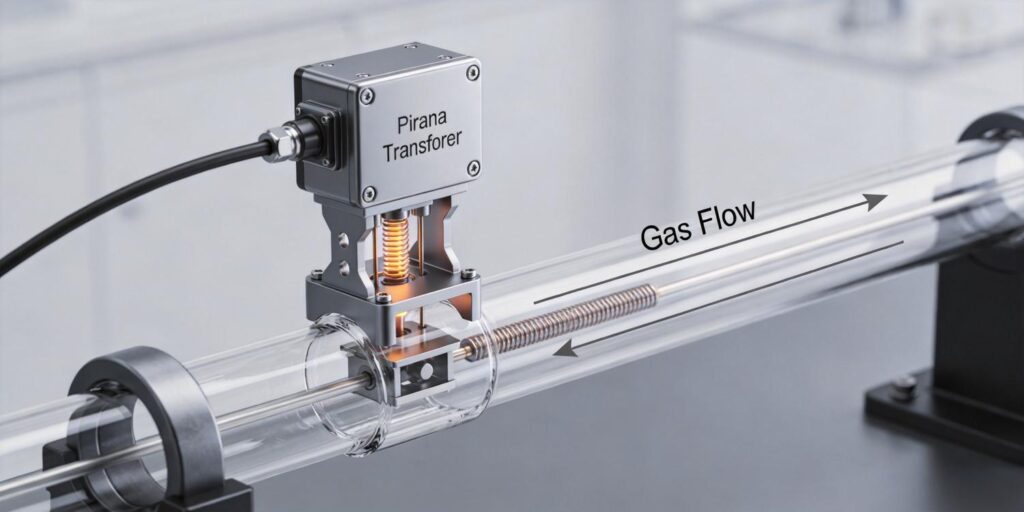
Pirani vacuum gauges measure pressure indirectly through the thermal conductivity of the residual gas. In the VG-SP205 Pirani Vacuum Transmitter from Poseidon Scientific, a platinum filament is held at constant temperature by a precision feedback circuit. Gas molecules collide with the hot filament and transfer heat to the cooler gauge envelope. Higher pressure means more molecules, more collisions, and greater heat loss—requiring more electrical power to maintain filament temperature. The controller converts this power (or voltage/current) into a pressure reading.
Different gases conduct heat at dramatically different rates because thermal conductivity depends on molecular mass, specific heat, and collision cross-section. Light gases such as helium transfer heat far more efficiently than heavier gases such as argon or nitrogen. At the same true pressure, a Pirani gauge calibrated for air will therefore report an incorrect value when the chamber contains another gas.
Typical thermal conductivity values at room temperature and moderate pressure illustrate the magnitude of the effect:
| Gas | Thermal Conductivity (mW/m·K) | Relative to Air |
|---|---|---|
| Helium (He) | 156 | ≈6.5× higher |
| Hydrogen (H₂) | 182 | ≈7.6× higher |
| Air / Nitrogen (N₂) | 26 | 1.0 (reference) |
| Argon (Ar) | 18 | ≈0.7× lower |
This fundamental difference means the power-versus-pressure curve shifts for every gas. In the linear operating zone (roughly 10 Torr to 10⁻² Torr), the effect is most pronounced and predictable. Outside this band—near atmosphere or below 10⁻³ Torr—the response becomes nonlinear, amplifying gas-induced errors up to ±50 %. Understanding these differences is essential for any engineer working with mixed-gas processes such as leak testing, sputtering, or battery electrode drying.
Gas Correction Factors: Converting Indicated Pressure to True Pressure
Manufacturers publish gas correction factors (also called relative sensitivity or gas factors) to convert the pressure displayed by a Pirani gauge calibrated for air or nitrogen into the true pressure for other gases. These factors are empirical, derived from calibration against a reference instrument (typically a capacitance diaphragm gauge) in pure gas.
Standard correction factors for common gases (VG-SP205 calibrated for air, relative sensitivity = 1.0):
| Gas | Correction Factor | Meaning |
|---|---|---|
| Air / N₂ | 1.00 | No correction needed |
| Helium (He) | 0.55–0.65 | Indicated pressure is too high; multiply by factor for true pressure |
| Hydrogen (H₂) | 0.50–0.60 | Strong over-reading |
| Argon (Ar) | 1.30–1.45 | Indicated pressure is too low; multiply indicated value by factor |
| Oxygen (O₂) | 0.95–1.05 | Minor correction |
These ranges reflect slight variations between gauge geometries and operating temperatures. In practice, engineers apply the factor in the PLC or DAQ software: true pressure = indicated pressure × correction factor. Without correction, helium leak testing can produce errors exceeding 50 %, while argon sputtering processes may appear to run at lower pressure than reality, affecting plasma density and film stoichiometry.
The Poseidon VG-SP205 is factory-calibrated exclusively in air, consistent with industry practice for cost-effective production. For applications dominated by a single non-air gas, custom firmware mapping is available at no extra charge for orders of 5–10 units. This loads a gas-specific lookup table directly into the transmitter, eliminating external correction and restoring full accuracy across the linear range.
Calibration: Factory Standards and Field Limitations
Pirani gauges cannot be user-calibrated in the field. The sealed sensor geometry, filament resistance, and compensation coefficients are fixed at manufacture. Poseidon Scientific performs multi-point calibration in a controlled vacuum system against a reference capacitance manometer, stepping pressure in air while recording filament power and applying temperature compensation across 15–50 °C. The resulting curve is stored in non-volatile memory.
Because thermal conductivity is gas-dependent, the calibration is valid only for air (or the specific gas requested for custom units). Attempting to use a standard air-calibrated gauge in pure helium without correction introduces systematic error that grows with pressure. In the linear zone the error is roughly proportional to the conductivity ratio; at the extremes it becomes unpredictable.
Field verification is limited to spot checks against a trusted reference gauge at one or two known pressures (typically 1 Torr and 100 Torr in air). Significant deviation indicates filament contamination, aging, or operation outside the compensated temperature band—none of which can be corrected on site. Annual verification against a certified reference is recommended for critical research or process work. When readings drift beyond ±10 % in the linear zone, replacement of the entire transmitter is the only reliable solution.
Application Considerations: Choosing the Right Approach for Your Process
Gas sensitivity in Pirani gauges becomes a non-issue when the process gas is air or nitrogen and pressure stays within the linear zone. In these common cases—vacuum ovens, foreline monitoring, or load-lock cycling—the VG-SP205 delivers fast response (0.5–2 s), excellent long-term stability, and essentially zero maintenance thanks to its corrosion-resistant platinum filament.
When the gas mixture varies or contains helium, hydrogen, or argon, engineers have three practical options:
- Apply correction factors in software—simple, zero hardware cost, but requires accurate knowledge of instantaneous gas composition.
- Request custom gas mapping at order time—free for modest quantities; the transmitter outputs true pressure directly, simplifying PLC logic and data logging.
- Use a hybrid setup with cold cathode for high vacuum—the VG-SM225 is far less sensitive to gas type (ionization cross-section variation is typically only a factor of 2–3) and covers the range below 10⁻³ Torr where Pirani resolution collapses.
In semiconductor PVD, battery electrolyte filling, or mass-spectrometer source chambers, the hybrid VG-SP205 + VG-SM225 configuration is standard. Both share the same RJ45 connector, 0–10 V analog output, and customizable RS232 protocol, enabling seamless range switching and unified data acquisition. The Pirani handles rough vacuum with zero magnetic field; the cold cathode provides contamination-tolerant high-vacuum monitoring with field-cleanable electrodes.
Engineers should always document the dominant gas or mixture during specification. Poseidon Scientific supports custom mapping and protocol customization from just 5–10 units, ensuring the gauge reports true pressure without external computation or driver development.
Optimize Gas-Sensitive Vacuum Measurement for Your Application
Understanding thermal conductivity differences and gas correction factors is essential for accurate Pirani gauge use in real-world research and industrial environments. Whether you apply software correction, request custom firmware mapping, or combine the VG-SP205 Pirani Vacuum Transmitter with the VG-SM225 Cold Cathode Vacuum Gauge for full-range coverage, the result is reliable, repeatable pressure data without the premium cost or rigidity of imported legacy instruments.
Poseidon Scientific designed both transmitters with industrial and laboratory engineers in mind: compact footprints, platinum-filament durability, field-cleanable high-vacuum capability, and free protocol customization from small order quantities. The combination delivers seamless integration with PLCs, DAQ systems, and SCADA platforms while minimizing total cost of ownership.
Contact the Poseidon Scientific applications engineering team today for a no-obligation consultation. Share your pressure range, dominant gases, chamber type, and integration platform, and receive a firm quotation, custom gas-correction example, and protocol sample within 24 hours.
Explore full specifications and request an evaluation unit:
Eliminate gas-induced errors. Achieve true pressure readings. Your optimized vacuum measurement solution starts here.


