Target Antidepressants for MCX SPE Extraction
Mixed-mode cation exchange (MCX) solid phase extraction is particularly well-suited for the isolation of basic antidepressant compounds from biological matrices. The target antidepressants in this method include:
- Fluoxetine (Prozac®) – A bicyclic antidepressant with pKa of approximately 9.8, widely used for depression treatment with therapeutic levels of 40-450 ng/mL in plasma
- Sertraline – A selective serotonin reuptake inhibitor (SSRI) with basic amine functionality
- Paroxetine – Another SSRI antidepressant with strong basic properties
These compounds share common structural features including aromatic rings and basic amine groups that make them ideal candidates for MCX extraction. According to forensic literature, fluoxetine and its metabolite norfluoxetine have been successfully extracted using mixed-mode SPE columns with recoveries exceeding 85%.
Plasma Sample Preparation Strategies
Protein Precipitation vs. Dilution Approaches
For plasma samples containing antidepressants, two primary sample preparation strategies are commonly employed:
Protein Precipitation: This method involves adding organic solvents or acids to precipitate plasma proteins. While effective for removing proteins, it may not adequately address phospholipid interference and can dilute the sample, potentially reducing sensitivity.
Dilution Method: The preferred approach for MCX SPE involves dilution with appropriate buffer systems. For antidepressant extraction, the recommended procedure includes:
- Take 1 mL of plasma sample
- Add internal standard (if applicable)
- Dilute with 4 mL of deionized water
- Add 2 mL of 0.1 M phosphate buffer, pH 6.0
- Mix/vortex thoroughly
- Adjust pH to 6.0 ± 0.5 if necessary
This dilution approach maintains the analytes in solution while reducing matrix viscosity and protein binding, facilitating more efficient SPE extraction.
Cartridge Conditioning Protocol
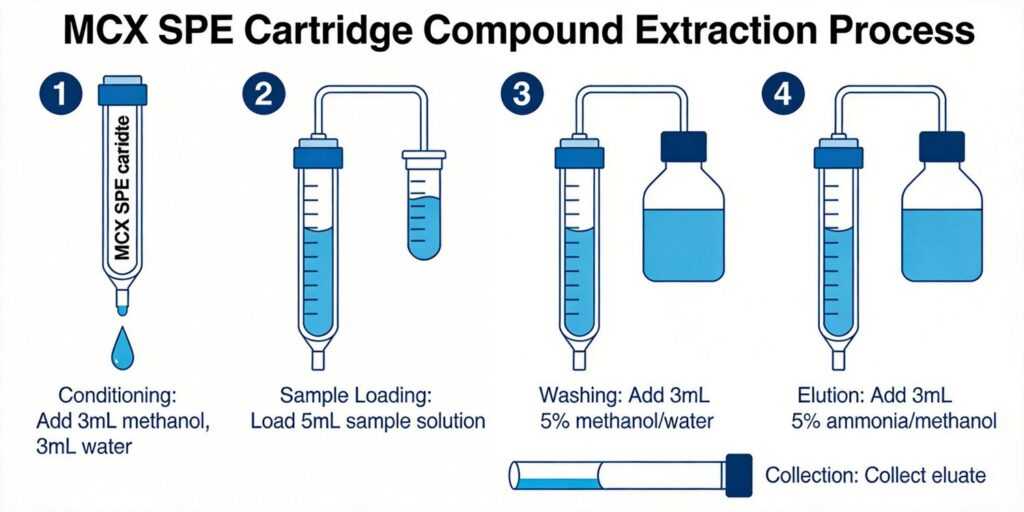
Proper conditioning of the MCX cartridge is critical for reproducible results. The conditioning sequence should follow this order:
- Methanol Wash: 3 mL of methanol to activate the sorbent and remove any contaminants
- Water Wash: 3 mL of deionized water to remove methanol and prepare the sorbent for aqueous sample loading
- Buffer Equilibration: 1 mL of 0.1 M phosphate buffer, pH 6.0 to establish the optimal pH environment
Important Note: Maintain aspiration at ≤3 in. Hg to prevent sorbent drying, which can create channels and reduce extraction efficiency.
Sample Loading at Optimal pH Conditions
The Science Behind pH <3 Loading
Loading samples at pH <3 serves a critical purpose in MCX extraction of antidepressants. At this acidic pH:
- Basic amine groups on the antidepressant molecules become protonated (positively charged)
- The sulfonic acid groups on the MCX sorbent remain ionized (negatively charged)
- This creates strong ionic interactions between the protonated antidepressants and the sulfonate groups on the sorbent
The protonation enhances retention through cation exchange mechanisms while the hydrophobic C8/C18 portions of the mixed-mode sorbent provide additional retention through reversed-phase interactions.
Washing Protocol for Matrix Cleanup
Sequential Washing for Optimal Purity
A carefully designed washing protocol removes interfering compounds while retaining target antidepressants:
- Water Wash: 3 mL of deionized water removes water-soluble impurities, salts, and polar interferences
- Methanol Wash: 3 mL of methanol effectively removes lipids, non-polar interferences, and neutral compounds
This sequential approach leverages the dual retention mechanism of MCX sorbents. The water wash removes polar impurities that might interact weakly with the cation exchange sites, while the methanol wash elutes hydrophobic compounds retained by the reversed-phase portion of the sorbent.
Optional Acid Wash for Enhanced Selectivity
Removing Weakly Basic Interferences
For samples with complex matrices or when analyzing multiple basic compounds, an optional acid wash can improve specificity:
- Acid Wash Solution: 1 mL of 1.0 M acetic acid
- Purpose: Removes weakly basic compounds that have lower pKa values than the target antidepressants
- Mechanism: The acidic environment maintains strong protonation of target antidepressants while potentially deprotonating weaker bases, allowing their elution
This step is particularly valuable in forensic applications or when analyzing antidepressants alongside other basic drugs with varying pKa values.
Elution Using 5% Ammonium Hydroxide in Methanol
The Elution Chemistry
The elution step represents the critical reversal of retention mechanisms:
- Elution Solvent: 5% ammonium hydroxide in methanol (v/v)
- Volume: Typically 3 mL for 200 mg cartridges
- Flow Rate: 1-2 mL/min for optimal recovery
Chemical Mechanism: The alkaline conditions (pH 11-12) deprotonate the antidepressant amines, neutralizing their positive charge and disrupting the ionic interaction with sulfonate groups. Simultaneously, the methanol component disrupts hydrophobic interactions with the reversed-phase portion of the sorbent.
Preparation Note: Prepare elution solvent fresh daily to ensure consistent alkaline conditions and prevent degradation.
LC-MS/MS Compatibility Considerations
Optimizing for Mass Spectrometric Analysis
When preparing samples for LC-MS/MS analysis, several factors require special attention:
Solvent Compatibility
The 5% ammonium hydroxide in methanol eluent is generally compatible with reversed-phase LC systems, but consider these adjustments:
- Evaporation and Reconstitution: Evaporate eluate to dryness under gentle nitrogen stream at 40°C
- Reconstitution Solvent: Use mobile phase or mobile phase-compatible solvent (e.g., acetonitrile-water mixtures)
- pH Adjustment: Ensure reconstituted sample pH matches LC mobile phase conditions
Matrix Effects Mitigation
MCX extraction significantly reduces matrix effects compared to simpler extraction methods:
- Phospholipid Removal: The methanol wash effectively removes most phospholipids that cause ion suppression
- Protein Elimination: Dilution and SPE process remove proteins that could interfere with chromatography
- Salt Reduction: Washing steps remove salts that could cause ion suppression or enhancement
Instrument Compatibility
For direct injection without evaporation, consider eluting with smaller volumes of solvents compatible with your LC-MS/MS system, such as methanol with 0.1% formic acid or acetonitrile with ammonium acetate buffer.
Method Recovery Validation Data Targets
Establishing Performance Criteria
For antidepressant analysis using MCX SPE, establish these validation targets:
Recovery Targets
- Primary Target: >85% recovery for all target antidepressants
- Acceptable Range: 85-110% recovery
- Precision: <15% RSD for replicate extractions
Validation Parameters
Based on literature methods for similar compounds:
| Parameter | Target Value | Acceptance Criteria |
|---|---|---|
| Extraction Efficiency | >85% | Consistent across concentration range |
| Matrix Effects | 85-115% | Signal suppression/enhancement |
| Process Efficiency | >70% | Combined recovery and matrix effects |
| Carryover | <20% of LLOQ | In blank after high concentration sample |
Quality Control Samples
Include QC samples at three concentrations:
- Low QC: 3x lower limit of quantification (LLOQ)
- Mid QC: Mid-range of calibration curve
- High QC: 75-85% of upper limit of quantification (ULOQ)
Troubleshooting and Optimization Tips
Common Issues and Solutions
Low Recovery Issues
- Problem: Incomplete elution
Solution: Increase elution volume to 2×3 mL or increase ammonium hydroxide concentration to 5-10% - Problem: Sample breakthrough during loading
Solution: Reduce loading flow rate to 0.5-1 mL/min or use larger cartridge capacity
Matrix Effect Problems
- Problem: Ion suppression in LC-MS/MS
Solution: Add additional wash step with 2-5% formic acid in water before methanol wash - Problem: High background in chromatograms
Solution: Implement more stringent washing with acidified methanol (0.1% formic acid)
Reproducibility Concerns
- Problem: Variable recovery between batches
Solution: Standardize drying times and vacuum pressures, use consistent cartridge lots - Problem: Inconsistent pH during loading
Solution: Verify sample pH before loading and use pH-adjusted buffers for dilution
Alternative Elution Strategies
Solvent Systems for Specific Applications
While 5% ammonium hydroxide in methanol is standard, alternative elution systems may offer advantages:
- For Direct LC Injection: 2% ammonium hydroxide in acetonitrile:methanol (50:50)
- For Evaporation Efficiency: 5% ammonium hydroxide in isopropanol (better for complete drying)
- For Polar Metabolites: Methanol:water:ammonium hydroxide (80:15:5) for comprehensive elution
Conclusion
The MCX SPE method for antidepressant extraction represents a robust, selective approach for isolating basic compounds from complex biological matrices. By leveraging dual retention mechanisms—cation exchange for ionic interactions and reversed-phase for hydrophobic interactions—this method achieves both high recovery and excellent sample cleanup. The step-by-step protocol outlined here, when properly validated, can deliver consistent results with recoveries exceeding 85% while maintaining compatibility with sensitive LC-MS/MS detection systems.
For laboratories considering method implementation or optimization, attention to pH control during sample loading, careful washing protocol execution, and appropriate elution solvent selection are the key factors determining success. Regular validation against established performance criteria ensures method reliability for both clinical monitoring and forensic applications of antidepressant analysis.
For more information about MCX SPE products and their applications in pharmaceutical analysis, visit our MCX SPE Cartridges page or explore our complete line of 96-well SPE plates for high-throughput applications.