
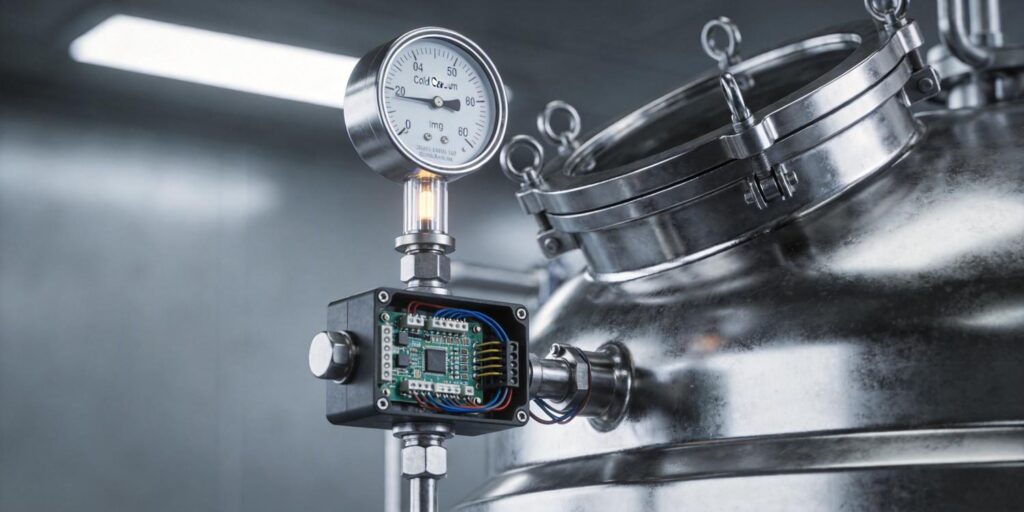
Explain Discharge Current Regulation Principle
Cold-cathode gauges, such as Poseidon Scientific’s VG-SM225 Cold Cathode Vacuum Gauge, operate on the Penning discharge principle. A high negative voltage is applied to the cathode (initial startup at –2500 V, then regulated to –2000 V working voltage) while a permanent NdFeB magnet produces an axial field of approximately 100 gauss. Free electrons emitted by field emission or cosmic rays are trapped in spiraling trajectories by the crossed electric and magnetic fields. These electrons collide with residual gas molecules, creating an avalanche of secondary electrons and positive ions. The resulting ion current collected at the cathode becomes the measurable signal.
Current regulation is self-sustaining once the discharge ignites. After the initial high-voltage pulse, the circuit automatically drops to the lower working voltage, maintaining a stable discharge without external electron sources. The compact positive-magnetron (“工”-shaped cathode inside a perforated anode) geometry ensures the electron path length remains consistent, delivering repeatable current at any given pressure. This design eliminates the hot-filament wear and outgassing issues of thermionic gauges while providing the fast response needed for high-vacuum process control.
Built-in software and hardware protection circuits automatically disable high voltage above 10⁻³ Torr, preventing arcing during roughing and extending electrode life. The result is a highly stable discharge current that serves as the foundation for accurate pressure measurement across the 10⁻³ to 10⁻⁷ Torr operating range.
Relationship Between Ion Current and Pressure
In the linear operating region, ion current (i₊) is directly proportional to gas density and therefore absolute pressure (P). The relationship is expressed as i₊ = K · iₑ · P, where K incorporates ionization efficiency, electron path length, and collection geometry. For the VG-SM225, the symmetric electrode layout and 100-gauss magnetic field produce a nearly linear i₊ vs. P curve from 10⁻³ Torr down to approximately 5 × 10⁻⁷ Torr when operated at constant –2000 V.
This linearity stems from the avalanche multiplication factor remaining constant: each primary electron generates a fixed number of ion pairs per unit pressure. Because the discharge is magnetically confined, electron energy distribution stays uniform, avoiding the non-linear saturation effects seen in older inverted-magnetron designs. The 0–10 V analog output (scaled from the effective 2–8 V span) and customizable RS232 digital stream both reflect this proportional relationship, giving engineers a clean, real-time pressure signal for PID control loops or safety interlocks.
Temperature compensation—implemented via both analog circuitry and embedded firmware—further stabilizes the constant K across the full 15 °C–50 °C operating envelope, ensuring the ion-current-to-pressure mapping remains accurate regardless of ambient fluctuations.
Non-Linearity Risks at Transition Zones
Non-linearity appears at two critical zones. Above 10⁻³ Torr, molecular density becomes high enough that ion–ion collisions reduce avalanche efficiency; current actually decreases with rising pressure. The VG-SM225’s protection logic prevents operation in this region by shutting off high voltage and flashing the status LED. Attempting measurements here without protection would produce erratic, non-monotonic readings and accelerate electrode contamination.
At the low-pressure extreme (<5 × 10⁻⁷ Torr), startup delays lengthen dramatically (up to 30 minutes at 10⁻⁷ Torr) because fewer molecules are available for ionization. Once ignited, the curve may exhibit a slight power-law deviation (i₊ ∝ Pⁿ where n ≈ 1.1–1.4) due to reduced secondary emission. The positive-magnetron geometry of the VG-SM225 minimizes this effect compared with larger legacy designs, keeping the useful linear range wider and more repeatable. Field data confirm that proper shielding from plasma or stray electrons eliminates most low-end non-linearity, preserving measurement accuracy for high-vacuum coating and analytical applications.
Electronic Stabilization Circuits
Poseidon’s VG-SM225 incorporates dedicated stabilization circuitry to maintain constant discharge conditions. A precision high-voltage regulator holds the working potential at –2000 V ±1 % regardless of supply fluctuations. Current-sense amplifiers monitor the ion current in real time, feeding a feedback loop that adjusts the effective gain and compensates for minor electrode surface changes. Temperature sensors integrated into the electronics board trigger firmware corrections that keep the overall transfer function linear across the operating range.
Additional safeguards include over-current limiting to prevent arcing and a digital filter that averages 10–20 samples before updating the output. The RS232 protocol transmits not only pressure but also raw current, status flags, and voltage values, allowing advanced users to implement external software linearization when extreme accuracy is required. These circuits collectively reduce drift to <±5 % and extend mean time between failures to 25 000–40 000 hours in clean environments.
Field Calibration Validation Method
Periodic field validation confirms continued linearity without full factory recalibration. The procedure is straightforward:
- Expose the gauge to local atmosphere and verify output near 760 Torr (9.8–10 V analog or equivalent digital value). Record ambient temperature.
- Evacuate to a known mid-range point (10⁻⁴ Torr) using a calibrated leak valve and dry nitrogen; compare against a reference gauge or capacitance manometer.
- Check the transition at 10⁻³ Torr: the cold-cathode reading should match the Pirani companion gauge within ±10 % before the protection circuit disables high voltage.
- Log RS232 status bits for any contamination or startup-delay flags.
- If deviation exceeds 10 %, perform electrode polishing with 500-mesh emery paper (modular head design allows this without breaking main seals) and repeat the two-point check.
This method takes 95 % of cases. Poseidon ships each unit with a NIST-traceable certificate and detailed validation checklist, making field checks both fast and auditable.
Practical Example in High Vacuum Coating
A reactive sputtering line producing optical coatings for precision optics experienced pressure instability during TiO₂ deposition. The legacy cold-cathode gauge, mounted close to the magnetron target, showed non-linear jumps of 30–50 % whenever plasma ignited. Ion current was inflated by plasma electrons, shifting indicated pressure from the true 8 × 10⁻⁶ Torr setpoint and causing inconsistent film indices.
Replacement with a Poseidon VG-SM225 installed on a 25 cm side tubulation with grounded baffle restored linearity immediately. Electronic stabilization circuits held discharge current within ±2 % of nominal, while the RS232 digital output allowed the PLC to cross-check against the companion VG-SP205 Pirani during transition. Coating uniformity improved from ±12 % to ±2 %, throughput increased 25 %, and electrode maintenance dropped to once per year. The compact size and any-orientation mounting fit the tight cluster-tool geometry without redesign, delivering ROI in under six months.
Conclusion and Next Steps
Stable discharge current is the cornerstone of accurate, linear pressure measurement in cold-cathode gauges. The VG-SM225 Cold Cathode Vacuum Gauge achieves this through self-regulated Penning discharge, precision voltage and current control circuits, and a compact positive-magnetron geometry that minimizes transition-zone non-linearity. Engineers gain reliable high-vacuum data from 10⁻³ to 10⁻⁷ Torr with minimal drift, seamless integration via 0–10 V analog and customizable RS232, and easy field validation that keeps systems running at peak performance.
Whether monitoring sputtering, PECVD, electron-beam systems, or vacuum furnaces, this gauge combines durability, linearity, and low ownership cost in a package engineered specifically for industrial reliability.
Ready to optimize current stability and measurement linearity in your high-vacuum process? Explore the VG-SM225 Cold Cathode Vacuum Gauge today. It pairs perfectly with the VG-SP205 Pirani Vacuum Transmitter for full-range coverage and supports 5–10 unit protocol customization for your exact controller.
Contact our applications engineering team for a free technical consultation. We’ll review your process parameters, recommend mounting and shielding configurations, and provide a customized linearity validation worksheet—helping you achieve stable, repeatable vacuum measurement with minimal downtime.


