Major Herbicides Monitored in Water Analysis
Environmental monitoring programs for water quality routinely target a diverse range of herbicide classes due to their widespread agricultural use and potential for runoff into surface and groundwater. Among the most commonly monitored compounds are acidic herbicides, which present unique analytical challenges. These include phenoxy acid herbicides like 2,4-D, MCPA, and dicamba, as well as sulfonylureas such as chlorsulfuron and metsulfuron-methyl. Research by Ngan and Ikesaki (1991) demonstrated the determination of nine acidic herbicides in water and soil using gas chromatography with electron-capture detection, highlighting the importance of selective extraction methods for these polar compounds.
Triazine herbicides, including atrazine and simazine, remain priority analytes despite regulatory restrictions in many regions. Studies by Cai et al. (1993) achieved sub-parts-per-trillion level determination of atrazine in water using solid-phase extraction, underscoring the sensitivity requirements for environmental monitoring. Other important classes include phenylureas, organophosphates, and chloroacetamides, each requiring specific analytical approaches for accurate quantification in complex environmental matrices.
Acidic Nature of Many Herbicide Compounds
The chemical structure of many herbicides includes acidic functional groups that significantly influence their environmental behavior and analytical determination. Phenoxy acid herbicides typically contain carboxylic acid groups with pKa values ranging from 2.8 to 4.3, making them partially ionized at environmental pH levels. Sulfonylurea herbicides feature sulfonylurea bridges that can dissociate under basic conditions, while benzoic acid derivatives like dicamba exhibit pKa values around 1.9.
This acidic character presents both challenges and opportunities for analytical chemists. In aqueous environmental samples, these compounds can exist in both neutral and anionic forms depending on pH, affecting their solubility, mobility, and extractability. The ionization state directly impacts retention mechanisms during solid-phase extraction, making pH control a critical parameter in method development. Research by Howard and Taylor (1992) on sulfonylurea herbicides demonstrated the importance of understanding acid-base properties for quantitative supercritical fluid extraction from aqueous matrices via solid-phase extraction.
Why WAX SPE Provides Selective Retention
Weak Anion Exchange (WAX) solid-phase extraction represents a sophisticated solution for the selective isolation of acidic herbicides from environmental waters. Unlike traditional reversed-phase sorbents that rely primarily on hydrophobic interactions, WAX sorbents employ a mixed-mode retention mechanism combining both ion-exchange and reversed-phase interactions. This dual functionality provides enhanced selectivity for strong acidic compounds that might otherwise exhibit poor retention on conventional C18 phases.
The WAX sorbent contains weak anion exchange functional groups (typically tertiary amines) that interact with negatively charged acidic herbicides through ionic interactions when the analytes are in their anionic form. Simultaneously, the polymeric backbone provides hydrophobic retention for neutral species and contributes to overall capacity. According to Waters documentation, Oasis WAX was specifically developed to provide sample preparation for strong acidic compounds, with a strictly controlled ion-exchange capacity of 0.6 meq/g. This controlled functionality ensures consistent performance and minimizes variability in analytical results.
Mechanistic Advantages Over Traditional SPE
The mixed-mode nature of WAX sorbents offers several distinct advantages for environmental monitoring applications. First, the ion-exchange component provides orthogonal selectivity that can separate acidic herbicides from neutral matrix interferences. Second, the combination of mechanisms often allows for stronger retention than either mechanism alone, enabling larger sample volumes to be processed without breakthrough. Third, the ability to use different elution conditions for ionic versus hydrophobic interactions provides flexibility in method development and optimization.
Sample pH Adjustment Before Loading
Proper pH adjustment represents the most critical step in WAX SPE method development for acidic herbicides. Since ion-exchange retention depends on the analytes existing in their anionic form, samples must be adjusted to a pH at least 2 units above the pKa of the target compounds. For most acidic herbicides with pKa values between 2 and 5, this typically means adjusting to pH 6-8 using appropriate buffers.
Common approaches include adding phosphate buffers (pH 7-8) or ammonium acetate buffers (pH 6-7) to water samples before loading. The buffer concentration should be sufficient to maintain pH stability throughout the loading process, typically 10-50 mM. Research by Wells and Michael (1987b) demonstrated the importance of pH control for recovery of picloram and 2,4-dichlorophenoxyacetic acid from aqueous samples by reversed-phase solid-phase extraction, principles that apply equally to WAX applications.
It’s essential to consider that some environmental waters have significant buffering capacity due to dissolved carbonates and other components. In such cases, additional buffer may be required to achieve and maintain the target pH. The use of pH paper or a calibrated pH meter during method development is recommended to verify proper adjustment.
Washing Protocols for Dissolved Organic Matter Removal
Environmental water samples contain complex mixtures of dissolved organic matter (DOM) that can interfere with herbicide analysis and reduce method performance. Humic and fulvic acids, in particular, can compete with target analytes for binding sites on WAX sorbents and co-elute during analysis, causing matrix effects in LC-MS. Effective washing protocols must balance the removal of these interferences while maintaining high recovery of target herbicides.
A typical WAX washing sequence begins with a mild acidic wash (2-5% formic acid in water or methanol) to remove weakly retained neutral and basic compounds while keeping acidic herbicides protonated and retained through hydrophobic interactions. This is often followed by a methanol or acetonitrile wash to remove non-polar interferences. Research by Pichon et al. (1996) demonstrated simple removal of humic and fulvic acid interferences using polymeric sorbents for simultaneous solid-phase extraction of polar acidic, neutral and basic pesticides.
Optimizing Wash Stringency
The stringency of washing steps must be carefully optimized for each application. Too aggressive washing can lead to premature elution of target compounds, while insufficient washing leaves interfering compounds that affect downstream analysis. Factors to consider include:
- Wash solvent composition and pH
- Wash volume (typically 2-5 column volumes)
- Flow rate during washing
- Specific interferences present in the water matrix
Studies by Senseman et al. (1995) investigated the influence of dissolved humic acid and Ca-montmorillonite clay on pesticide extraction efficiency from water using solid-phase extraction disks, providing valuable insights into interference management strategies.
Elution Strategies for LC-MS Analysis
Effective elution of acidic herbicides from WAX sorbents requires conditions that disrupt both ionic and hydrophobic interactions. The most common approach involves using an organic solvent containing a volatile acid or base that neutralizes the ionic interactions. For LC-MS compatibility, the elution solvent should be volatile and compatible with the chromatographic system.
A typical elution protocol might include:
- Initial elution with methanol containing 2-5% formic acid to protonate the analytes and disrupt ionic interactions
- Follow-up elution with methanol containing 2-5% ammonium hydroxide to ensure complete recovery of strongly retained compounds
According to Waters method development protocols, a 4-step approach for WAX includes loading pre-treated sample, washing with 5% NH₄OH, eluting with 2% formic acid in methanol, and final elution with 100% methanol. This sequential approach ensures complete recovery while maintaining selectivity.
Elution Volume Optimization
The required elution volume depends on several factors including sorbent mass, analyte properties, and previous washing conditions. Typically, 2-5 mL of elution solvent per 100 mg of sorbent provides complete recovery for most acidic herbicides. It’s often beneficial to collect eluate in fractions to determine the minimum volume needed for quantitative recovery, thereby minimizing dilution and improving detection limits.
Example Environmental Monitoring Workflow
A comprehensive environmental monitoring workflow for acidic herbicides using WAX SPE typically follows these steps:
1. Sample Collection and Preservation
Collect water samples in clean glass or plastic containers, preserving with appropriate agents (often hydrochloric acid to pH ~2) to prevent biodegradation. Store at 4°C and analyze within recommended holding times.
2. Sample Preparation
Filter samples through 0.45 μm membrane filters to remove particulate matter. Adjust pH to 6-8 using ammonium hydroxide or appropriate buffer. Add internal standards at this stage if using isotope dilution methods.
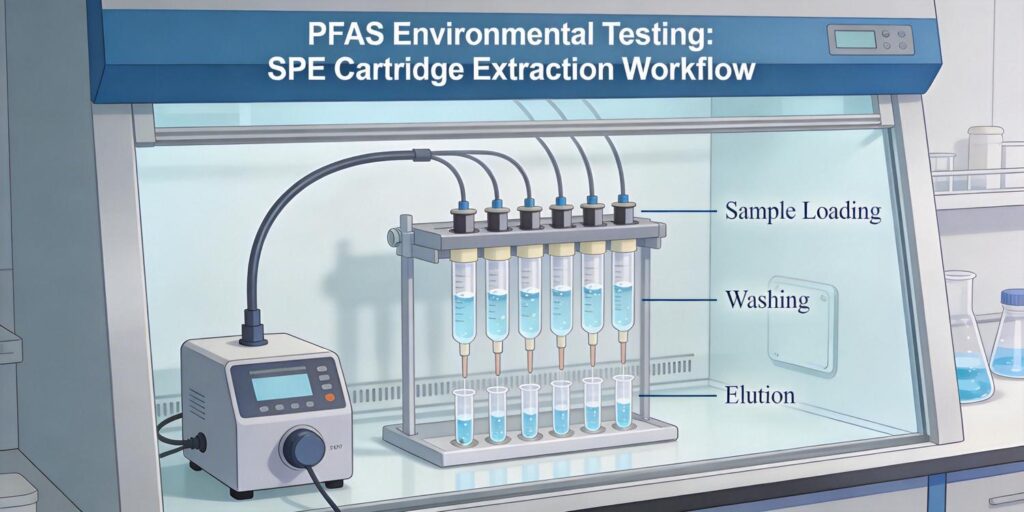
3. SPE Procedure
- Conditioning: Condition WAX cartridge with 2-3 mL methanol followed by 2-3 mL water or buffer at sample pH
- Loading: Load sample at controlled flow rate (typically 5-10 mL/min)
- Washing: Wash with 2-3 mL of 2% formic acid in water, followed by 2-3 mL methanol
- Drying: Apply vacuum or positive pressure to dry sorbent bed (5-10 minutes)
- Elution: Elute with 2-4 mL of 2% formic acid in methanol, followed by 2-4 mL of 5% ammonium hydroxide in methanol
4. Extract Processing
Combine eluates and evaporate to near dryness under gentle nitrogen stream. Reconstitute in initial mobile phase composition for LC-MS analysis. Filter through 0.2 μm syringe filter if necessary.
5. LC-MS/MS Analysis
Analyze using reversed-phase LC with MS/MS detection in negative ion mode for most acidic herbicides. Use appropriate quality control samples including blanks, matrix spikes, and continuing calibration verification.
6. Data Interpretation and Reporting
Quantify against calibration standards, applying appropriate correction for recovery and matrix effects. Report results with proper units and detection limits, noting any quality control issues.
This workflow, when properly implemented with Poseidon Scientific WAX SPE cartridges, provides reliable, sensitive determination of acidic herbicides in environmental waters. The mixed-mode selectivity of WAX sorbents makes them particularly valuable for monitoring programs targeting diverse herbicide classes in complex matrices.
For laboratories requiring high-throughput analysis, 96-well SPE plates with WAX chemistry offer automation compatibility while maintaining the selective retention characteristics needed for acidic herbicide monitoring.