PFAS Environmental Concern Overview
Perfluorinated compounds (PFAS) represent one of the most pressing environmental challenges of our time. These synthetic chemicals, characterized by strong carbon-fluorine bonds, exhibit exceptional persistence in the environment and bioaccumulation potential. PFAS contamination has been detected globally in water sources, soil, and biological samples, raising significant public health concerns due to their association with various adverse health effects including developmental issues, immune system suppression, and increased cancer risk.
The environmental persistence of PFAS stems from their chemical stability, making traditional water treatment methods largely ineffective. This has created an urgent need for reliable analytical methods capable of detecting these compounds at trace levels (parts-per-trillion) in environmental matrices. As regulatory agencies worldwide establish increasingly stringent limits for PFAS in drinking water, the demand for robust sample preparation techniques has never been greater.
Sample Preparation of Water Samples
Proper sample preparation is critical for accurate PFAS analysis in water matrices. Water samples typically require filtration through 0.45 μm glass fiber filters to remove particulate matter that could interfere with the extraction process. It’s essential to use PFAS-free materials throughout the sampling and preparation process to avoid contamination, as these compounds are ubiquitous in laboratory environments.
For drinking water samples, direct extraction is often possible, while wastewater and surface water may require additional pretreatment steps. The sample volume typically ranges from 100 mL to 1 L, depending on the expected concentration levels and detection limits required. Maintaining sample integrity through proper preservation (typically at 4°C) and minimizing storage time before extraction is crucial for reliable results.
MAX SPE Conditioning Procedure
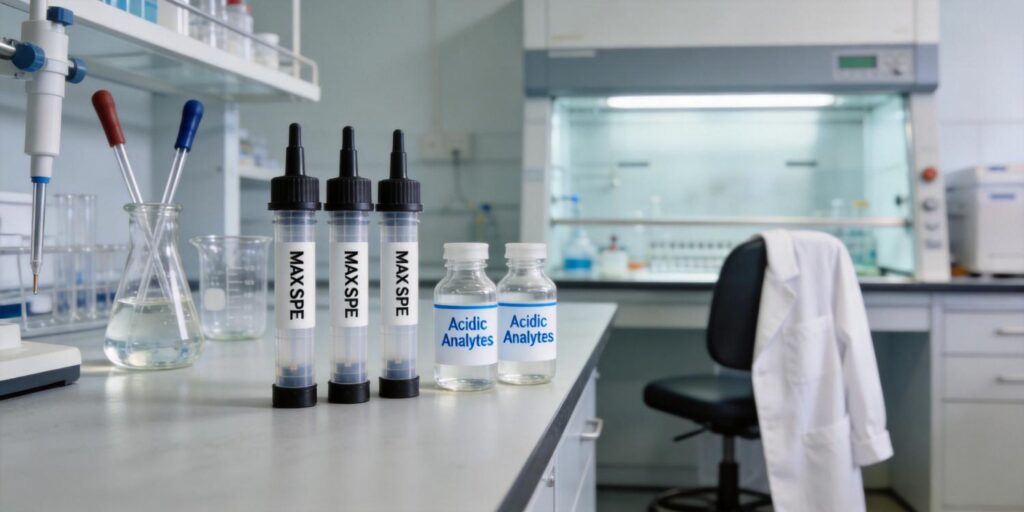
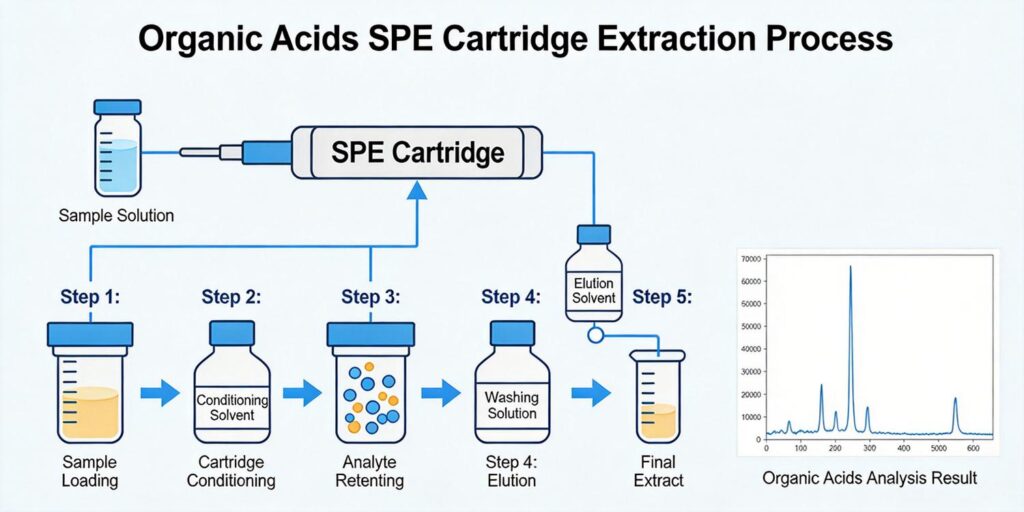
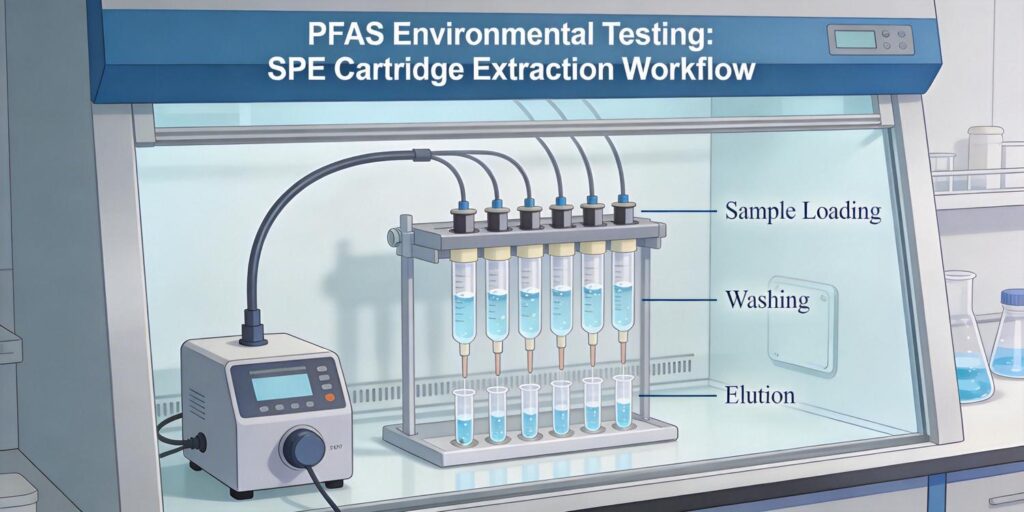
Mixed-mode anion exchange (MAX) SPE cartridges provide the ideal combination of hydrophobic and anion exchange interactions necessary for efficient PFAS extraction. The conditioning procedure begins with 5-10 mL of methanol to activate the sorbent bed, followed by 5-10 mL of deionized water to remove excess methanol and prepare the cartridge for aqueous sample loading.
Proper conditioning ensures optimal retention of both perfluorinated carboxylic acids (PFCAs) and perfluorinated sulfonic acids (PFSAs). The methanol step solvates the hydrophobic polymer backbone while activating the quaternary ammonium anion exchange sites. The water wash removes residual methanol that could otherwise reduce retention efficiency during sample loading. It’s critical to maintain a consistent flow rate (approximately 1-2 mL/min) throughout the conditioning process to ensure uniform sorbent activation.
Sample Loading at Controlled pH
pH control during sample loading is paramount for maximizing PFAS retention on MAX cartridges. The sample should be adjusted to pH 7-8 using ammonium acetate or ammonium hydroxide buffer to ensure that the acidic PFAS compounds (pKa values typically 0-3) are fully deprotonated and thus strongly retained via anion exchange mechanisms.
The loading flow rate should be carefully controlled at 5-10 mL/min to allow sufficient interaction time between analytes and sorbent sites. For large sample volumes, maintaining a consistent flow rate prevents breakthrough and ensures quantitative recovery. The loading process should be monitored to ensure the cartridge bed remains wet throughout, as drying can lead to poor recovery and irreproducible results.
Wash Steps to Remove Inorganic Salts
Following sample loading, a series of wash steps effectively removes inorganic salts and weakly retained matrix components while maintaining PFAS retention. Typically, 5-10 mL of 25 mM ammonium acetate in water (pH 7-8) is used to remove residual salts and polar interferences.
An additional wash with 5-10 mL of methanol helps remove hydrophobic interferences while keeping PFAS retained through strong anion exchange interactions. The methanol wash is particularly effective at removing humic acids and other organic matrix components that could interfere with subsequent LC-MS/MS analysis. Careful optimization of wash solvent composition and volume is essential to balance matrix removal with analyte retention.
Elution with Ammonium Hydroxide in Methanol
The elution step employs 5-10 mL of 2-5% ammonium hydroxide in methanol to disrupt the anion exchange interactions and release retained PFAS compounds. The basic conditions neutralize the quaternary ammonium sites while the methanol provides sufficient elution strength to overcome hydrophobic interactions.
Elution should be performed slowly (1-2 mL/min) to ensure complete analyte recovery. The eluate is typically collected in polypropylene tubes to minimize PFAS adsorption to container walls. For maximum recovery, a second elution with pure methanol may be employed, though most methods achieve >90% recovery with a single ammonium hydroxide/methanol elution. The collected eluate is often concentrated under a gentle stream of nitrogen to achieve the necessary detection limits for trace analysis.
LC-MS/MS Analysis Parameters
Liquid chromatography coupled with tandem mass spectrometry (LC-MS/MS) provides the sensitivity and selectivity required for PFAS analysis at trace levels. Typical chromatographic conditions employ a C18 or equivalent reversed-phase column (2.1 × 50 mm, 1.7-1.8 μm particle size) maintained at 40-50°C.
The mobile phase typically consists of water and methanol or acetonitrile, both containing 2-5 mM ammonium acetate to enhance ionization efficiency. A gradient elution from 20% to 95% organic over 10-15 minutes effectively separates the various PFAS homologs. Mass spectrometric detection utilizes electrospray ionization in negative mode with multiple reaction monitoring (MRM) transitions specific to each target compound.
Key MS/MS parameters include optimized collision energies, dwell times, and resolution settings to maximize sensitivity while minimizing cross-talk between transitions. Method validation should include assessment of linearity (typically 1-500 ng/L), precision (<20% RSD), accuracy (80-120% recovery), and limits of detection (0.1-1 ng/L for most compounds). Quality control measures including matrix spikes, laboratory control samples, and isotopically labeled internal standards are essential for reliable data generation.
Method Performance and Applications
The MAX SPE method for PFAS extraction consistently demonstrates recoveries of 80-120% for a wide range of compounds including PFOA, PFOS, PFHxS, and various short-chain alternatives. The method’s robustness has been validated for various water matrices including drinking water, groundwater, surface water, and wastewater effluent.
This approach is particularly valuable for environmental monitoring programs, regulatory compliance testing, and source tracking investigations. The ability to simultaneously extract and concentrate multiple PFAS compounds makes it an efficient solution for comprehensive environmental assessment programs.
Comparison with Alternative SPE Chemistries
While other SPE chemistries like HLB (hydrophilic-lipophilic balance) can extract PFAS, MAX cartridges offer superior selectivity through their anion exchange functionality. This results in cleaner extracts with fewer matrix interferences, particularly important for complex environmental samples. The mixed-mode mechanism also provides more consistent recovery across the diverse range of PFAS compounds with varying chain lengths and functional groups.
Future Developments and Considerations
As PFAS regulations evolve and new compounds emerge, method development continues to advance. Recent trends include miniaturization of SPE formats, automation for high-throughput analysis, and development of more selective sorbents for emerging PFAS compounds. The integration of online SPE with LC-MS/MS systems offers particular promise for increased efficiency and reduced contamination risk.
For laboratories seeking reliable PFAS analysis, the MAX SPE method provides a proven, robust approach that balances recovery, selectivity, and practicality. Proper implementation following the detailed procedures outlined above ensures reliable data generation for environmental monitoring and regulatory compliance applications.