Types of Organic Acids in Environmental Samples
Environmental samples contain a diverse range of organic acids that require specialized cleanup strategies for accurate analysis. These include carboxylic acids such as formic, acetic, propionic, and butyric acids, which are commonly found in water, soil, and biological matrices. More complex acids like humic and fulvic acids present in soil and water samples create significant analytical challenges due to their structural complexity and strong matrix interactions.
According to research on SPE applications, acidic drugs and metabolites often require specific extraction approaches. For instance, non-steroidal anti-inflammatory drugs (NSAIDs) like ibuprofen, diclofenac, and naproxen contain carboxylic acid groups that behave differently during extraction compared to neutral compounds. The presence of functional groups capable of forming intramolecular hydrogen bonds or exhibiting pseudo-zwitterionic characteristics further complicates the extraction process.
Environmental samples also contain phenolic acids, fatty acids, and various degradation products that can interfere with target analyte detection. The concentration of endogenous acids in biological matrices has limited the usefulness of certain SPE phases, making method optimization critical for successful analysis.
Adjusting Sample pH to Ensure Ionization
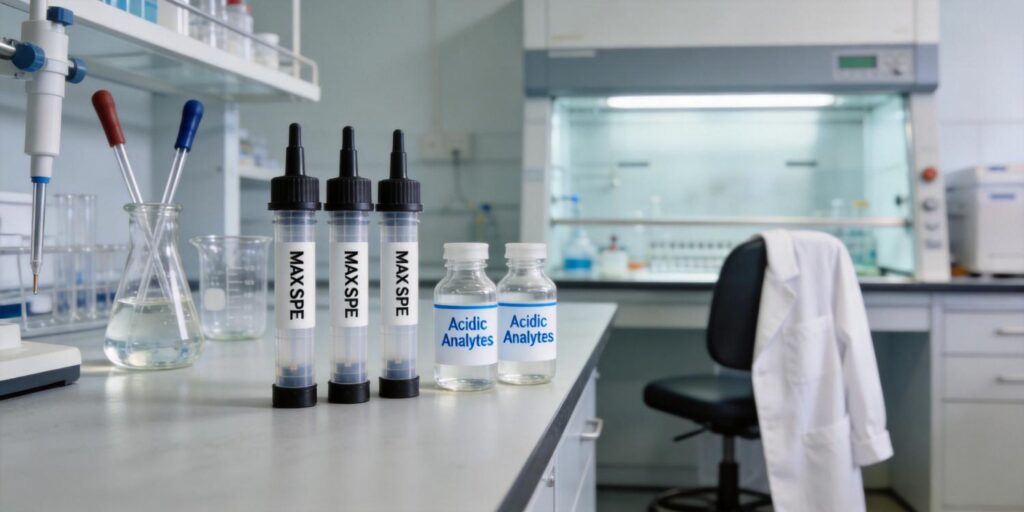
Proper pH adjustment is the cornerstone of successful MAX SPE cleanup for organic acid analysis. Mixed-mode anion exchange (MAX) cartridges rely on ionic interactions between the negatively charged analytes and the positively charged quaternary amine groups on the sorbent surface. For optimal retention, organic acids must be in their ionized (anionic) form during sample loading.
Research indicates that quoted pKa values should be used as guides rather than absolute rules, as the effective acidity or basicity of functional groups near bonded silica surfaces may differ significantly from solution values. For most carboxylic acids with pKa values between 3-5, adjusting the sample pH to 2-3 units above the pKa ensures complete ionization. Typically, this means adjusting to pH 6-8 for most applications.
As documented in SPE protocols, “Many drugs have acidic or basic properties, and it can be anticipated that their cartridge retention and elution behavior will be affected by the pH of the extraction system.” At pH 3.3, acidic, neutral, and some weakly basic drugs behave as relatively nonpolar compounds, while other basic drugs behave as charged species. This principle applies equally to environmental organic acids.
For complex samples containing multiple acid types, a compromise pH may be necessary, though this may require additional optimization of wash and elution conditions to maintain adequate recovery across all target analytes.
Conditioning MAX Cartridges with Methanol and Water
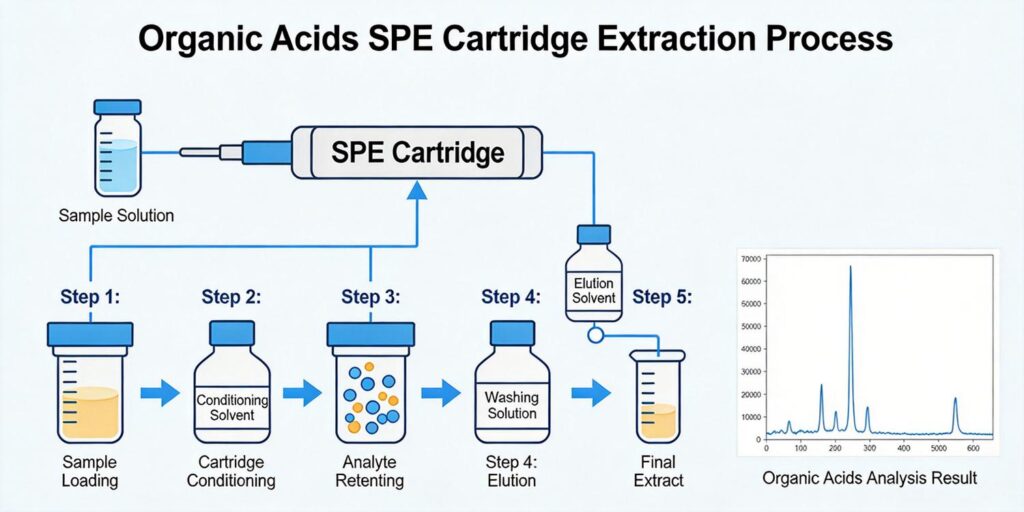
Proper conditioning of MAX cartridges is essential for activating both the reversed-phase and ion-exchange mechanisms. The standard conditioning protocol involves sequential application of methanol followed by water or buffer solution. Methanol serves to solvate the hydrophobic polymeric backbone and prepare the sorbent for aqueous sample loading.
According to established SPE procedures, cartridges should be conditioned with 2 mL of methanol followed by 2 mL of appropriate buffer or water. It’s crucial to maintain approximately 1-2 mm of conditioning solvent above the sorbent bed to prevent drying before sample application. As noted in SPE guidelines, “The cartridge must not become dry before sample application.”
For MAX cartridges specifically designed for acidic compounds, the ion-exchange capacity is typically controlled at 0.25 meq/g, ensuring reproducible SPE protocols. These water-wettable polymeric sorbents remain stable across pH 0-14, making method development more straightforward compared to silica-based materials.
Conditioning with the same buffer used for sample pH adjustment helps maintain consistent ionic strength and pH conditions throughout the extraction process, minimizing analyte breakthrough during loading.
Washing Neutral Matrix Components
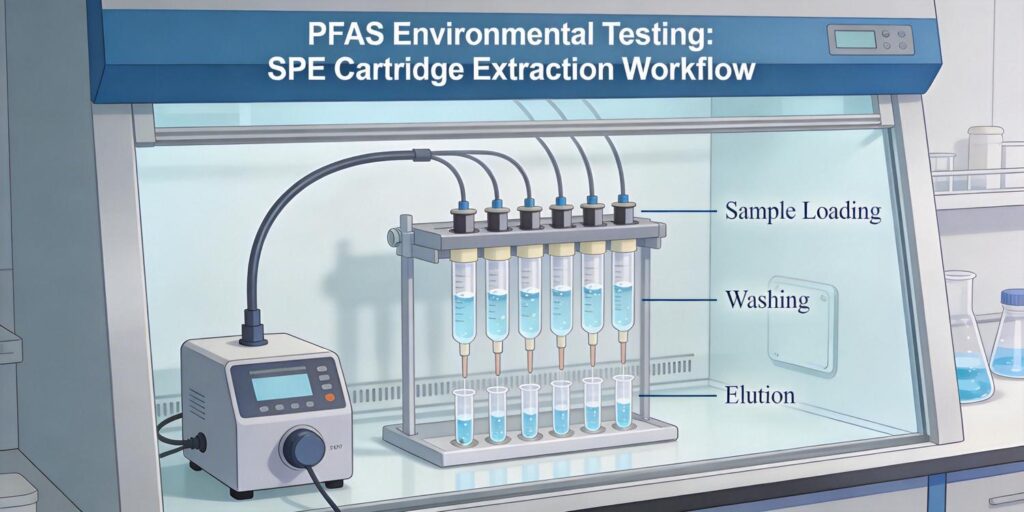
Effective washing removes neutral and weakly retained matrix components while maintaining strong retention of target organic acids through ionic interactions. The wash step typically employs solvents with sufficient organic content to elute neutral interferences but insufficient to disrupt the ion-exchange binding of target acids.
Common wash solvents include water, methanol/water mixtures (typically 5-20% methanol), or buffers with controlled pH and ionic strength. Research shows that 5% methanol solutions effectively exclude salts and other organic interferences while maintaining analyte retention. For more complex matrices, sequential washes with different solvents may be necessary.
As documented in SPE optimization studies, “Determine strongest wash solvent that will not elute analyte” is a key principle in method development. The wash step should be optimized to maximize removal of matrix interferences while minimizing analyte loss. Typically, 1-3 mL of wash solvent is sufficient, though this may vary based on cartridge size and sample complexity.
For environmental samples containing high levels of humic substances or other complex matrices, additional wash steps with solvents like hexane or ethyl acetate may be necessary to remove non-polar interferences that could co-elute with target analytes.
Elution with Acidified Solvent
Elution of retained organic acids from MAX cartridges requires disruption of both the ionic and hydrophobic interactions. This is typically achieved using acidified organic solvents that protonate the analytes, converting them to their neutral forms while simultaneously providing sufficient eluotropic strength to overcome reversed-phase retention.
Common elution solvents include methanol or acetonitrile acidified with formic acid, acetic acid, or hydrochloric acid (typically 2-5% acid content). The acid concentration should be sufficient to lower the pH below the pKa of the target acids, ensuring complete protonation. Research indicates that 0.01-0.1 M acid concentrations in organic solvents generally provide effective elution.
SPE optimization studies recommend allowing “cartridge/plate to soak with eluent for 0.5 – 1 min. (increases recovery)” and note that “sometimes several smaller eluent aliquots can improve recovery.” Typical elution volumes range from 1-3 mL depending on cartridge capacity and analyte loading.
For complex mixtures, gradient elution or sequential elution with solvents of increasing strength may improve separation of different acid classes. However, for routine environmental analysis, a single acidified solvent elution generally provides adequate recovery for most carboxylic acids.
Recovery Optimization
Optimizing recovery involves systematic evaluation of multiple parameters including pH conditions, solvent compositions, flow rates, and drying steps. Recovery studies should be conducted using fortified samples at relevant concentration levels to ensure method robustness.
Key factors affecting recovery include:
- Flow Rate Control: Research shows that “Slow Load or Elute Flow Rate” significantly impacts recovery. Optimal flow rates typically range from 1-2 mL/min for loading and 0.5-1 mL/min for elution.
- Solvent Composition: The percentage of organic modifier in wash and elution solvents must be carefully optimized. Studies indicate that 65% ethanol-water solutions can effectively retain vitamins while allowing elution with pure ethanol.
- pH Precision: Small variations in pH can dramatically affect ionization states and recovery. Buffer systems with good capacity at the target pH provide more consistent results than simple acid/base adjustments.
- Drying Conditions: Proper drying between aqueous wash steps and organic elution prevents solvent immiscibility issues. Vacuum drying for 2-5 minutes at 10-15 in. Hg is typically sufficient.
Recovery validation should include assessment of matrix effects by comparing fortified sample recoveries with standard solution recoveries. As documented in SPE studies, recoveries for acidic compounds using optimized methods typically range from 85-105% with relative standard deviations below 10%.
For environmental applications, method validation should also consider analyte stability in the loading solvent and matrix, linearity across expected concentration ranges, and potential interferences from co-extracted matrix components. Regular quality control using fortified samples and method blanks ensures ongoing method performance.
Practical Considerations for Environmental Applications
When applying MAX SPE cleanup to environmental samples, several practical considerations enhance method success:
- Sample Pretreatment: Filtration or centrifugation to remove particulate matter prevents cartridge clogging and ensures consistent flow rates.
- Ionic Strength Adjustment: Adding appropriate salts or buffers maintains consistent ionic strength, which affects ion-exchange efficiency.
- Cartridge Capacity Considerations: The typical capacity for analytes and matrix is about 1-3% of cartridge bed weight (excluding ion-exchange capacity). Overloading leads to breakthrough and reduced recovery.
- Evaporation and Reconstitution: After elution, gentle evaporation under nitrogen at moderate temperatures (30-40°C) prevents analyte degradation. Reconstitution in mobile phase-compatible solvents facilitates subsequent chromatographic analysis.
Comparison with Alternative SPE Phases
While MAX cartridges excel for organic acid analysis, understanding their advantages relative to other SPE phases helps in method selection:
| SPE Phase | Mechanism | Best For | Limitations |
|---|---|---|---|
| MAX | Mixed-mode anion exchange + reversed-phase | Acidic compounds, carboxylic acids | May require pH optimization |
| HLB | Hydrophilic-lipophilic balance | Broad spectrum, polar compounds | Less selective for ionized acids |
| C18 | Reversed-phase | Non-polar to moderately polar compounds | Poor retention of ionized acids |
| WCX | Mixed-mode cation exchange | Basic compounds | Not suitable for acids |
The mixed-mode nature of MAX cartridges provides superior selectivity for acidic compounds compared to single-mechanism phases, particularly in complex environmental matrices where multiple interferences are present.
Conclusion
MAX SPE cleanup represents a powerful strategy for organic acid analysis in environmental samples, offering excellent selectivity and recovery when properly optimized. The key to success lies in careful control of pH conditions throughout the extraction process, appropriate solvent selection for conditioning and washing, and systematic optimization of recovery parameters. By following the principles outlined in this guide and adapting them to specific analytical needs, laboratories can develop robust methods for accurate quantification of organic acids across diverse environmental matrices.
For further information on SPE products and applications, visit our MAX SPE Cartridges product page or explore our complete range of 96-well SPE plates for high-throughput applications.