
Chemical Properties of Acidic Pharmaceuticals
Acidic pharmaceuticals represent a diverse class of compounds characterized by their ability to donate protons in aqueous solutions. These drugs typically contain carboxylic acid (-COOH), sulfonic acid (-SO3H), or phenolic hydroxyl (-OH) functional groups that can dissociate to form negatively charged species. Understanding their chemical properties is fundamental to selecting the appropriate SPE sorbent for optimal extraction.
The most critical parameter for acidic drugs is their acid dissociation constant (pKa), which determines their ionization state at different pH values. As noted in forensic applications literature, “The pKa of ibuprofen is 5.9. This means that as you get close to the pKa and lower the pH of the separation you are increasing the nonionic molecular form, thus increasing the recovery of the drug on a hydrophobic bonded phase.” This principle applies broadly to acidic pharmaceuticals including NSAIDs like ketoprofen (pKa=5.9), ibuprofen (pKa=5.2), and diclofenac.
Acidic drugs exhibit varying degrees of hydrophobicity, which influences their retention on reversed-phase sorbents. Compounds with higher log P values (more hydrophobic) generally show better retention on non-polar phases. However, many acidic pharmaceuticals are relatively hydrophilic, with some like NBQX having log Poct values around 0, making their retention challenging on traditional reversed-phase materials.
Structural features such as intramolecular hydrogen bonding (as seen in diflunisal) or pseudo-zwitterionic character can significantly affect extraction behavior. These compounds may exhibit reduced efficiency in organic solvent extraction, particularly with solvents having high non-polar components.
Retention Mechanism Comparison: HLB vs. MAX
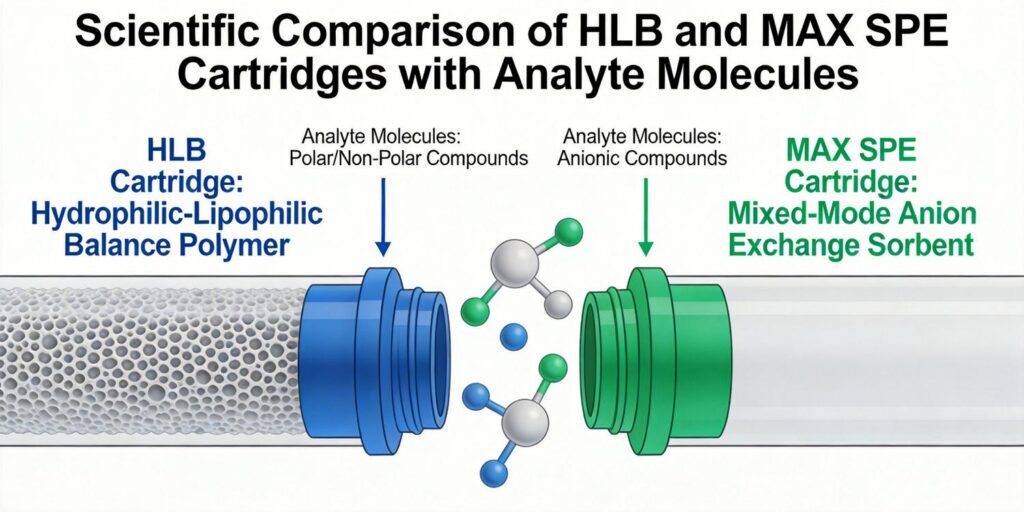
HLB (Hydrophilic-Lipophilic Balance) Sorbents
HLB sorbents, such as those offered by Poseidon Scientific, utilize a unique polymeric structure that provides both hydrophilic and lipophilic retention mechanisms. These sorbents are particularly effective for retaining acidic drugs through:
- Hydrophobic interactions with the lipophilic portions of the polymer
- Hydrogen bonding with the hydrophilic N-vinylpyrrolidone moieties
- Secondary interactions that can retain partially ionized species
For acidic drugs, HLB sorbents work best when the compounds are in their neutral (non-ionized) form. As research indicates, “Reversed phase or hydrophobic separations require the analyte to be in the nonionized or molecular form. If the analyte is ionized reversed phase separation will give a lower recovery.” This means sample pH must be carefully controlled to protonate acidic functional groups.
MAX (Mixed-mode Anion Exchange) Sorbents
MAX sorbents combine reversed-phase retention with strong anion exchange functionality, offering dual retention mechanisms specifically designed for acidic compounds. According to Waters documentation, “The Oasis MAX (Mixed-mode Anion eXchange) Sorbent has a tightly controlled ion-exchange capacity of 0.25 meq/g, ensuring reproducible SPE protocols for extraction of acidic compounds and metabolites from biological fluids.”
The retention mechanisms in MAX sorbents include:
- Ion-exchange interactions between negatively charged acidic drugs and positively charged quaternary ammonium groups
- Hydrophobic interactions with the polymeric backbone
- Enhanced selectivity through pH-controlled retention and elution
MAX sorbents are particularly valuable for strongly acidic compounds (pKa < 4) that remain ionized across a wide pH range and for polar acidic drugs that show poor retention on traditional reversed-phase materials.
Sample pH Considerations
Sample pH is arguably the most critical parameter in SPE method development for acidic drugs. The ionization state of acidic compounds directly determines which retention mechanism will be most effective and what recovery can be expected.
pH Optimization for HLB Sorbents
For HLB extraction of acidic drugs, the sample pH should be adjusted to at least 2 pH units below the compound’s pKa to ensure protonation. Research demonstrates that “When the sample is buffered at pH 6.0 the more strongly acidic drugs are present in their dissociated, ionic forms. These ionic species retain poorly by non-polar mechanisms, compared to the neutral species. Therefore, we changed the starting pH to 2.2.”
Practical guidelines for HLB extraction:
- For carboxylic acids (pKa ~4-5): pH 2-3
- For phenolic compounds (pKa ~9-10): pH 7-8
- For sulfonic acids (pKa < 2): Consider alternative sorbents or ion-pairing
pH Optimization for MAX Sorbents
MAX sorbents offer greater flexibility in pH selection because they can retain acidic drugs through ion-exchange when compounds are ionized. However, optimal pH conditions still need to be established. Studies show that “Acceptable recoveries were obtained for this acidic analyte at pH values between 2 and 4 using both Bond Elut C8 and Certify II (containing a mixture of non-polar and anion exchange functionalities). Optimal recoveries were obtained at pH 3.0 on both sorbents.”
For MAX extraction:
- Load at pH where compounds are ionized (typically pH > pKa + 1)
- Wash at similar pH to remove neutral and basic interferences
- Elute by changing pH to neutralize the ion-exchange interaction
It’s important to note that quoted pKa values pertain to specific conditions, and “the effective acidity or basicity of a functional group close to a bonded silica surface may be very different. Consequently, you may use quoted values of molecular properties as a guide for selection of experimental conditions of pH, but it is always wise to verify the selection by experiment.”
Recovery Comparison Experiments
Experimental Design Considerations
When comparing HLB and MAX sorbents for acidic drug extraction, several experimental factors must be controlled:
- Sample matrix: Plasma, urine, and whole blood require different approaches
- Drug concentration: Typically 1-10 μg/mL for method development
- pH profiling: Systematic evaluation across pH 2-9 in 0.5-1 unit increments
- Wash optimization: Minimizing matrix interference while maintaining recovery
- Elution optimization: Solvent composition, volume, and pH considerations
Comparative Recovery Data
Research comparing different SPE approaches for acidic drugs reveals important patterns. For NSAIDs spiked into horse urine at 10 μg/mL, mixed-mode SPE cartridges provided cleaner extracts than liquid-liquid extraction, with recoveries varying by compound:
- Carprofen: 139% recovery relative to solvent extraction
- Ibuprofen: Good recovery on both HLB and mixed-mode sorbents
- Naproxen: Variable recovery depending on sorbent and conditions
Studies on comprehensive SPE procedures show that “the starting pH of 2.2 results in less ionization of the acidic drugs and hence, better retention on the cartridge. It should be emphasized, however, that the amounts of water in the sample application step and in the wash step should be kept as small as possible. If not, the more polar acidic compounds will be partly washed away.”
Case Study: Polar Acidic Drugs
For polar acidic compounds like paracetamol (acetaminophen), recovery is highly dependent on sample dilution and wash volume. Research demonstrates that increasing sample dilution or wash volume significantly reduces recovery of polar acidic drugs. This highlights the importance of method optimization for specific compound classes.
Comparative studies between Certify II (mixed-mode) and C8 sorbents for the experimental drug NBQX showed:
- Optimal recoveries at pH 3.0 on both sorbents
- Cleaner chromatograms with Certify II at pH 3.5
- Almost complete lack of retention on non-polar sorbents at pH values above 6
Practical Recommendations
Based on extensive research and practical experience, here are key recommendations for choosing between HLB and MAX sorbents:
- For moderately hydrophobic acidic drugs (log P > 2) with pKa values between 4-6: HLB sorbents with pH adjustment to 2-3 units below pKa
- For polar or hydrophilic acidic drugs (log P < 1): MAX sorbents with ion-exchange retention
- For strongly acidic drugs (pKa < 3): MAX sorbents or HLB with ion-pairing reagents
- For complex matrices with multiple drug classes: MAX sorbents for better selectivity
- For high-throughput applications: Consider 96-well SPE plates with appropriate sorbent chemistry
When developing methods for acidic pharmaceuticals, always perform initial screening experiments across multiple pH values and sorbent types. As research emphasizes, “The first experiment should be a combined screening of sorbent types and pH values of the dilution buffer. For each sorbent tested, buffers with pH values of 2, 3, 4, 5, 6, 7, 8, and 9 are used for diluting the sample before application to the SPE cartridge.”
For Poseidon Scientific customers, both HLB SPE cartridges and MAX SPE cartridges offer robust solutions for acidic drug extraction, with the choice depending on specific compound properties and analytical requirements.


