
Installation Errors: Positioning and Mounting Practices That Eliminate Systematic Bias
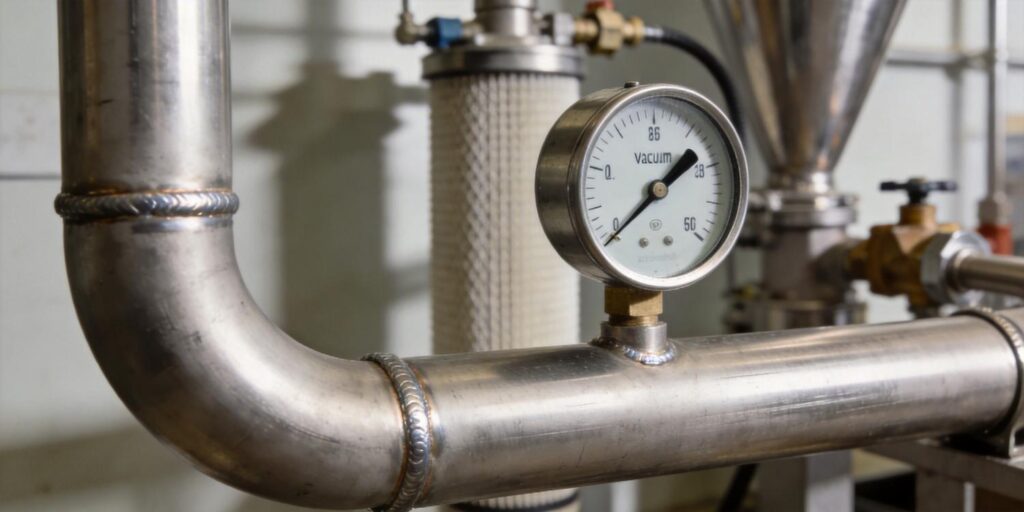
Vacuum gauge readings are only as accurate as the physical location and connection to the chamber. Even the most precise transmitter will report erroneous values if installed where pressure differs from the process volume. In thin-film deposition, metallurgy, and freeze-drying systems, engineers commonly encounter three installation-related errors that the Poseidon VG-SP205 Pirani Vacuum Transmitter and VG-SM225 Cold Cathode Vacuum Gauge are specifically engineered to minimize.
First, mounting directly at a pump port or high-conductance manifold creates a systematic offset. Gas flow during pump-down produces a pressure gradient; the gauge may read 20–50 % lower than the actual chamber center. Best practice: install on a dedicated KF16 or KF25 port on the chamber wall or use a short standoff tube (300–600 mm) to average the true process volume. Both Poseidon gauges support any orientation—no preferred mounting direction—so placement flexibility is complete.
Second, thermal gradients from heaters or plasma sources cause local heating. The VG-SP205’s platinum filament and the VG-SM225’s electrodes operate optimally at 15–50 °C. Exceeding this limit introduces uncompensated drift. Solution: use water-cooled flanges or radiation shields; keep the gauge head at least 300 mm from hot zones. Poseidon’s compact footprint fits tight spaces where larger legacy gauges cannot.
Third, poor sealing or loose KF clamps introduce virtual leaks. Both models achieve <10⁻¹¹ Pa·m³/s with standard centering rings and O-rings. Always torque clamps to specification (10–15 Nm) and perform a pressure-rise leak test immediately after installation. These simple steps eliminate the most common source of apparent base-pressure drift before it affects process control.
Field data from mass-spectrometer OEMs and vacuum-furnace retrofits confirm that proper installation alone reduces total measurement error by 30–40 % compared with “quick-and-dirty” mounting.
Environmental Factors: Mastering Temperature, Gas Composition, and Contamination Effects
Vacuum is never empty—temperature, residual gases, and surface contamination constantly influence gauge output. Understanding and mitigating these factors is essential for repeatable results.
Temperature Compensation
Pirani gauges are inherently sensitive to ambient temperature because heat transfer depends on both pressure and thermal gradients. The VG-SP205 employs dual circuit-plus-algorithm compensation, holding readings stable across its entire 15–50 °C operating range. Without this, a 10 °C shift can introduce ±30 % error at the low end of the range. Cold-cathode gauges exhibit milder thermal drift, but Poseidon’s design keeps the magnet and electrodes within spec.
Gas-Composition Dependence
Different gases conduct heat or ionize at different rates. The VG-SP205 is factory-calibrated for air/nitrogen; water vapor (common in freeze-drying) produces a deliberate positive offset that engineers exploit for sublimation endpoint detection. In reactive sputtering (Ar + O₂), cross-check against a capacitance manometer. The VG-SM225 ion-current response is also gas-dependent but remains linear across its 10⁻³ to 10⁻⁷ Torr range. For critical processes, establish a gas-specific correction factor during initial qualification—both Poseidon transmitters support unit scaling (Torr/mbar/Pa) via customizable RS232 to match your recipe.
Contamination Control
Metal vapors, pump oil, and carbon deposits are the leading causes of long-term drift. The VG-SP205’s sealed platinum filament tolerates clean environments for 3–5 years with zero maintenance. The VG-SM225’s removable sensor head allows quick electrode cleaning (500-grit sandpaper, 2 minutes per plate) without breaking the vacuum envelope. Schedule cleaning when ignition time exceeds 5 minutes at 10⁻⁶ Torr or readings drop one decade—restoring original performance in under 10 minutes.
Always vent with 99.999 % dry nitrogen through a 0.5 µm filter and limit rise rate to <200 Torr/s. These environmental controls keep total measurement uncertainty below ±15 % across thousands of cycles.
Signal Interference: Shielding and Wiring Practices for Clean Analog and Digital Output
Industrial environments are electrically noisy. Heater currents, RF plasma, and motor drives can couple into gauge cables, producing jitter on the 0–10 V analog output or corrupted RS232 frames. Poseidon transmitters incorporate robust filtering, yet proper installation practices eliminate residual interference.
Route signal cables at least 30 cm from high-current heater leads and use shielded twisted-pair wiring for the RJ45 connector. Ground the shield at one end only (controller side) to avoid ground loops. The industry-standard RJ45 connector on both gauges mates directly with most PLC and SCADA systems; optional DB9/DB15 adapters are available for legacy harnesses.
For the VG-SM225, the 100-gauss neodymium magnet is localized—maintain >10 cm separation from magnetic-sensitive components or personnel. The built-in high-voltage protection circuit automatically disables the 2000 V supply above 10⁻³ Torr, preventing false readings during roughing.
In digital mode, the fully customizable RS232 protocol allows embedding status flags (high-voltage active, sensor ready) and error codes. Disable software averaging during fast transients to preserve true response time (<300 ms for Pirani, <1 s for cold cathode once lit). These steps reduce noise-induced error to <0.1 % full scale, delivering clean data for PID control loops and batch records.
Calibration Plan: Factory-Trusted Mapping Plus Smart Verification Protocols
Field calibration of thermal-conductivity or cold-cathode gauges is impractical for most industrial users. Poseidon transmitters ship with permanent factory mappings established against NIST-traceable standards. These mappings remain valid for the instrument lifetime when proper installation, venting, and cleaning procedures are followed.
Implement a three-tier verification plan:
- Daily/Shift Check: Compare gauge reading with a reference capacitance manometer at one known process pressure (e.g., 100 mTorr). Record offset in your CMMS.
- Quarterly Functional Test: Perform a pressure-rise leak test and confirm ignition time (VG-SM225) or output stability (VG-SP205). No adjustment required if within ±15 %.
- Annual or Post-Event Review: After major contamination events, electrode cleaning, or three consecutive out-of-spec leak tests, return the gauge for factory re-mapping. Most users never need this step.
The VG-SP205’s temperature-compensation algorithm and the VG-SM225’s software interlocks eliminate the drift mechanisms that force frequent recalibration in older designs. Cross-checking with a capacitance manometer during process pressure further validates the thermal-conductivity offset as a sensitive moisture indicator—turning a potential error source into a process-control asset.
This plan satisfies FDA 21 CFR 211, AMS 2759, and ISO 9001 requirements while keeping gauges in specification without expensive field standards or downtime.
CTA
Measurement errors in vacuum systems are rarely caused by the gauge itself—they result from installation, environment, interference, or overlooked verification. The Poseidon VG-SP205 Pirani Vacuum Transmitter and VG-SM225 Cold Cathode Vacuum Gauge are engineered to minimize every one of these sources: temperature-compensated output, cleanable electrodes, robust RJ45/RS232 interfaces, automatic high-voltage protection, and factory mappings that stay accurate for years.
Explore the VG-SP205 Pirani Vacuum Transmitter for fast, maintenance-free rough-to-medium vacuum monitoring and the VG-SM225 Cold Cathode Vacuum Gauge (PTR225N compatible) for linear high-vacuum performance down to 10⁻⁷ Torr.
Ready to slash measurement uncertainty in your system? Send us your current gauge model, installation photos, and process pressure band. Our applications team will return a free error-audit checklist, custom RS232 protocol sample (5–10 unit minimum), and side-by-side performance data versus INFICON, MKS, or domestic alternatives. Contact us today and transform potential measurement errors into reliable, repeatable process data—while cutting instrumentation costs by 40–60 %.


