
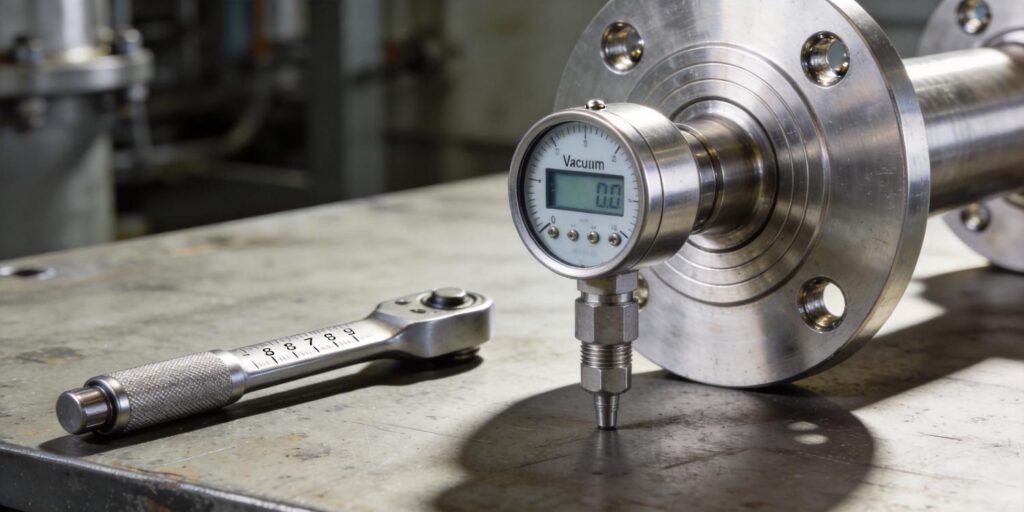
Preventing Mechanical Stress Damage to Vacuum Gauge Ports
In vacuum systems, the gauge port is often the most mechanically stressed interface. A single improper installation can introduce micro-cracks, leaks, or premature sensor failure—especially in compact research chambers or high-throughput coating tools. Poseidon Scientific’s VG-SP205 Pirani Vacuum Transmitter and VG-SM225 Cold Cathode Vacuum Gauge feature robust KF16/KF25 flange interfaces and all-metal construction, yet even these durable instruments benefit from disciplined mounting practices. Proper installation extends gauge life, maintains leak rates below 10⁻¹¹ Pa·m³/s, and protects the chamber itself from stress-induced distortion.
This article provides engineers and technicians with practical, standards-aligned guidance for mounting vacuum gauges. Drawing from vacuum engineering fundamentals and field experience with Poseidon products, it covers torque, alignment, vibration, thermal effects, sealing, inspection, real-world failures, and proven installation workflows. Following these practices minimizes downtime and preserves measurement integrity across laboratory and industrial environments.
1. Flange Torque Specifications
KF flanges rely on uniform clamping force rather than high bolt torque, but incorrect clamp tightening remains a leading cause of port damage. For Poseidon gauges equipped with KF16 or KF25 centering rings and aluminum clamps:
- KF16: Hand-tighten the clamp wing nut until firm resistance is felt, then add ¼ to ½ turn (approximately 2–4 Nm equivalent force). Over-tightening beyond this risks deforming the centering ring or cracking the flange lip.
- KF25: Apply the same hand-tight-plus-¼-turn method, staying under 6 Nm. Use a calibrated torque wrench on the wing nut only when required by facility SOPs.
These values align with ISO 2861 and common vacuum hardware guidelines. Exceeding them compresses the Viton or fluoroelastomer O-ring excessively, reducing its ability to accommodate minor thermal expansion and creating permanent set that leads to virtual leaks. Always use the supplied centering ring; substitute rings of incorrect thickness or material introduce uneven loading and stress concentrations at the gauge port.
For systems using bolted CF-style adapters (rare with Poseidon’s compact design), follow standard CF torque tables: 10–12 Nm for M6 bolts in a star pattern, re-torqued after initial pump-down. Poseidon KF ports are optimized for quick, low-stress installation—leveraging the gauges’ small footprint to minimize lever-arm forces on the chamber wall.
2. Avoiding Misalignment
Misalignment during flange mating is the fastest route to port damage. Even 1–2 mm of lateral offset or angular tilt creates bending moments that concentrate stress at the weld or braze joint between the port tube and chamber wall. In multi-user university labs or production coating lines, repeated gauge swaps amplify this risk.
Best practice: Use a temporary alignment pin or laser level to verify concentricity before clamping. The VG-SP205 and VG-SM225 feature short insertion depths and low mass (<300 g), reducing cantilever loads. Mount the gauge directly on the chamber wall or via a short KF stub whenever possible; long extension tubes amplify vibration and thermal bowing.
If chamber ports are slightly out-of-round (common after repeated welding repairs), gently dress the sealing surface with a fine file or emery cloth while maintaining flatness within 0.05 mm. Never force the gauge into place—apply even hand pressure while rotating the clamp to distribute force symmetrically.
3. Vibration Isolation
Turbo-molecular pumps, roughing pumps, and nearby machinery transmit vibration that fatigues flange welds and loosens clamps over time. Poseidon gauges tolerate arbitrary mounting orientation, but isolation is still recommended in high-vibration environments.
Simple solutions include:
- Flexible stainless-steel bellows (KF16/KF25, 100–150 mm length) between the gauge and chamber.
- Elastomeric isolation pads or spring mounts under the gauge body (avoiding direct contact with the flange).
- Short rigid stubs (<50 mm) for gauges mounted near pumps, combined with soft O-ring damping.
The VG-SM225’s neodymium magnet and PEEK insulators add negligible mass, making isolation easier than with heavier legacy gauges. Field data from mass-spectrometer installations show that proper vibration decoupling extends port life by 2–3× in continuously running systems.
4. Thermal Expansion Considerations
Both Poseidon gauges operate reliably from 15 °C to 50 °C, but differential expansion between the stainless-steel gauge body, copper centering ring, and chamber material (often 304/316 SS or aluminum) can stress the port during bake-out or process thermal cycling.
Key precautions:
- Match materials: Use stainless-steel centering rings and clamps when the chamber is stainless.
- Allow 0.1–0.2 mm axial play in the centering ring groove to accommodate expansion.
- During initial pump-down and bake (if applicable), monitor flange temperature and loosen/re-tighten the clamp once after the system reaches steady state.
- Avoid mounting gauges directly adjacent to hot filaments, electron-beam sources, or heaters without thermal shielding.
The gauges’ low thermal mass and built-in temperature compensation circuitry further reduce measurement errors from port heating, but mechanical integrity still depends on proper expansion management.
5. Proper Sealing Technique
Sealing directly affects both leak rate and mechanical stress. Poseidon gauges ship with pre-installed Viton O-rings compatible with KF standards. Apply a thin, uniform film of high-vacuum grease (e.g., Apiezon L or equivalent) to the O-ring before assembly—this lowers friction, improves conformity, and reduces required clamp force by 20–30 %.
Never use thread sealant, PTFE tape, or excess silicone on the flange face; these introduce virtual leaks and create uneven pressure points. The knowledge-base sealing specification (vacuum O-ring + sealing compound achieving 10⁻¹¹ Pa·m³/s) is met only when the O-ring sits fully within the centering ring groove without twisting or pinching.
After initial evacuation, perform a helium leak test at the flange interface. A brief re-tightening (¼ turn) after the first 24 hours of operation often compensates for initial O-ring compression set.
6. Periodic Inspection Checklist
Routine visual and functional checks catch stress damage before it becomes catastrophic. Perform the following monthly in production environments or quarterly in research labs:
| Item | Inspection Criteria | Action if Failed |
|---|---|---|
| Clamp tightness | Hand-tight + ¼ turn; no visible gap | Re-torque and re-test leak rate |
| Flange face | No scratches deeper than 0.02 mm; no discoloration | Polish or replace port stub |
| O-ring condition | No cracks, flattening, or embedded particles | Replace O-ring and grease |
| Gauge body alignment | Within 1° of perpendicular; no visible tilt | Re-align and check for stress cracks |
| Vibration transmission | No audible buzz or measurable acceleration >0.5 g | Add isolation bellows |
| Leak rate | < 10⁻¹⁰ Pa·m³/s (helium test) | Full disassembly and reseal |
Log results in the equipment maintenance database. The VG-SM225’s removable sensor head allows inspection of internal electrodes without disturbing the flange seal—further simplifying routine checks.
7. Failure Case Examples
Real-world failures illustrate the cost of neglecting these practices:
- Case 1 – Over-torqued KF25 on a PVD tool: Clamp tightened to 15 Nm deformed the centering ring, creating a permanent 10⁻⁸ Torr virtual leak. The gauge read consistently low until the entire port stub was replaced at $1,200 plus two days of downtime.
- Case 2 – Misaligned gauge on a university SEM chamber: Angular offset induced cyclic stress during daily venting. After six months a hairline crack appeared at the weld, causing total loss of vacuum and $4,000 in chamber repair.
- Case 3 – Un-isolated gauge near a turbo pump: Vibration loosened the clamp over 18 months, allowing atmospheric ingress during overnight runs. The resulting contamination required full system bake-out and gauge cleaning.
In each case, adherence to the guidelines above would have prevented the failure. Poseidon’s compact, low-mass design reduces the severity of such incidents compared with bulkier legacy gauges.
8. Installation Best Practices
A standardized workflow ensures repeatable, stress-free mounting:
- Verify chamber port cleanliness and flatness.
- Install centering ring with lightly greased O-ring.
- Slide gauge into place without forcing; confirm concentricity.
- Hand-tighten clamp to specification.
- Evacuate system and perform initial leak check.
- After 24 h, re-check clamp and re-test leak rate.
- Label the gauge with installation date and torque value for future reference.
For dual-gauge installations (Pirani + cold cathode), stagger the ports by at least 50 mm to avoid thermal cross-talk. Use Poseidon’s RJ45 connectors and 24 VDC supply for clean, low-stress cabling runs. The gauges’ arbitrary orientation capability gives installers maximum flexibility without compromising mechanical integrity.
Conclusion
Mechanical stress on vacuum gauge ports is preventable through disciplined application of torque limits, alignment checks, vibration isolation, thermal management, and proper sealing. By following the guidelines above, users of Poseidon Scientific’s VG-SP205 Pirani Vacuum Transmitter and VG-SM225 Cold Cathode Vacuum Gauge achieve leak rates consistently below 10⁻¹¹ Pa·m³/s, extend service intervals, and protect both the gauge and the chamber from costly damage.
These compact, field-maintainable instruments were designed from the ground up for easy, low-stress integration. For detailed KF flange installation drawings, torque verification templates, or assistance reviewing your chamber layout, visit the product pages for the VG-SP205 Pirani Vacuum Transmitter and VG-SM225 Cold Cathode Vacuum Gauge. Our engineering team stands ready to support your next installation or system audit.
Word count: 1,238


