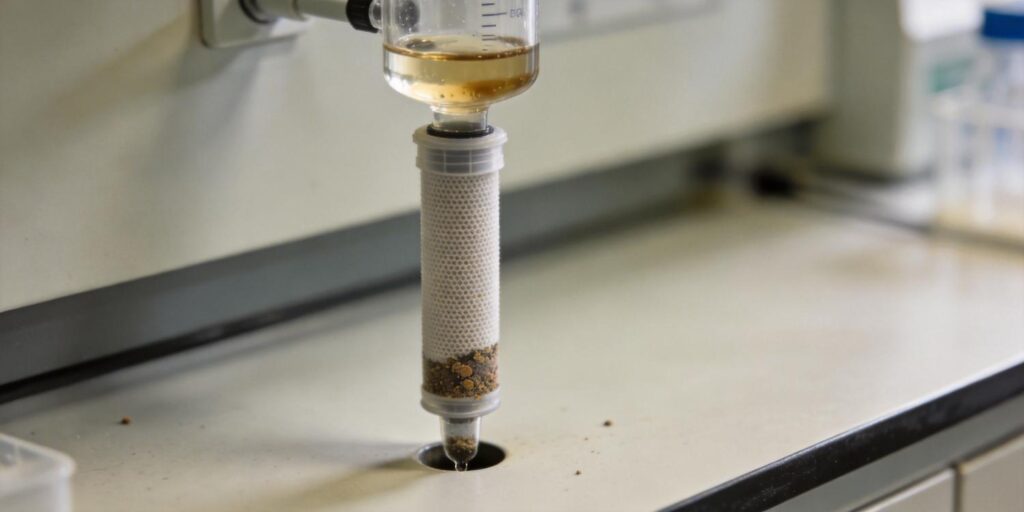
Matrix effects in LC-MS analysis represent one of the most persistent challenges in analytical chemistry, particularly when solid-phase extraction (SPE) cleanup fails to deliver the expected signal enhancement. As Dr. Xu, product manager at Poseidon Scientific, I’ve observed countless cases where laboratories struggle with residual matrix suppression despite implementing SPE protocols. This comprehensive troubleshooting guide examines why matrix effects persist and provides systematic solutions for achieving cleaner extracts and more reliable LC-MS results.
Understanding Matrix Effects in LC-MS Analysis
Matrix effects occur when co-eluting compounds from the sample matrix interfere with the ionization process in the mass spectrometer, leading to either signal suppression or enhancement. These effects are particularly problematic in LC-MS analysis because they can compromise method accuracy, precision, and sensitivity. The fundamental issue lies in the competition for charge during electrospray ionization, where matrix components can either inhibit or enhance analyte ionization.
Research indicates that matrix effects are not uniform across all analytes or matrices. As noted in forensic applications, “the matrix that contains your analyte is a factor in determining the capacity of your column. The sample matrix can compete with the analyte” (Forensic and Clinical Applications of Solid Phase Extraction). This competition extends beyond simple capacity issues to complex interactions that affect ionization efficiency.
Sources of Matrix Interference After SPE Cleanup
Even after seemingly successful SPE cleanup, several factors can contribute to persistent matrix effects:
Incomplete Removal of Phospholipids and Lipids
Phospholipids are notorious for causing matrix effects in biological samples. These compounds often co-elute with analytes and can significantly suppress ionization. Traditional reversed-phase SPE methods may not adequately remove phospholipids due to their amphiphilic nature.
Residual Proteins and Peptides
Protein residues that survive SPE cleanup can cause significant matrix effects. As documented in SPE literature, “polar solvents will disrupt H and pi bonds, the primary polar bonding mechanisms” (Forensic and Clinical Applications of Solid Phase Extraction). However, incomplete protein removal remains a common issue, particularly with complex biological matrices.
Ionic Interferences
Salts and ionic compounds can persist through SPE cleanup and interfere with ionization. The Waters Oasis catalog notes that mixed-mode sorbents provide “best reduction of matrix effects” through their dual retention mechanisms, highlighting the importance of addressing ionic interferences specifically.
Matrix-Induced Sorbent Deactivation
Complex matrices can “poison” the sorbent surface, reducing its effectiveness for subsequent samples. This phenomenon is particularly problematic in high-throughput environments where multiple samples are processed sequentially.
Evaluating Wash Step Strength
The wash step is critical for removing matrix interferences while retaining target analytes. Many laboratories use wash solvents that are too weak, allowing interfering compounds to remain on the sorbent.
Optimizing Wash Solvent Composition
According to SPE optimization guidelines, “the best approach toward using SPE of sorbents is to search for a solvent mixture that will wash the most interferences from the sorbent without loss of analyte” (Forensic and Clinical Applications of Solid Phase Extraction). This requires systematic testing of wash solvent strength, typically starting with 5-10% organic content and gradually increasing until analyte breakthrough is observed.
pH Considerations in Wash Steps
Wash pH dramatically affects cleanup efficiency. For ionizable compounds, maintaining proper pH during washing is essential. The literature emphasizes that “wash pH may greatly affect cleanup and/or recovery. Keep analyte and sorbent pKa in mind if applicable” (Forensic and Clinical Applications of Solid Phase Extraction).
Volume and Flow Rate Optimization
Safe wash volumes vary by sorbent mass, with typical guidelines suggesting 2.5 mL for 100 mg sorbents and 25 mL for 1000 mg sorbents (Forensic and Clinical Applications of Solid Phase Extraction). Flow rates should be controlled to ensure adequate contact time between wash solvent and sorbent.
Adjusting pH Conditions for Better Selectivity
pH manipulation is one of the most powerful tools for improving SPE selectivity and reducing matrix effects.
Analyte pKa Considerations
Understanding analyte pKa values is essential for optimizing pH conditions. For ion-exchange SPE, maintaining a pH at least 2 units away from the relevant pKa ensures proper ionization states for both analyte and sorbent.
Matrix pH Adjustment
Sample pretreatment often involves pH adjustment to optimize analyte retention. As noted in method development strategies, “the pH of the sample and that of the sorbent should be equivalent for optimal binding” (Forensic and Clinical Applications of Solid Phase Extraction). This alignment maximizes retention efficiency while minimizing matrix interference.
Wash and Elution pH Optimization
pH adjustments during wash and elution steps can significantly improve selectivity. For cation exchange procedures, “elution solvents often utilize ammonium hydroxide to reverse the ionic state of the drugs with subsequent release from ionic bonds” (Forensic and Clinical Applications of Solid Phase Extraction). Proper pH control during these steps is critical for minimizing matrix effects.
Testing Alternative Sorbent Chemistries
When traditional reversed-phase sorbents fail to adequately reduce matrix effects, alternative chemistries often provide solutions.
Mixed-Mode Sorbents
Mixed-mode sorbents combine reversed-phase and ion-exchange functionalities, offering orthogonal selectivity. Waters research shows that mixed-mode sorbents provide “cleanest extracts” and “best reduction of matrix effects” (Waters Oasis Catalog). Poseidon Scientific’s MCX (mixed-mode cation exchange) and MAX (mixed-mode anion exchange) cartridges are specifically designed to address persistent matrix effects through dual retention mechanisms.
Hydrophilic-Lipophilic Balanced (HLB) Sorbents
HLB sorbents like Poseidon Scientific’s HLB cartridges offer balanced retention for acids, bases, and neutrals. Their water-wettable nature allows direct loading of aqueous samples without sacrificing recovery, potentially reducing matrix effects associated with conditioning issues.
Specialty Sorbents for Specific Matrices
Certain matrices require specialized sorbents. For example, WAX (weak anion exchange) sorbents are particularly effective for strong acids (pKa < 1), while WCX (weak cation exchange) sorbents excel with strong bases (pKa > 10).
Experimental Design for Troubleshooting Matrix Suppression
Systematic troubleshooting requires careful experimental design to identify the root causes of persistent matrix effects.
Post-Column Infusion Experiments
Post-column infusion with analyte standard while injecting extracted blank matrix helps visualize matrix effects across the chromatographic run. This technique identifies regions of significant suppression or enhancement.
Standard Addition Method
Adding known concentrations of analyte to pre-extracted matrix samples helps quantify matrix effects. Comparing response in matrix versus neat solvent provides quantitative assessment of suppression/enhancement.
Fraction Collection Studies
Collecting fractions during SPE elution and analyzing each separately helps identify which fractions contain the most problematic matrix components. This information guides optimization of wash and elution conditions.
Design of Experiments (DOE)
DOE approaches efficiently evaluate multiple variables simultaneously, including sorbent type, wash composition, pH conditions, and flow rates. This systematic approach identifies optimal conditions while minimizing experimental runs.
Verifying Improvements Through Validation Experiments
Once troubleshooting identifies potential solutions, rigorous validation ensures method robustness.
Recovery and Matrix Effect Assessment
Calculate absolute and relative matrix effects using established protocols. The FDA Bioanalytical Method Validation guidelines provide frameworks for assessing matrix effects in validated methods.
Precision and Accuracy Testing
Evaluate method precision and accuracy across multiple matrix lots to ensure consistent performance. Include at least six different matrix sources to assess variability.
Stability Studies
Assess analyte stability in the final extract and during sample processing. Matrix components can catalyze degradation reactions that might be misinterpreted as matrix effects.
Cross-Validation with Reference Methods
When possible, cross-validate results with established reference methods or alternative sample preparation techniques to confirm that matrix effect reductions are genuine improvements.
Conclusion
Persistent matrix effects after SPE cleanup typically result from incomplete removal of specific matrix components, suboptimal method conditions, or inappropriate sorbent selection. By systematically evaluating wash step strength, pH conditions, and sorbent chemistry, laboratories can significantly reduce matrix effects and improve LC-MS method performance.
As the SPE product manager at Poseidon Scientific, I recommend starting troubleshooting with a thorough assessment of current method conditions, followed by systematic testing of alternative approaches. Our MCX, MAX, and HLB cartridges offer specialized solutions for challenging matrix effect scenarios, while our 96-well SPE plates enable high-throughput method optimization.
Remember that optimal SPE method development balances recovery, selectivity, and cleanliness. As noted in forensic applications, “recovery is a relative asset to overall extraction performance. In an optimized method, recovery is a balance between sensitivity and selectivity” (Forensic and Clinical Applications of Solid Phase Extraction). Sometimes accepting slightly lower recovery in exchange for significantly reduced matrix effects represents the optimal compromise for reliable LC-MS analysis.