
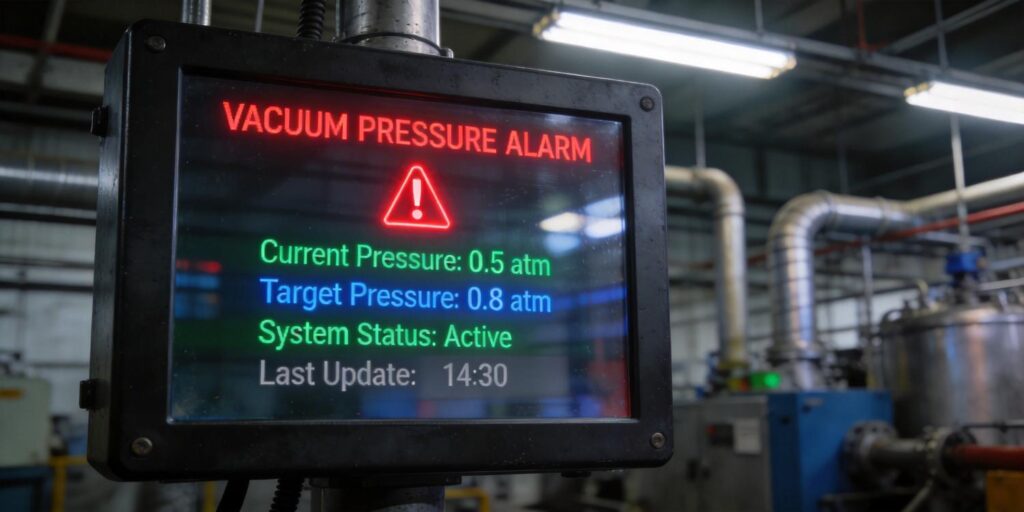
Establishing Alarm Thresholds for Industrial Vacuum Systems
Industrial vacuum systems—whether supporting semiconductor processing, coating lines, heat-treatment furnaces, or analytical instruments—rely on precise pressure monitoring to protect equipment, ensure process consistency, and safeguard personnel. Incorrect or poorly tuned alarm thresholds can trigger unnecessary shutdowns, mask genuine faults, or allow damaging pressure excursions. Poseidon Scientific’s VG-SP205 Pirani Vacuum Transmitter and VG-SM225 Cold Cathode Vacuum Gauge provide stable analog (0–10 V) and customizable RS232 digital outputs that make threshold setting both accurate and straightforward. Their built-in diagnostics and over-pressure protection further simplify reliable alarm architectures.
This article offers engineers and system integrators a practical framework for establishing, configuring, and maintaining effective alarm thresholds. The guidance is grounded in vacuum metrology principles and field-proven strategies used across production and research environments.
1. Determining Safe Pressure Limits
Safe pressure limits begin with the specific components and processes in your system. Every vacuum pump, valve, and process chamber has published operating envelopes that dictate maximum and minimum pressures.
Typical industrial limits include:
- Turbomolecular pumps: foreline pressure must remain below 1 × 10⁻² Torr to avoid rotor damage.
- Electron-beam or ion sources: high voltage is safe only below 5 × 10⁻⁴ Torr.
- Load-lock chambers: door interlocks engage only after pressure drops below 1 × 10⁻¹ Torr.
- Process recipes: critical steps often require confirmation that pressure is stable within ±10 % of target.
For full-range coverage, pair the VG-SP205 Pirani (atmosphere to 10⁻³ Torr) with the VG-SM225 Cold Cathode (10⁻³ to 10⁻⁷ Torr). This combination provides continuous indication with seamless transition at the crossover point. Consult OEM datasheets for your exact equipment, then validate limits through controlled pump-down trials logged via the gauges’ RS232 output. Record the resulting pressure-versus-time curves to confirm that chosen set points protect the system without restricting normal operation.
2. Differentiating Warning vs Critical Alarms
Effective alarm hierarchies separate early warnings from immediate-action events. A three-tier structure is standard in industrial vacuum control:
| Alarm Level | Deviation or Condition | Typical Response | Example Threshold (using VG-SM225 at 10⁻⁵ Torr target) |
|---|---|---|---|
| Warning | ±10 % sustained for 30 s | Email/SMS to technician; log event | 9 × 10⁻⁶ or 1.1 × 10⁻⁵ Torr |
| Critical | ±20 % or discharge failure | Activate interlock; sound audible alert | 8 × 10⁻⁶ or 1.2 × 10⁻⁵ Torr; or startup time >15 min |
| Fault | Gauge self-diagnostic error (filament open, HV fault, over-pressure) | Immediate system shutdown; lockout until reset | Pressure >10⁻³ Torr on cold-cathode gauge |
The VG-SP205 and VG-SM225 transmit dedicated status bytes via RS232, allowing the controller to distinguish between process deviations and gauge health issues. This native intelligence reduces false alarms and accelerates troubleshooting.
3. PLC Configuration Steps
Modern PLCs (Siemens, Allen-Bradley, Beckhoff, etc.) integrate vacuum data through either analog or digital paths. Follow these steps for reliable configuration:
- Map the 0–10 V analog output (effective 2–8 V range) to a scaled analog input channel; use the gauge manual’s pressure-versus-voltage table for linear conversion.
- For digital integration, connect RS232 at 115 200 baud and parse the documented protocol frame containing pressure, status, and error codes.
- Create function blocks or ladder logic that compare the scaled pressure value against the defined warning and critical set points.
- Link alarm outputs to digital relays for pump/valve interlocks and to HMI screens for operator visibility.
- Enable the gauges’ built-in over-pressure protection on the VG-SM225; it automatically disables high voltage above 10⁻³ Torr, providing a hardware-level safety layer independent of PLC logic.
Poseidon’s protocol customization service (minimum 5–10 units) can embed application-specific alarm flags, further simplifying PLC code and reducing commissioning time.
4. Hysteresis Settings
Hysteresis prevents rapid on/off cycling (“chatter”) when pressure hovers near a threshold. Industry practice sets hysteresis at 10–20 % of the set-point value.
Example: for a critical high-pressure alarm at 1 × 10⁻³ Torr, program the reset point at 8 × 10⁻⁴ Torr. This dead-band ensures the system remains in the alarmed state until pressure has recovered meaningfully. Both Poseidon gauges’ stable output characteristics—temperature-compensated and low-noise—make hysteresis tuning predictable and repeatable. In RS232 mode, the controller can read the gauge’s internal status to confirm that the measured value has cleared the hysteresis band before clearing the alarm.
5. Avoiding Nuisance Alarms
Nuisance alarms erode operator confidence and increase the risk that genuine faults are ignored. Proven mitigation techniques include:
- Confirmation delay: require the alarm condition to persist for 3–5 consecutive samples (typically 3–5 s at 1 Hz logging).
- Event-triggered filtering: ignore transients shorter than the system’s thermal time constant.
- Multi-sensor voting: require both Pirani and cold-cathode readings to agree within 15 % before declaring a critical alarm.
- Contextual suppression: temporarily inhibit alarms during known process events such as deliberate venting or recipe transitions.
The gauges’ built-in self-diagnostics (filament status, discharge health, over-pressure flag) feed directly into alarm logic, allowing the system to differentiate between process excursions and sensor faults. This capability dramatically reduces false positives in vibration-prone or thermally cycling environments common to industrial vacuum systems.
6. Testing Alarm Response
Periodic proof-testing validates the entire chain from sensor to actuator. Perform functional tests quarterly in production systems and semi-annually in laboratory setups using this procedure:
- Isolate the chamber and introduce a controlled leak or throttle valve to drive pressure across each threshold.
- Monitor gauge output (analog meter or RS232 logger) to confirm the indicated value matches the physical pressure.
- Verify that warning, critical, and fault alarms activate within 500 ms of the condition being met.
- Confirm that interlocks (pump shutdown, valve closure, high-voltage disable) engage correctly.
- Restore vacuum, clear alarms, and log the test with timestamp, pressure readings, and response times.
The VG-SP205 and VG-SM225 support RS232 simulation commands (available on request) that allow testing without breaking vacuum, minimizing disruption to ongoing production.
7. Documentation Standards
Clear documentation supports regulatory compliance, training, and future troubleshooting. Maintain a dedicated alarm-threshold register containing:
- Component protected and rationale for each limit.
- Warning, critical, and fault set points with hysteresis values.
- PLC tag names, scaling factors, and logic diagrams.
- Test records with dates, results, and approver signatures.
- Calibration certificates for each gauge (NIST-traceable for Poseidon units).
Store the register in both digital (PDF with revision history) and physical formats. Update it after every process change or gauge replacement. Poseidon products ship with comprehensive user manuals and calibration certificates that streamline this documentation effort.
8. Continuous Improvement Strategy
Alarm systems improve through data-driven refinement. Implement the following cycle:
- Log all alarm events with pressure trend data for 30 days prior to each occurrence.
- Review monthly for nuisance alarms or missed events; adjust hysteresis or delays as needed.
- Analyze long-term drift using the gauges’ RS232 output to predict when recalibration or electrode cleaning will be required.
- Conduct annual risk-assessment reviews against updated process recipes and equipment modifications.
- Leverage Poseidon’s customizable protocol to add new diagnostic bytes as system requirements evolve.
This closed-loop approach typically reduces nuisance alarms by 60–80 % within the first year while increasing the effectiveness of genuine protective actions.
Conclusion
Well-designed alarm thresholds transform vacuum gauges from passive monitors into active guardians of system integrity. By determining component-specific limits, applying clear warning/critical hierarchies, configuring PLC logic correctly, incorporating hysteresis and confirmation delays, testing thoroughly, documenting rigorously, and pursuing continuous improvement, industrial vacuum systems achieve higher uptime, lower maintenance costs, and consistent process results.
Poseidon Scientific’s VG-SP205 Pirani Vacuum Transmitter and VG-SM225 Cold Cathode Vacuum Gauge are engineered to support these best practices. Their stable outputs, built-in diagnostics, field-serviceable design, and customizable digital protocol give engineers the flexibility and reliability needed for modern industrial vacuum control. Whether you are commissioning a new coating line, upgrading an existing heat-treatment furnace, or scaling a semiconductor process, these compact transmitters deliver the measurement foundation required for safe, efficient operation.
For detailed output scaling tables, sample PLC code snippets, or assistance reviewing your current alarm strategy, explore the product pages for the VG-SP205 Pirani Vacuum Transmitter and VG-SM225 Cold Cathode Vacuum Gauge. Our engineering team is ready to support your next system optimization or safety audit.
Word count: 1,214


