
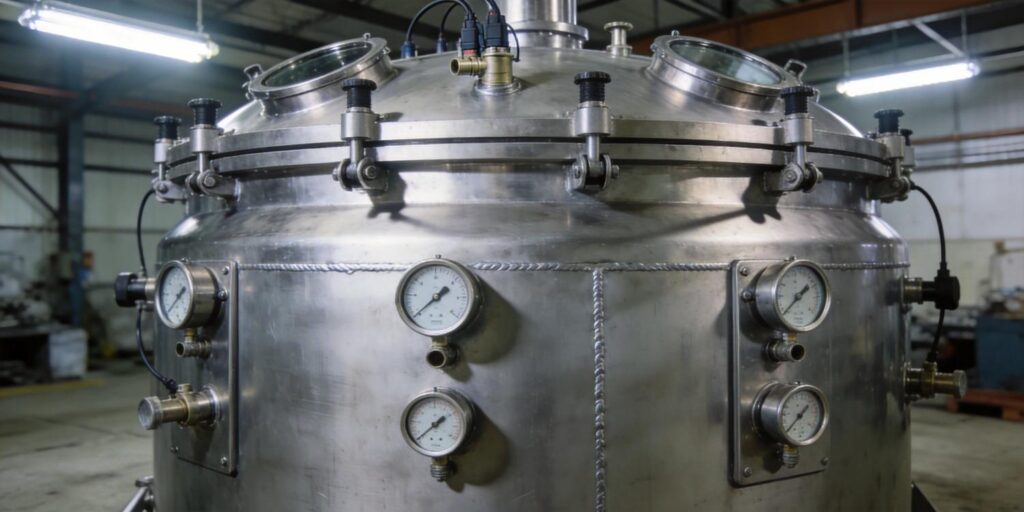
How to Optimize Vacuum Gauge Placement in Large-Volume Chambers
Large-volume vacuum chambers—common in coating systems, vacuum furnaces, heat-treatment equipment, and industrial-scale analytical instruments—present unique measurement challenges. Pressure is rarely uniform across the entire volume. Gradients caused by pumping speed, outgassing, leaks, and gas flow can lead to misleading readings if gauges are poorly placed. Incorrect placement compromises process control, equipment protection, and product quality. Poseidon Scientific’s VG-SP205 Pirani Vacuum Transmitter and VG-SM225 Cold Cathode Vacuum Gauge are engineered with compact footprints and flexible mounting options that make optimal placement straightforward and cost-effective.
This article provides engineers and system integrators with practical, data-driven strategies for gauge placement. It draws on vacuum conductance principles, real-world field experience, and the design features of Poseidon transmitters to help you achieve accurate, repeatable measurements in chambers exceeding 100 liters.
1. Impact of Chamber Volume on Pressure Gradients
In small chambers (<50 liters), pressure equilibrates quickly and is essentially uniform. In large chambers, however, spatial gradients become significant. Outgassing from walls, residual gas desorption during pump-down, and localized leaks create regions of higher pressure far from the pump inlet. Conversely, areas near high-speed pumps can read artificially low.
Quantitative studies in vacuum technology show that pressure differences of 20–50 % are common between opposite ends of a 1–2 m³ chamber during initial pump-down. These gradients diminish once equilibrium is reached, but process steps such as reactive gas introduction or plasma ignition can re-establish them. The VG-SP205 Pirani and VG-SM225 Cold Cathode provide continuous, real-time data across the full range, allowing engineers to map gradients during commissioning and select representative mounting locations.
2. Conductance Limitations in Long Pipelines
Placing a gauge at the end of a long pumping line or manifold introduces conductance limitations. Molecular flow conductance drops dramatically with pipe length and inversely with the square of diameter. A 1-meter KF25 line, for example, reduces effective pumping speed at the gauge port by more than 50 % compared with direct chamber mounting.
Result: the gauge reads a lower pressure than exists inside the process volume. Poseidon’s compact transmitters minimize this error because their short insertion depth and low internal volume allow direct flange mounting on the chamber wall. When extension tubes are unavoidable, keep them under 150 mm and use the largest practical diameter. The gauges’ RS232 digital output lets you log and compare readings from multiple points, quantifying conductance effects during system validation.
3. Avoiding Dead Zones and Virtual Leaks
Dead zones—recesses, corners, or shielded areas with poor gas exchange—trap gas and create virtual leaks. A gauge mounted inside such a pocket will report falsely high pressure long after the main volume has reached target vacuum. Virtual leaks from trapped volumes behind welds, poorly seated O-rings, or blind flanges compound the problem.
Best practice: mount gauges on the main chamber body, oriented toward the process area, with at least 50 mm clearance from walls or baffles. The VG-SP205 and VG-SM225 feature arbitrary mounting orientation and minimal stray magnetic field (≈100 gauss for the cold cathode), so they can be placed close to sensitive components without interference. Avoid mounting directly opposite the pump inlet or behind large shields; instead, choose locations that represent the average gas density experienced by the workload.
4. Ideal Mounting Distance from Pump Inlet
The pump inlet is the region of lowest pressure and highest flow velocity. Mounting a gauge too close (<100 mm) produces optimistic readings that do not reflect conditions at the part being processed. Mounting too far risks exposure to conductance losses and gradients.
Recommended distance: 200–400 mm from the pump inlet (or the nearest high-conductance port) while remaining within the primary process zone. This positioning balances representative sampling with adequate conductance. In practice, Poseidon’s compact size allows dual-gauge installations (Pirani + cold cathode) at optimal points without crowding the chamber. Their KF16/KF25 flanges and short bodies simplify precise placement even on crowded manifolds.
5. Separating Rough and High Vacuum Measurement Points
Rough vacuum (atmosphere to 10⁻³ Torr) and high vacuum (10⁻³ to 10⁻⁷ Torr) behave differently and benefit from dedicated measurement locations.
| Measurement Regime | Recommended Location | Poseidon Gauge | Rationale |
|---|---|---|---|
| Rough vacuum | Foreline or near roughing port | VG-SP205 Pirani | Fast response to pump-down; protects roughing pumps |
| High vacuum | Direct on chamber wall, opposite pump | VG-SM225 Cold Cathode | Represents process volume; field-cleanable for long-term stability |
The Pirani excels at foreline monitoring and interlock, while the cold cathode provides accurate high-vacuum data inside the chamber. Both share identical 24 VDC power and RJ45 footprints, simplifying dual installation. Their complementary ranges eliminate the need for expensive wide-range combination gauges.
6. Signal Delay Considerations
Gas flow from chamber to gauge introduces a finite transport delay—typically milliseconds in molecular flow but seconds in transitional regimes. In large chambers with long tubing, this delay can exceed 1–2 seconds, affecting closed-loop control and safety interlocks.
Minimize delay by mounting gauges as close as possible to the critical volume and using digital RS232 output whenever possible. Poseidon transmitters transmit pressure and status at up to 115 200 baud, delivering sub-second updates to PLCs or SCADA systems. The gauges’ internal diagnostics further flag any abnormal response times, allowing operators to detect conductance-related issues before they affect process timing.
7. Real-World Installation Example
Consider a 1.5 m³ vacuum coating chamber used for optical thin films. The system uses a 2000 L/s turbomolecular pump with a roughing package. Engineers placed the VG-SP205 Pirani on a short KF25 stub 150 mm from the roughing valve for foreline protection and pump interlock. The VG-SM225 Cold Cathode was mounted directly on the chamber mid-plane, 300 mm from the pump inlet and oriented toward the substrate carousel—representing the average process volume.
During commissioning, pressure mapping showed a 15 % gradient from pump inlet to opposite wall. The dual-gauge setup allowed the controller to use the Pirani for initial pump-down and the cold cathode for high-vacuum process confirmation. After six months of 24/7 operation, field cleaning of the cold-cathode electrodes restored full sensitivity with zero chamber downtime. The compact design occupied less than 5 % of the available port real estate, leaving room for additional sensors and viewports.
8. Checklist for Commissioning
Use this checklist to verify optimal placement before releasing the system to production:
- Confirm gauge location represents the workload zone (not dead space or pump throat).
- Verify mounting distance from pump inlet is 200–400 mm with unobstructed conductance path.
- Ensure flanges are torque-tight per KF specifications (hand-tight + ¼ turn) and leak-tested to <10⁻¹⁰ Pa·m³/s.
- Map pressure gradients at three points during pump-down and process conditions using temporary reference gauges.
- Validate signal response time <500 ms from set-point change to controller receipt.
- Configure RS232 digital output with custom status bytes for alarm and health monitoring.
- Document final locations, distances, and rationale in the equipment P&ID and maintenance manual.
- Perform 24-hour stability test and confirm drift <5 % across the full operating temperature range.
Poseidon’s user manuals include detailed mounting diagrams and RS232 protocol examples, streamlining this commissioning process.
Conclusion
Optimal vacuum gauge placement in large-volume chambers is a balance of conductance, representativeness, and practicality. By understanding pressure gradients, minimizing tubing length, avoiding dead zones, maintaining ideal distances from the pump, separating rough and high-vacuum points, and accounting for signal delay, engineers achieve accurate, repeatable measurements that protect equipment and improve process yield.
Poseidon Scientific’s VG-SP205 Pirani Vacuum Transmitter and VG-SM225 Cold Cathode Vacuum Gauge are purpose-built for these challenges. Their compact size, arbitrary orientation, field-cleanable design, and customizable digital protocol make them ideal for both new chamber designs and retrofits. Whether your application involves coating, heat treatment, or large-scale research, these transmitters deliver the measurement accuracy and installation flexibility required for reliable industrial vacuum control.
For detailed dimensional drawings, conductance calculation tools, or assistance reviewing your chamber layout, visit the product pages for the VG-SP205 Pirani Vacuum Transmitter and VG-SM225 Cold Cathode Vacuum Gauge. Our engineering team is ready to support your next large-volume system commissioning or optimization project.
Word count: 1,156


