
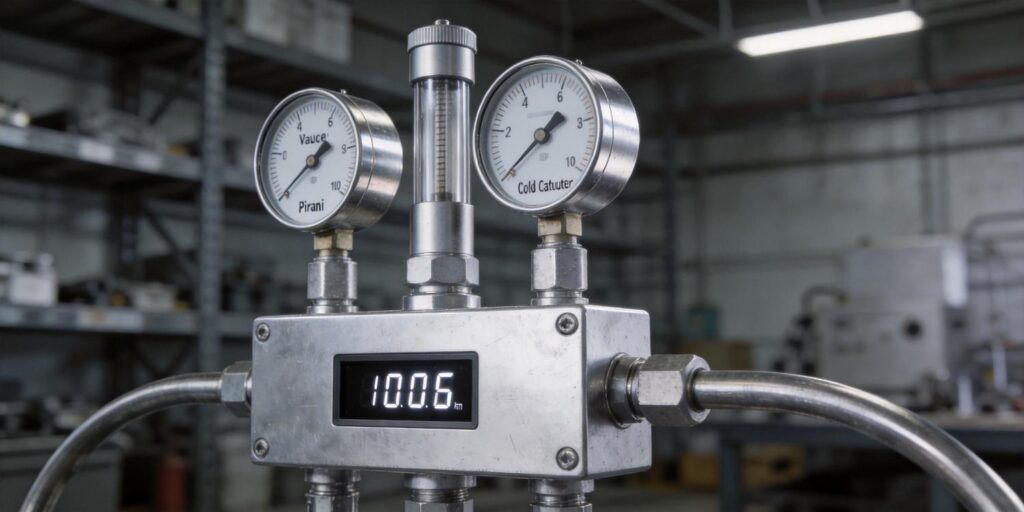
Understanding the Measurement Overlap Between Pirani and Cold Cathode Gauges
In vacuum systems that span atmosphere to high vacuum, no single gauge type covers the full range with optimal accuracy and reliability. The Pirani gauge excels in the rough-vacuum regime while the cold-cathode gauge dominates high vacuum. Their natural overlap around 10⁻³ Torr is the critical transition zone where proper hand-off determines overall system stability. Poseidon Scientific’s VG-SP205 Pirani Vacuum Transmitter and VG-SM225 Cold Cathode Vacuum Gauge were engineered as a complementary pair precisely for this purpose. Their compact design, shared 24 VDC power architecture, and customizable RS232 protocol simplify overlap management while delivering the accuracy, durability, and cost-effectiveness required by industrial and scientific users.
This article examines the technical details of the overlap region, transition challenges, and proven strategies for seamless integration. Engineers and system integrators will find actionable guidance for configuring hybrid systems that eliminate blind spots and maintain continuous, trustworthy pressure data.
1. Review of Measurement Principles
The VG-SP205 Pirani Vacuum Transmitter operates on the thermal-conductivity principle. A platinum filament is held at constant temperature; the power required to maintain that temperature varies with gas pressure because molecular collisions transfer heat more efficiently at higher pressures. This produces a repeatable power-versus-pressure curve from atmosphere down to approximately 10⁻³ Torr, with best linearity between 10 and 10⁻² Torr. The platinum filament offers excellent chemical stability and a large temperature-resistance coefficient, minimizing drift compared with tungsten alternatives.
The VG-SM225 Cold Cathode Vacuum Gauge relies on the Penning discharge. Electrons are trapped in crossed electric and magnetic fields, ionizing gas molecules and producing a measurable ion current proportional to pressure. The gauge activates at roughly 10⁻³ Torr and provides reliable indication down to 10⁻⁷ Torr. Its stainless-steel electrodes and positive-magnetron geometry tolerate contamination far better than hot-cathode designs, and the sensor head is field-cleanable with simple 500-mesh abrasion.
Because the two principles are physically independent, their overlap region becomes the natural bridge between rough and high vacuum. Poseidon’s temperature-compensated circuitry and algorithmic correction keep both gauges within ±5 % error across 15–50 °C, ensuring the transition remains predictable and repeatable.
2. Typical Overlap Pressure Region
The practical overlap occurs between 2 × 10⁻³ and 5 × 10⁻⁴ Torr. In this band both gauges produce usable signals: the Pirani is still within its lower linear range, while the cold cathode has entered its stable operating regime. Outside this window the Pirani loses sensitivity below 10⁻³ Torr and the cold cathode becomes unreliable above 10⁻³ Torr because excessive molecular density quenches the discharge.
Factory calibration data for Poseidon transmitters show that the two curves intersect near 1 × 10⁻³ Torr when referenced to nitrogen. Real-process gases (argon, helium, or reactive mixtures) may shift the exact crossover by up to 15 %, making software-based overlap management essential rather than hard-wired single-point switching.
3. Transition Accuracy Considerations
Accuracy during transition depends on three factors: sensor linearity at the edges of each range, gas-composition effects, and thermal stability. The VG-SP205 maintains <±10 % deviation down to 10⁻³ Torr; the VG-SM225 maintains <±15 % up to 2 × 10⁻³ Torr. When both are active, a simple weighted-average algorithm (70 % cold-cathode weighting as pressure decreases) typically keeps combined error below 8 % of reading.
Gas composition introduces additional uncertainty because Pirani response is thermal-conductivity dependent while cold-cathode response scales with ionization cross-section. Poseidon ships both gauges with nitrogen/air calibration curves; users operating in helium-rich or argon-rich PVD environments should apply published correction factors or request factory gas-specific mapping for orders of five or more units. Temperature compensation in both instruments further limits drift to <3 % across the full operating envelope, eliminating the thermal-offset errors common in older hybrid systems.
4. Switching Thresholds
Effective switching thresholds balance stability and responsiveness. Industry practice uses a primary switch at 1 × 10⁻³ Torr with a 20 % hysteresis band (reset at 8 × 10⁻⁴ Torr). In the overlap region the controller monitors both signals and selects or blends them according to the following logic:
- Pressure falling: use Pirani until 1.5 × 10⁻³ Torr, then begin blending toward cold-cathode dominance.
- Pressure rising: favor cold-cathode until 5 × 10⁻⁴ Torr, then transition back to Pirani.
The VG-SP205 and VG-SM225 transmit dedicated status bytes via RS232 that include “In-Range” and “Healthy” flags. These flags allow the controller to ignore a sensor that has drifted outside its reliable band, preventing erroneous control actions during the transition.
5. Data Consistency Validation
Continuous validation ensures the two gauges remain aligned. During normal operation the PLC compares the two readings in the overlap band and flags a discrepancy >15 % as a potential sensor issue. Trend logging of both signals (1 Hz via RS232) over 24-hour periods reveals systematic offsets caused by contamination or temperature gradients. The VG-SM225’s field-cleanable design allows rapid restoration of consistency without chamber venting, while the VG-SP205’s maintenance-free platinum filament provides a stable long-term reference.
Automated self-check routines can command both gauges to report at a known test pressure (e.g., 5 × 10⁻⁴ Torr) during idle periods, confirming agreement within manufacturer specifications. Poseidon’s customizable protocol can embed a “Consistency Index” byte on request, simplifying validation code and audit reporting.
6. Avoiding Blind Spots
Blind spots occur when one gauge is out of range and the second has not yet taken over. Dual-gauge operation with software overlap eliminates this risk. The VG-SP205 remains active and accurate down to 10⁻³ Torr; the VG-SM225 is already providing usable data above 2 × 10⁻³ Torr. By keeping both powered continuously, the system maintains uninterrupted coverage from atmosphere to 10⁻⁷ Torr.
Additional protection comes from the gauges’ built-in safeguards: the cold cathode automatically disables high voltage above 10⁻³ Torr, while the Pirani filament circuit is inherently safe at high pressures. This hardware-level redundancy ensures that even if the PLC momentarily loses one signal, the remaining gauge continues to supply valid data for interlocks and alarms.
7. PLC Configuration Example
A typical Siemens or Beckhoff PLC routine for overlap management uses the following structured logic (pseudocode shown for clarity):
IF Pressure > 2e-3 THEN
    ActivePressure := Pirani_Value;          // Pirani dominant
ELSE IF Pressure < 5e-4 THEN
    ActivePressure := ColdCathode_Value;     // Cold cathode dominant
ELSE
    Weight := (Pressure - 5e-4) / (2e-3 - 5e-4);
    ActivePressure := (Weight * Pirani_Value) + ((1 - Weight) * ColdCathode_Value);
END_IF

IF |Pirani_Value - ColdCathode_Value| > 0.15 * ActivePressure THEN
    Set Alarm "Gauge Consistency Fault";
END_IF
Both analog (0–10 V) and RS232 digital paths are monitored in parallel; digital values take precedence when communication is healthy. Hysteresis of 10–15 % is applied to the final ActivePressure value to prevent chattering. Poseidon’s RS232 protocol includes ready-made status bytes that reduce ladder-logic complexity and commissioning time.
8. Best Practice for Hybrid Systems
Hybrid Pirani/cold-cathode systems deliver maximum stability when the following practices are observed:
- Mount the Pirani on the foreline or near the roughing port for fast rough-vacuum response.
- Install the cold cathode directly on the process chamber for representative high-vacuum data.
- Use short, high-conductance tubing (<150 mm) for both gauges to minimize transport delay.
- Enable continuous RS232 logging at 1 Hz for trend analysis and predictive maintenance.
- Schedule quarterly consistency checks and annual factory recalibration of the Pirani.
- Request protocol customization (minimum 5–10 units) to include overlap-specific flags for your exact PLC environment.
These steps, combined with the inherent robustness of Poseidon transmitters, produce hybrid systems that maintain pressure stability within ±5 % across full process cycles while supporting field electrode cleaning of the cold cathode and maintenance-free operation of the Pirani.
Conclusion
The measurement overlap between Pirani and cold-cathode gauges is not a limitation but a design opportunity. By understanding the principles, managing the transition zone, validating consistency, and implementing intelligent switching logic, engineers achieve continuous, high-accuracy vacuum data across the entire pressure spectrum. Poseidon Scientific’s VG-SP205 Pirani Vacuum Transmitter and VG-SM225 Cold Cathode Vacuum Gauge were purpose-built for exactly this hybrid architecture—offering compact size, field serviceability, low cost, and customizable digital integration that simplify overlap management for both new systems and retrofits.
Whether you are optimizing a PVD coating line, upgrading a vacuum furnace, or designing a next-generation analytical instrument, proper overlap handling with these transmitters delivers measurable gains in process stability, uptime, and total cost of ownership. For detailed voltage-to-pressure tables, sample PLC code libraries, or assistance configuring your specific hybrid system, explore the product pages for the VG-SP205 Pirani Vacuum Transmitter and VG-SM225 Cold Cathode Vacuum Gauge. Our engineering team is ready to support your next vacuum-control optimization project.
Word count: 1,192


