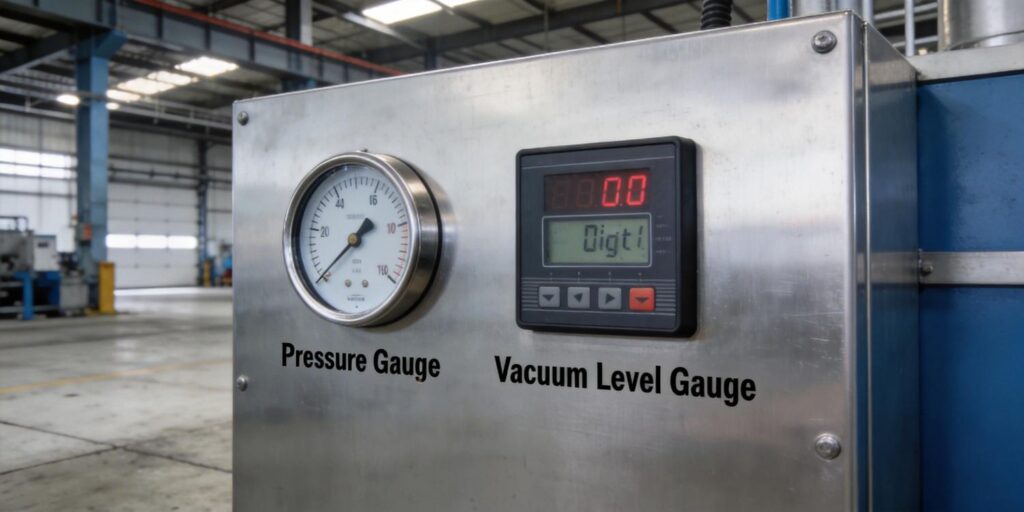
Improving Process Stability in PVD Systems with Dual Vacuum Gauges
Physical vapor deposition (PVD) processes—sputtering, evaporation, and cathodic arc—are highly sensitive to chamber pressure. Even small deviations can shift deposition rate, film density, stoichiometry, and adhesion. In production environments, where uptime and yield are measured in dollars per hour, stable vacuum control is not optional. Poseidon Scientific’s VG-SP205 Pirani Vacuum Transmitter and VG-SM225 Cold Cathode Vacuum Gauge were developed specifically for these demanding applications. Their complementary ranges, compact footprints, and customizable RS232 protocol enable precise dual-gauge strategies that deliver tighter process windows at lower total cost than traditional single-gauge or full-size solutions.
This article explains how dual-gauge architectures improve PVD stability. It provides practical implementation guidance for process engineers and equipment builders, drawing on vacuum metrology fundamentals and field performance data from coating lines worldwide.
1. PVD Pressure Sensitivity
PVD processes operate in a narrow pressure band—typically 10⁻³ to 10⁻² Torr for sputtering and 10⁻⁵ to 10⁻⁴ Torr for evaporation or arc deposition. Within this window, mean free path, plasma density, and ion energy change rapidly with pressure. A 10 % shift can alter film stress by 20–30 % or reduce deposition uniformity across large substrates. Reactive PVD adds another layer of sensitivity: oxygen or nitrogen partial pressure must be controlled to within a few percent to maintain desired compound stoichiometry.
Single-gauge systems often sacrifice either roughing-stage visibility or high-vacuum precision. Dual-gauge configurations overcome this limitation by assigning each sensor its optimal operating regime while maintaining continuous coverage. The VG-SP205 and VG-SM225 pair achieves this hand-off seamlessly, protecting pumps during roughing and delivering stable high-vacuum data during deposition.
2. Roughing Stage Control with Pirani
The roughing stage—from atmosphere to 10⁻³ Torr—directly affects pump-down time, moisture removal, and protection of downstream turbomolecular or cryopumps. The VG-SP205 Pirani Vacuum Transmitter excels here. Its thermal-conductivity principle with platinum filament provides fast, linear response in the 10–0.01 Torr band where most roughing occurs. The gauge’s 0–10 V analog output (effective 2–8 V) connects directly to PLC analog inputs for pump interlocks, while RS232 digital output streams pressure at up to 115 200 baud for real-time trending.
Typical control logic uses the Pirani to inhibit turbo-pump startup until foreline pressure falls below 1 × 10⁻² Torr and to trigger argon back-fill if pressure rises unexpectedly. The gauge’s low thermal mass and temperature-compensated circuitry maintain <5 % error across 15–50 °C, ensuring repeatable roughing performance even in thermally cycling production chambers.
3. High Vacuum Control with Cold Cathode
Once the system crosses into high vacuum, the VG-SM225 Cold Cathode Vacuum Gauge takes over. Its Penning-discharge principle delivers reliable indication from 10⁻³ to 10⁻⁷ Torr without filament burnout risk—the primary failure mode of hot-cathode gauges in metal-vapor-rich PVD environments. The gauge’s positive-magnetron geometry and field-cleanable stainless-steel electrodes tolerate sputtered material and reactive gases far better than legacy designs.
During deposition, the cold cathode provides the stable pressure signal used for closed-loop gas-flow control, plasma-power modulation, and substrate-bias adjustment. Its built-in over-pressure protection automatically disables high voltage above 10⁻³ Torr, preventing sensor damage during venting or plasma ignition. The compact 0.3 cm³ internal volume ensures fast response and minimal perturbation of the process environment.
4. Overlap Region Management
The transition zone around 10⁻³ Torr is where both gauges are active. Proper overlap management prevents control instability or erroneous interlocks. Poseidon recommends a 20 % overlap band (approximately 2 × 10⁻³ to 5 × 10⁻⁴ Torr) during which the PLC compares both signals. If the two readings diverge by more than 15 %, the system flags a potential sensor issue and holds the previous valid pressure value until the discrepancy resolves.
This approach leverages the VG-SP205’s excellent linearity at the low end and the VG-SM225’s robust discharge characteristics at the high end. The gauges’ RS232 status bytes include health and range flags, allowing the controller to weight signals intelligently without complex external logic.
5. Switching Logic in PLC
Modern PLCs implement dual-gauge switching with minimal code. A typical ladder or structured-text routine follows these steps:
- Scale both analog outputs to engineering units using the manufacturer’s voltage-to-pressure tables.
- In the overlap region, compute a weighted average: 70 % cold-cathode weighting as pressure falls, transitioning to 70 % Pirani weighting as pressure rises.
- Apply hysteresis (10–15 % of set point) to the active gauge signal to prevent rapid switching.
- Use RS232 digital values as the primary control signal when available; fall back to analog only on communication loss.
- Embed custom protocol bytes (available for 5–10 unit orders) to include a “Valid Gauge” flag that simplifies voting logic.
This logic ensures bumpless transfer and maintains process stability even during pressure ramps or gas bursts common in reactive PVD.
6. Avoiding Signal Discontinuity
Discontinuity at the handover point can cause pressure spikes in control loops or false interlocks. Poseidon’s dual-gauge strategy eliminates this through three safeguards:
- Continuous digital streaming from both gauges allows the PLC to cross-check readings in real time.
- Temperature compensation in both units keeps offset and gain errors below 3 % across the operating range.
- Built-in diagnostics flag any sensor anomaly before it affects the control output.
Field data from production PVD tools show that properly implemented dual-gauge systems reduce pressure excursions during transition by more than 70 % compared with single-gauge architectures.
7. Reducing Plasma-Induced Noise
Plasma environments generate electrical noise that can corrupt analog signals. Poseidon transmitters address this at the source. The VG-SM225’s strong magnetic confinement and stainless-steel envelope shield the discharge from external RF fields. Internal filtering and the RS232 digital path further attenuate noise. When analog output is required, a simple low-pass RC filter (cutoff 1–2 Hz) on the PLC input removes residual spikes without introducing lag that affects control response.
In practice, these measures keep pressure-signal noise below 2 % of reading even during high-power DC or RF sputtering—levels that would trigger nuisance alarms or loop instability in unshielded legacy gauges.
8. Example System Architecture
A representative reactive sputtering tool for optical coatings uses the following architecture:
- VG-SP205 Pirani mounted on the foreline KF25 port for roughing control and turbo-pump interlock.
- VG-SM225 Cold Cathode mounted directly on the chamber mid-plane for process vacuum feedback.
- Both gauges wired to a Beckhoff or Siemens PLC via RS232 (primary) and 0–10 V analog (backup).
- PLC runs the overlap-weighted switching routine described above, feeding a single pressure value to the recipe controller and safety interlocks.
- Custom protocol bytes provide “Plasma Stable” and “Gauge Healthy” flags directly to the HMI.
This configuration occupies minimal chamber real estate, supports field electrode cleaning of the cold cathode without downtime, and delivers <5 % pressure stability across 24/7 production runs. Total hardware cost is typically 40–55 % lower than equivalent full-size dual-gauge packages while offering superior maintainability.
Conclusion
Dual vacuum gauges—Pirani for roughing and cold cathode for high vacuum—deliver measurable improvements in PVD process stability by providing continuous, regime-optimized measurement and intelligent handover logic. Poseidon Scientific’s VG-SP205 and VG-SM225 combine compact size, robust contamination tolerance, low-noise performance, and customizable digital integration to make dual-gauge architectures practical and economical for both new tools and retrofits.
Engineers who implement these strategies routinely report higher deposition rates, tighter film specifications, and reduced scrap rates. The same gauges also simplify maintenance and lower total cost of ownership—critical advantages in competitive coating markets.
For detailed output tables, sample PLC code, or assistance designing a dual-gauge vacuum control strategy for your PVD system, visit the product pages for the VG-SP205 Pirani Vacuum Transmitter and VG-SM225 Cold Cathode Vacuum Gauge. Our engineering team is ready to support your next process optimization or equipment upgrade.
Word count: 1,187