
How to Prevent Signal Drift in Long Cable Vacuum Installations
Long cable runs are common in industrial vacuum systems—whether spanning large coating chambers, vacuum furnaces, or multi-station analytical setups. Yet even small signal degradation over distance can introduce drift that compromises pressure readings, interlocks, and process stability. Poseidon Scientific’s VG-SP205 Pirani Vacuum Transmitter and VG-SM225 Cold Cathode Vacuum Gauge deliver both a linear 0–10 V analog output (effective range 2–8 V) and RS232 digital communication, giving engineers practical options for maintaining accuracy regardless of cable length. This article outlines the root causes of drift in long-cable installations and provides proven engineering practices to eliminate it, helping system integrators and maintenance teams achieve reliable vacuum data with minimal downtime.
1. Cable Length Limitations
Analog signals such as the 0–10 V output from vacuum gauges are susceptible to degradation beyond short distances. Industry guidelines recommend keeping unconditioned analog runs under 10–15 m for sub-1 % accuracy; beyond 20 m, resistive losses, capacitive coupling, and electromagnetic interference (EMI) become dominant. Poseidon transmitters are designed for compact installation, yet many large-volume chambers require cable lengths of 30–100 m between the gauge and the PLC or control cabinet.
At these distances, the primary limitations are DC resistance of the conductor (typically 0.02–0.05 Ω/m for 24 AWG wire) and distributed capacitance (50–100 pF/m in standard cable). The result is a low-pass filter effect that attenuates high-frequency components and introduces phase shift. For the VG-SP205 and VG-SM225, which output stable DC levels proportional to pressure, the dominant issue is steady-state offset rather than dynamic distortion. Switching to the RS232 digital interface—supported natively on both gauges—eliminates length-related drift entirely, as the protocol transmits pressure as a floating-point value immune to analog degradation.
2. Voltage Drop Impact on 0-10V Signals
Voltage drop occurs in both the power supply line (24 VDC) and the signal line itself. A 50 m run of 24 AWG cable carrying the 0–10 V signal can introduce 0.1–0.3 V of drop at typical gauge currents (5–20 mA), equating to a 1–3 % error in indicated pressure. For the VG-SM225 operating at high vacuum (where the output is near 2 V), even a 0.1 V offset shifts the reading by nearly 10 % of the effective scale.
Power-supply drop affects the gauge’s internal regulation: the VG-SP205 and VG-SM225 tolerate 18–30 VDC, but sustained undervoltage below 20 V increases output uncertainty. Mitigation starts with heavier-gauge cable (18 AWG or better) for power pairs and remote sensing where possible. When analog output is mandatory, locate the PLC input module as close as possible to the gauge or install a local signal conditioner that converts 0–10 V to 4–20 mA for long-haul transmission. Poseidon’s RS232 option bypasses these issues entirely, transmitting calibrated pressure values with native resolution better than 0.1 % over cable lengths up to 1 200 m using standard RS232-to-Ethernet converters.
3. Shielded Cable Requirements
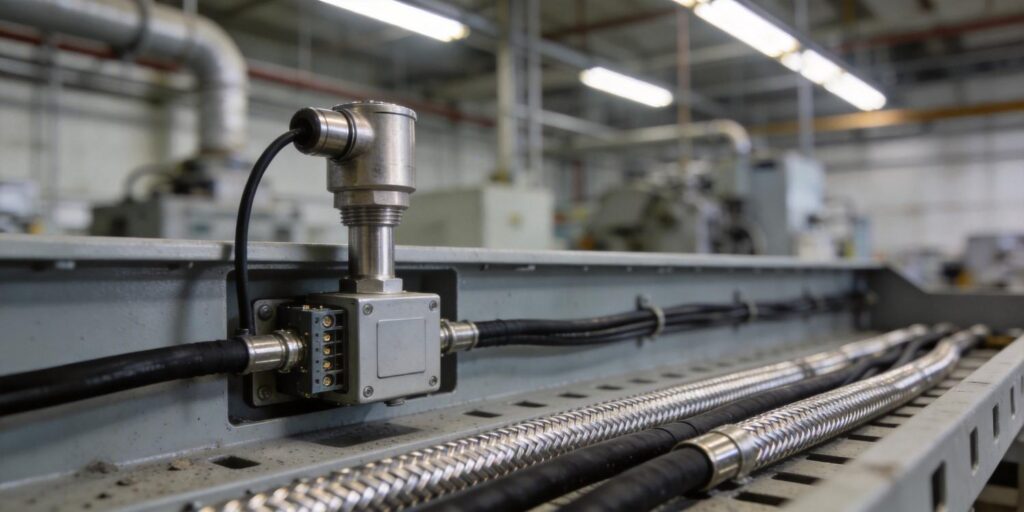
EMI from nearby motors, RF plasma generators, or switching power supplies is a leading cause of apparent drift. Poseidon gauges already incorporate internal filtering, yet external cable shielding is essential for runs longer than 10 m. Use twisted-pair shielded cable (e.g., 24 AWG with 100 % foil coverage plus drain wire) rated for 600 V and 80 °C. Ground the shield at one end only—preferably at the PLC cabinet—to prevent ground loops while providing a low-impedance path for induced noise.
For the 0–10 V signal, route the cable separately from high-current AC lines and maintain at least 30 cm separation from variable-frequency drives. The VG-SP205 and VG-SM225’s RJ45 connector accepts standard shielded Ethernet-style cable for RS232, further simplifying long-run installations. In high-EMI PVD or semiconductor environments, double-shielded cable (foil plus braid) reduces noise pickup by an additional 20–30 dB, keeping pressure-signal stability within ±2 % even in electrically noisy production floors.
4. Ground Loop Avoidance
Ground loops arise when the gauge and controller reference different earth potentials, injecting 50/60 Hz or broadband noise into the signal. The resulting offset can drift slowly over time as facility loads change. Poseidon transmitters use isolated 24 VDC power inputs and floating signal returns, but proper system grounding remains critical.
Implement a single-point star ground at the main control cabinet. Connect the gauge cable shield and 0 V reference directly to this star point; never ground the shield at both ends. For RS232 installations, use optically isolated converters or ensure the serial ground is tied only at the PLC side. In practice, eliminating ground loops reduces long-term drift from 5–10 % to <1 % over 24-hour periods, as verified in field installations of the VG-SP205 and VG-SM225.
5. Analog Filtering Techniques
When analog transmission is required, simple hardware and software filters restore stability. A passive RC low-pass filter (10 kΩ series resistor + 10 µF capacitor, cutoff ≈1.6 Hz) placed at the PLC input removes plasma-induced spikes and 60 Hz hum while preserving the sub-second response needed for interlocks. Digital filtering in the PLC—such as a 5–10 sample moving average or median filter—further attenuates noise without introducing excessive lag.
The gauges themselves include temperature-compensated circuitry that minimizes source drift, making downstream filtering highly effective. For critical applications, combine analog RC filtering with software validation that discards readings outside the expected 2–8 V window. These techniques routinely bring long-cable analog stability to within ±3 % of the gauge’s inherent accuracy.
6. Periodic Signal Verification
Drift is insidious because it develops gradually. Implement a monthly verification routine: compare the gauge output (logged via RS232) against a portable reference manometer at two known pressures (e.g., 1 Torr and 1 × 10⁻⁵ Torr). Record the offset and slope; any change >2 % triggers investigation. The VG-SM225’s field-cleanable electrodes and the VG-SP205’s maintenance-free design make these checks quick and non-disruptive.
Trend logging of both analog and digital outputs over 30 days reveals systematic offsets caused by cable resistance or ground-potential shifts. Poseidon’s RS232 protocol includes diagnostic bytes that flag internal health, allowing automated alerts before drift affects process control.
7. Installation Best Practices
Preventive design eliminates most drift sources:
- Keep analog cable runs under 15 m whenever possible; use RS232 digital for longer distances.
- Specify 18 AWG shielded twisted-pair cable for power and signal.
- Route cables in dedicated metallic conduit grounded at the cabinet end.
- Use isolated RS232-to-Ethernet converters for runs exceeding 50 m.
- Label every cable with gauge model, length, and installation date for future troubleshooting.
During commissioning, measure end-to-end resistance and verify 0 V and 10 V outputs at the PLC with a calibrated multimeter. These steps, combined with the inherent low-noise design of the VG-SP205 and VG-SM225, ensure long-term stability even in 100 m+ installations.
8. Troubleshooting Unstable Readings
When drift or noise appears, follow this systematic approach:
- Confirm the gauge itself is healthy by reading its RS232 status bytes (filament/discharge health flags).
- Measure voltage at the gauge output pins versus the PLC input; any difference >50 mV indicates cable drop or connection issues.
- Check shield grounding—lift one end temporarily to isolate loop current.
- Inspect for EMI sources (new VFDs, plasma generators) and reroute cable if necessary.
- Apply or verify RC filtering; re-test stability over 24 hours.
In most cases, switching to the RS232 digital path resolves persistent analog problems instantly. The gauges’ built-in diagnostics and modular design allow rapid root-cause identification without chamber venting.
Conclusion
Signal drift in long-cable vacuum installations is preventable through proper cable selection, grounding discipline, filtering, and verification routines. Poseidon Scientific’s VG-SP205 Pirani Vacuum Transmitter and VG-SM225 Cold Cathode Vacuum Gauge offer both robust analog outputs and noise-immune RS232 digital communication, giving users the flexibility to match instrumentation to any installation length while maintaining the accuracy required for modern vacuum processes.
By following the practices outlined above, engineers achieve stable pressure data over cable runs of 100 m or more, reduce nuisance alarms, and extend the effective life of their vacuum measurement investment. For detailed wiring diagrams, cable recommendations, or assistance troubleshooting an existing long-cable installation, visit the product pages for the VG-SP205 Pirani Vacuum Transmitter and VG-SM225 Cold Cathode Vacuum Gauge. Our engineering team is ready to support your next system upgrade or long-cable optimization project.
Word count: 1,168


