Chlorophyll Interference in LC-MS and HPLC Analysis
Chlorophyll, the primary photosynthetic pigment in plants, presents significant analytical challenges in LC-MS and HPLC analysis of plant samples. These green pigments exhibit strong UV-Vis absorption, particularly in the 400-700 nm range, which can cause severe interference with both UV detection and mass spectrometry analysis. In HPLC systems, chlorophyll can overload columns, reduce separation efficiency, and mask target analyte peaks. For LC-MS applications, chlorophyll can cause ion suppression, contaminate ion sources, and generate complex background signals that compromise detection limits and quantification accuracy.
Research has demonstrated that chlorophyll and its degradation products can significantly impact analytical performance. As noted in SPE literature, “SPE brings one very significant advantage to UV/visible analysis of compounds – its ability to concentrate” while simultaneously removing interfering pigments. The presence of chlorophyll in plant extracts often necessitates extensive sample cleanup to achieve reliable analytical results, particularly in trace analysis applications.
Sample Extraction Methods for Plant Matrices
Effective chlorophyll removal begins with proper sample extraction. Plant matrices consist of aqueous components, fatty portions, and insoluble fibrous material. For green plant analysis, common extraction methods include:
Solvent Extraction Techniques
Traditional approaches involve homogenization followed by solvent extraction using acetone, methanol, or acetonitrile. The Luke Procedure, a well-established multiresidue pesticide method, begins with blending samples with acetone followed by partitioning between dichloromethane and aqueous acetone. This approach effectively liberates analytes while minimizing co-extraction of interfering pigments.
Matrix Solid Phase Dispersion (MSPD)
For solid plant samples, MSPD has proven effective. This technique involves blending the sample with a solid support material, creating a semi-dry mixture that can be packed into a column for sequential elution. MSPD is particularly valuable for samples containing high levels of chlorophyll and other pigments.
QuEChERS Method
The Quick, Easy, Cheap, Effective, Rugged, and Safe (QuEChERS) approach has gained popularity for plant sample preparation. This method typically involves acetonitrile extraction followed by dispersive SPE cleanup using primary secondary amine (PSA) and other sorbents to remove pigments and other interferences.
Sorbent Chemistries Capable of Pigment Removal
Several SPE sorbent chemistries have demonstrated effectiveness in chlorophyll removal from plant extracts:
Primary Secondary Amine (PSA)
PSA sorbents are particularly effective for removing chlorophyll and other pigments from plant extracts. Their dual functionality provides both weak anion exchange and polar interactions that effectively retain chlorophyll while allowing many target analytes to pass through. In the Luke Procedure revision, “plant sugars and acids are retained on SAX and PSA sorbents while the analytes pass through unretained.”
Florisil (Magnesium Silicate)
Florisil has been widely used for pigment removal in environmental and food analysis. Certified Sep-Pak Florisil cartridges have demonstrated excellent performance in removing chlorophyll and other plant pigments while maintaining target analyte recovery. Studies comparing SPE devices found that Florisil effectively removes chlorophyll-related interferences in organochlorine pesticide analysis.
C18 and Other Reversed-Phase Sorbents
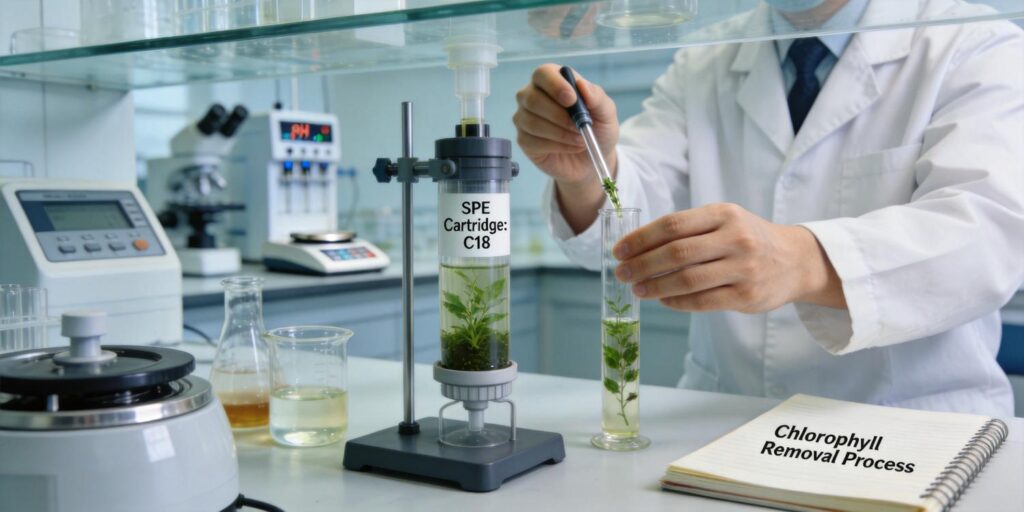
While C18 sorbents can retain chlorophyll, they are often used in pigment removal strategies where chlorophyll is retained and target analytes are collected in the effluent. Early SPE applications for plant materials often used C18 devices simply to remove pigments by passage of extracts through the device, collecting the effluent rather than the eluent.
Graphitized Carbon Black
Graphitized carbon black sorbents offer strong retention for planar molecules like chlorophyll, making them effective for pigment removal in certain applications where target analytes have different structural characteristics.
Optimized Washing Solvents for Chlorophyll Elimination
Proper solvent selection for washing steps is critical for effective chlorophyll removal while maintaining analyte recovery:
Non-Polar Wash Solvents
For reversed-phase SPE where chlorophyll is retained, initial washing with hexane or hexane-dichloromethane mixtures (typically 7:3 v/v) effectively removes non-polar interferences while retaining chlorophyll on the sorbent. This approach has been documented in methods where “the column was washed with two 1-ml portions of n-hexane-dichloromethane (7:3, v/v).”
Moderately Polar Wash Solutions
For normal-phase applications using Florisil or silica, washing with hexane-acetone mixtures (typically 90:10 v/v) effectively removes chlorophyll while retaining many target pesticides and other analytes. The 90:10 hexane/acetone ratio has been established as optimal for many pesticide residue applications.
Aqueous Wash Solutions
When using PSA or other polar sorbents, washing with water or dilute aqueous solutions can help remove water-soluble pigments and chlorophyll degradation products while retaining target analytes through different retention mechanisms.
Preventing Analyte Loss During Cleanup
Maintaining high analyte recovery while removing chlorophyll requires careful method optimization:
pH Control
Proper pH adjustment is crucial for maintaining analyte stability and retention characteristics. For acidic compounds, sample acidification to pH 2.2 has been shown to improve retention on non-polar sorbents by suppressing ionization. Conversely, for basic compounds, pH adjustment to ensure neutral or ionic forms can optimize retention on mixed-mode sorbents.
Solvent Strength Optimization
The solvent strength of wash solutions must be carefully controlled to ensure chlorophyll removal without eluting target analytes. Incremental increases in solvent polarity during washing steps can selectively remove chlorophyll while preserving analyte retention.
Flow Rate Control
Maintaining appropriate flow rates during sample loading and washing steps is essential for achieving optimal recovery. Research indicates that “recovery ∝ 1/flow,” emphasizing the importance of controlled flow rates for maximum analyte retention.
Applications in Pesticide Residue Testing
Chlorophyll removal is particularly critical in pesticide residue analysis of plant materials:
Multiresidue Pesticide Methods
The evolution of multiresidue pesticide methods has incorporated SPE cleanup steps specifically designed to remove chlorophyll and other plant pigments. The Luke Procedure represents a comprehensive approach where “SPE steps in each case contribute a clean-up of matrix components (for example, plant sugars and acids) while the analytes pass through unretained.”
Organochlorine Pesticide Analysis
For organochlorine pesticides, Florisil SPE cleanup has been extensively validated for chlorophyll removal. Certified Sep-Pak Florisil cartridges have demonstrated superior performance in removing chlorophyll and other plant-derived interferences compared to competitor products.
Modern High-Throughput Approaches
Contemporary pesticide residue analysis often employs 96-well SPE plates for high-throughput processing. These systems allow simultaneous cleanup of multiple samples, with sorbents like PSA effectively removing chlorophyll while maintaining high recovery of target pesticides.
Analytical Performance Improvements After Cleanup
Effective chlorophyll removal through SPE cleanup provides significant analytical benefits:
Enhanced Detection Sensitivity
By removing chlorophyll and other interfering pigments, SPE cleanup reduces background noise and improves signal-to-noise ratios. This enhancement is particularly important for trace-level analysis where chlorophyll can mask target analyte signals.
Extended Column Lifetime
Chlorophyll and other plant pigments can accumulate on HPLC columns, reducing separation efficiency and increasing backpressure. SPE cleanup significantly extends column life by preventing pigment deposition on analytical columns.
Improved Mass Spectrometer Performance
For LC-MS applications, chlorophyll removal reduces ion source contamination and minimizes ion suppression effects. This improvement leads to more stable calibration curves, better quantification accuracy, and reduced instrument maintenance requirements.
Enhanced Method Reproducibility
By consistently removing chlorophyll and other matrix interferences, SPE cleanup improves method precision and reproducibility. This consistency is particularly valuable in regulatory applications where method validation and quality control are critical.
Reduced Matrix Effects
Chlorophyll and related pigments contribute significantly to matrix effects in LC-MS analysis. Effective SPE cleanup minimizes these effects, leading to more accurate quantification and reduced need for matrix-matched calibration standards.
In conclusion, SPE cleanup represents a critical step in the analysis of plant samples, particularly for applications requiring chlorophyll removal. By selecting appropriate sorbent chemistries, optimizing washing conditions, and implementing proper method controls, analysts can achieve effective pigment removal while maintaining high analyte recovery. The resulting improvements in analytical performance justify the additional sample preparation step, particularly for sensitive applications like pesticide residue analysis and trace-level quantification in complex plant matrices.