Pigments Commonly Present in Plant Extracts
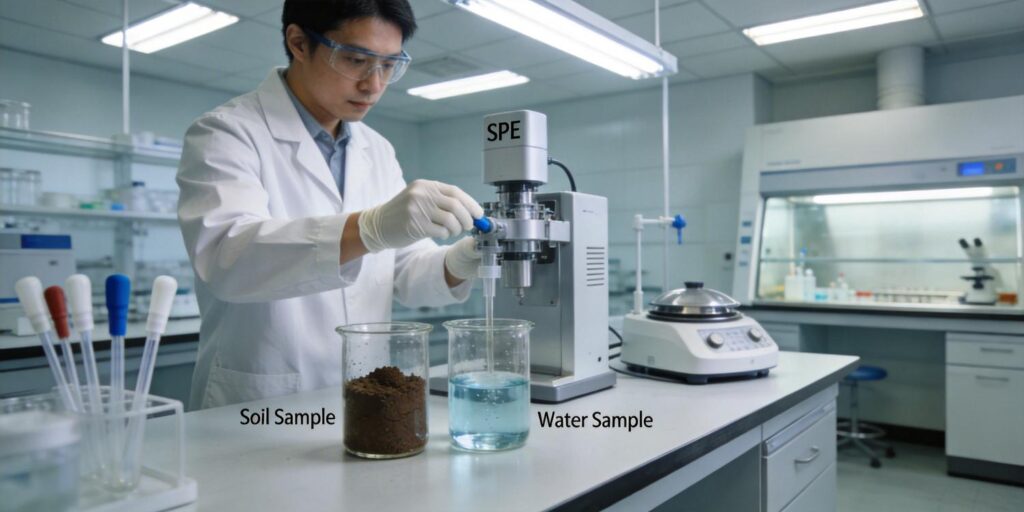
Plant extracts present a complex analytical challenge due to their rich pigment content, primarily chlorophylls and carotenoids. Chlorophylls, the green photosynthetic pigments, exist in several forms including chlorophyll a and b, each with distinct chemical structures and polarities. Carotenoids encompass both carotenes (non-polar hydrocarbons like β-carotene) and xanthophylls (oxygen-containing derivatives like lutein and zeaxanthin). These pigments are essential for plant physiology but create significant interference in analytical workflows.
According to Simpson and Wynne (2000), plant extracts contain numerous co-extractives including “waxes, which are often problematic in the analysis of fruit such as apples,” and these can be eliminated through careful solvent selection. The high lipid content in many plant matrices further complicates pigment removal, requiring specialized approaches to achieve clean analytical results.
Analytical Interference Caused by Pigments
Pigments interfere with analytical methods through multiple mechanisms. Chlorophylls exhibit strong UV-Vis absorption across broad spectral ranges, potentially masking target analyte signals in chromatographic detection. Carotenoids, with their conjugated double-bond systems, can cause baseline disturbances and co-elution issues in both HPLC and GC analyses. Furthermore, these pigments can foul analytical columns, reducing column lifetime and increasing maintenance costs.
The interference extends beyond spectral overlap. As noted in SPE literature, “pigments, too, were reportedly eliminated by coagulation steps” in some extraction protocols, indicating their persistent nature in analytical workflows. In pesticide analysis, these interferences can lead to false positives or negatives, compromising regulatory compliance and food safety assessments.
Extraction Steps Prior to SPE Cleanup
Effective pigment removal begins with proper sample preparation. Plant materials typically undergo initial extraction using solvents like acetone, methanol, or acetonitrile. Tsuji et al. (1995) demonstrated using “zinc acetate to coagulate fats in an acetonitrile extract of fruit or vegetables to allow pesticides to be extracted by a simple C18 process.” This preliminary step helps reduce the pigment load before SPE cleanup.
For solid plant materials, homogenization and filtration are essential. The extraction must convert the solid matrix into a liquid sample suitable for SPE processing. As Simpson and Wynne note, “the use of SPE techniques in the analysis of many phytochemicals is limited only by the requirement for the plant material to be processed as a liquid sample.” Proper pH adjustment may also be necessary, particularly for acidic or basic analytes that might co-extract with pigments.
Sorbent Chemistries Effective for Pigment Removal
Several SPE sorbent chemistries have proven effective for pigment removal from plant extracts:
Primary Retention Sorbents
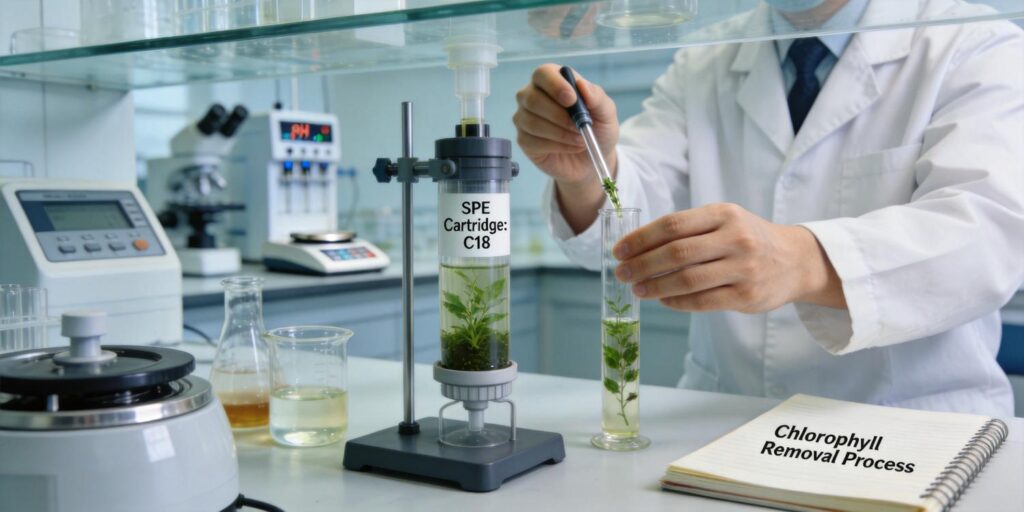
C18 and C8 Bonded Phases: These reversed-phase sorbents effectively retain non-polar pigments while allowing more polar analytes to pass through. Their hydrocarbon chains interact strongly with chlorophylls and carotenoids through hydrophobic interactions.
Polymer-based Sorbents: Styrene-divinylbenzene (SDVB) copolymers offer high capacity for pigment retention. As noted in SPE technology reviews, “polymer chemists have refined their craft over the last few years to produce highly uniform, clean, semi-rigid, or rigid polymers at a cost that makes them feasible as the basis for SPE sorbents.”
Secondary Cleanup Sorbents
Florisil: This magnesium silicate sorbent is particularly effective for pigment removal. According to Waters documentation, Florisil is “very-polar, highly-active, weakly-basic sorbent for adsorption of low to moderate polarity species from non-aqueous solutions” and is “specifically designed for the adsorption of pesticides using official AOAC, EPA, and JPMHLW regulated methods.”
Alumina: Available in acidic, basic, and neutral forms, alumina provides strong adsorption sites for pigments. It “exhibits specific interactions with the π-electrons of aromatic hydrocarbons, making it useful for applications like crude oil fractionation.”
Silica Gel: Normal-phase silica effectively retains polar pigments through hydrogen bonding and dipole-dipole interactions, making it suitable for non-polar extraction solvents.
Optimized Washing Solvents
Proper washing solvent selection is crucial for removing pigments while retaining target analytes. The washing strategy depends on the sorbent chemistry and analyte properties:
For Reversed-Phase Sorbents (C18, C8)
Moderately polar solvents like methanol-water mixtures (20-40% methanol) effectively wash away polar pigments while retaining non-polar analytes. Hexane-dichloromethane mixtures (7:3 v/v) have been successfully used in diol SPE columns for drug analysis, as demonstrated in pharmaceutical applications where “the column was washed with two 1-ml portions of n-hexane-dichloromethane (7:3, v/v).”
For Normal-Phase Sorbents (Silica, Florisil, Alumina)
Non-polar solvents like hexane or heptane effectively remove non-polar pigments. For more polar pigment removal, increasing percentages of ethyl acetate or acetone in non-polar solvents can be employed. The key is maintaining sufficient solvent strength to remove pigments without eluting target analytes.
For Mixed-Mode Sorbents
Combination washes using both aqueous and organic solvents address different pigment classes. For instance, water washes remove water-soluble pigments, while organic washes address lipid-soluble pigments.
Preventing Analyte Loss During Cleanup
Analyte recovery optimization requires careful balancing of pigment removal and analyte retention. Several strategies minimize analyte loss:
pH Control
Adjusting sample pH can dramatically affect both pigment and analyte retention. For acidic analytes, lowering pH protonates carboxylic acids, reducing their polarity and increasing retention on reversed-phase sorbents. For basic analytes, increasing pH deprotonates amines, similarly affecting retention characteristics.
Solvent Strength Optimization
The eluotropic series guides solvent selection for washing steps. Using solvents with just enough strength to remove pigments while retaining analytes requires systematic optimization. As noted in SPE methodology, “methanol/water wash and elution schemes were optimized for different toothpaste formulations” in cosmetic analysis, demonstrating the need for matrix-specific optimization.
Sequential SPE Approaches
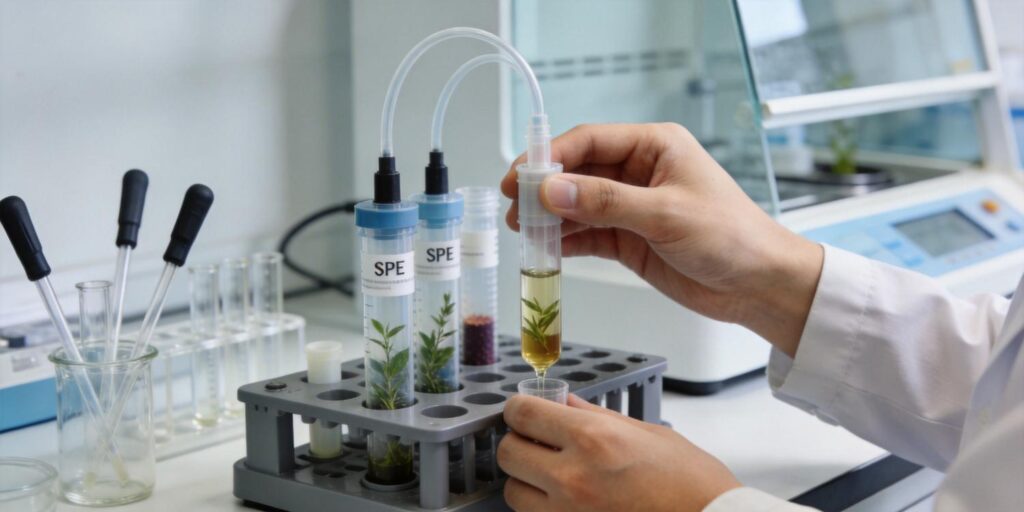
Using multiple SPE cartridges in series or parallel can separate pigment removal from analyte concentration. One cartridge retains pigments while another captures analytes, or vice versa. This approach has been demonstrated in beverage analysis where “a two-cartridge extraction of this kind is demonstrated in the clean-up of soft drinks during the analysis of aspartame degradation products.”
Example: Pesticide Analysis in Plant Matrices
Pesticide residue analysis in plant materials exemplifies the challenges and solutions for pigment removal. A comprehensive study by Luke (1995) explored “the extraction of a large range of pesticides from these matrices,” noting that “considerable sample manipulation and LLE is required by this method.”
Typical Workflow
1. Initial Extraction: Acetone or acetonitrile extraction with homogenization
2. Partitioning: Addition of salt solution and non-polar solvent (dichloromethane or hexane)
3. SPE Cleanup: Florisil or C18 cartridge cleanup
4. Final Analysis: GC-MS or LC-MS/MS determination
Optimized Conditions
For Florisil cleanup of pesticide extracts from plant materials, typical conditions include:
– Cartridge: 500 mg to 1 g Florisil
– Conditioning: 5 mL hexane or ethyl acetate
– Loading: Extract in minimal non-polar solvent
– Washing: 5-10 mL hexane or hexane:ethyl acetate (95:5)
– Elution: 10-15 mL ethyl acetate or acetone
Recovery Considerations
Pavoni and Errani (1996) reported extraction of benzimidazole fungicides “from a variety of fruit and vegetables followed by SPE clean-up of the extracts on NH2 bonded sorbents.” Their work highlights the importance of sorbent selection for specific pesticide classes.
The SPE strategy for complex samples typically follows one of two approaches: “A retention-cleanup-elution strategy is frequently used when the compounds of interest are present in levels too low for accurate and precise quantitation,” while “a pass-through cleanup strategy may be chosen when the desired sample component is present at a high concentration.”
Modern Approaches
Recent advancements include polymer-based sorbents like Oasis HLB, which contains “poly divinylbenzene-co-N-vinylpyrrolidone sorbents” that “exhibit both hydrophilic and lipophilic retention characteristics.” These sorbents play “a valid role in the extraction of medium-polar and non-polar organic compounds from mixtures of water and organic solvent,” making them suitable for plant extract cleanup.
For laboratories requiring high-throughput analysis, 96-well SPE plates offer simultaneous processing of multiple samples, significantly reducing analysis time while maintaining consistent pigment removal efficiency.
Successful pigment removal from plant extracts requires understanding both the chemical nature of the pigments and the analytical requirements of the target analytes. By selecting appropriate sorbent chemistries, optimizing washing solvents, and implementing proper sample preparation techniques, analysts can achieve clean extracts suitable for accurate quantification. The continued development of specialized SPE sorbents and formats ensures that pigment removal will remain a manageable challenge in plant extract analysis.