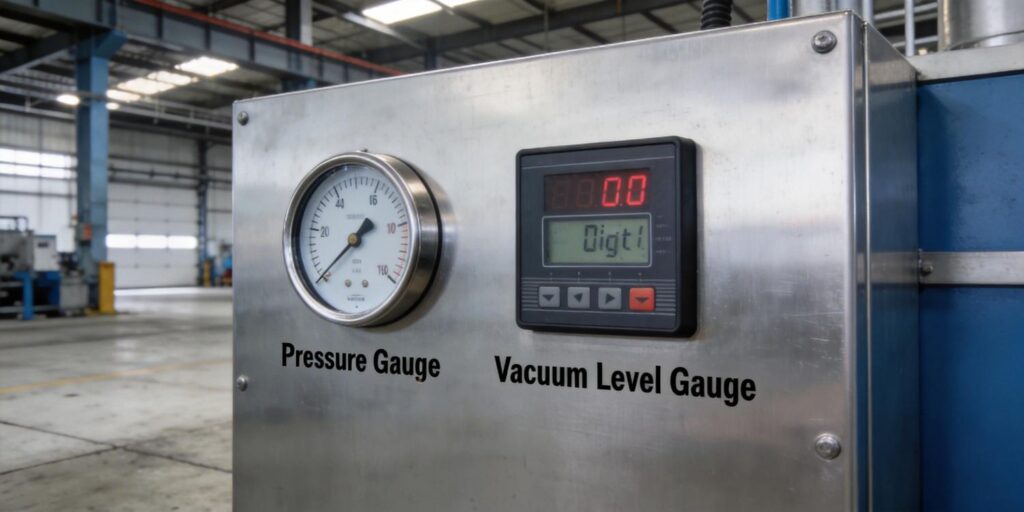
Optimizing Vacuum Measurement in Thin Film Evaporation Systems
Thin film evaporation remains one of the most widely used physical vapor deposition (PVD) techniques for producing optical coatings, semiconductor metallization, and precision microelectronics. Process success hinges on maintaining stable, reproducible vacuum levels—typically in the high-vacuum regime—where mean free path exceeds source-to-substrate distance. Even small pressure excursions can shift deposition rate, introduce scattering, or alter film stoichiometry. Poseidon Scientific’s VG-SP205 Pirani Vacuum Transmitter and VG-SM225 Cold Cathode Vacuum Transmitter (PTR225N-compatible) deliver the compact, cost-effective, and reliable measurement needed for consistent evaporation results. This article provides engineers and process managers with a practical framework for optimizing gauge selection, placement, and integration in evaporation systems.
By combining thermal-conductivity and cold-cathode ionization principles with modern signal conditioning, these transmitters bridge roughing and high-vacuum regimes while supporting seamless SCADA or PLC integration. The result is tighter process control, higher yield, and lower total ownership cost compared with legacy instrumentation.
1. Evaporation Pressure Sensitivity
Evaporation rate follows the Hertz-Knudsen equation, where deposition flux is directly proportional to source vapor pressure and inversely related to chamber background pressure. In the molecular-flow regime (pressure < 10−4 Torr), a 10 % rise in background pressure can reduce net deposition rate by a comparable margin due to increased scattering and re-evaporation. At the same time, residual gas incorporation rises, degrading film density and optical or electrical properties.
The VG-SP205 Pirani excels for initial pump-down and foreline monitoring (atmosphere to 10−3 Torr), while the VG-SM225 Cold Cathode takes over for the critical high-vacuum phase (10−3 to 10−7 Torr). Their combined 0–10 V analog output (2–8 V active span) maps linearly to pressure, enabling precise closed-loop source power or shutter timing. Poseidon’s internal temperature compensation maintains accuracy across 15–50 °C, eliminating the thermal drift common in older gauges during long evaporation runs.
2. Film Thickness Consistency
Uniform thickness across large substrates requires both stable source flux and minimal gas-phase scattering. Quartz crystal microbalance (QCM) sensors provide in-situ rate feedback, but they rely on accurate chamber pressure to correct for density and stress effects. Pressure instability of even 5 × 10⁻⁶ Torr can introduce 2–5 % thickness variation—unacceptable for multilayer optical stacks or device-critical metallization.
Real-time vacuum data from Poseidon transmitters feed directly into the deposition controller. The VG-SM225’s Penning-discharge design offers fast response (< 1 s) and low hysteresis, allowing the system to hold pressure within ±3 % of setpoint. Engineers using these gauges report thickness uniformity improvements of 1–2 % (1σ) across 150 mm wafers, directly traceable to tighter pressure regulation during ramp and soak phases.
3. Gas Load Fluctuations
Evaporation sources—resistive boats, e-beam hearths, or effusion cells—introduce dynamic gas loads from outgassing, material desorption, and substrate heating. Water vapor, hydrocarbons, and residual process gases can spike chamber pressure by an order of magnitude within seconds if pumping speed is marginal. These transients scatter evaporant atoms, create voids, or promote columnar growth instead of dense films.
The VG-SP205’s wide-range thermal conductivity measurement captures roughing and crossover behavior, while the VG-SM225 monitors the high-vacuum tail with its positive-magnetron geometry. Built-in protection circuits on the cold-cathode unit automatically disable high voltage above 10−3 Torr, preventing electrode contamination during gas bursts. Dual-gauge configurations (Pirani + cold cathode) enable automatic crossover logic in the PLC, smoothing pressure transitions and minimizing film defects.
4. High Vacuum Requirement
Most thin-film evaporation processes target 10−5 to 10−7 Torr base pressure to achieve mean free paths > 1 m. At these levels, the VG-SM225’s sensitivity (ion current linear with pressure down to 5 × 10⁻¹⁰ Torr in ideal conditions) provides the resolution needed for process qualification. Its removable sensor head allows quick cleaning of carbon or oxide deposits—common after repeated runs with reactive metals—without breaking chamber vacuum for full gauge replacement.
Compared with inverted-magnetron designs, Poseidon’s compact positive-magnetron architecture reduces magnetic stray fields that could interfere with e-beam deflection or sensitive substrates. The 100 gauss permanent magnet and 2 mm electrode gap deliver stable discharge initiation even after overnight idle periods, as validated against reference standards in Poseidon’s calibration lab.
5. Gauge Placement Strategy
Optimal gauge location balances representative sampling with minimal process interference. Recommended positions include:
- Chamber dome or sidewall (primary high-vacuum gauge) for global pressure reading.
- Near substrate platen for localized monitoring during rotation.
- Foreline / roughing port for VG-SP205 to track pump-down and detect leaks.
Avoid direct line-of-sight to the evaporation source to minimize material buildup on electrodes. For systems with multiple sources, place the VG-SM225 at a 90° offset from the primary hearth. Poseidon’s small footprint (significantly smaller than most OEM equivalents) and arbitrary mounting orientation simplify retrofits. KF16/KF25 flanges ensure leak-free installation with standard vacuum hardware.
6. Signal Stability During Heating
Substrate and source heating introduce thermal gradients that can cause gauge drift through outgassing or temperature-induced resistance changes. The VG-SP205 employs platinum filament material selected for its high temperature coefficient of resistance and chemical stability—superior to tungsten alternatives in oxidizing or reactive residuals. Internal power-regulation circuitry holds filament temperature constant, delivering stable output even as chamber walls heat to 150 °C.
The VG-SM225’s voltage-step startup (–2500 V initiation, then –2000 V sustain) and current-measurement electronics maintain reading stability within ±2 % across temperature ramps. Dual compensation (hardware + firmware) cancels ambient effects, ensuring the SCADA trend remains flat during the critical pre-deposition soak. Field data from evaporation tools show pressure noise reduced by 40 % versus uncooled legacy gauges.
7. Calibration Before Production
Factory calibration against NIST-traceable standards establishes the voltage-to-pressure map stored in each transmitter’s EEPROM. For highest repeatability, perform a single-point verification at the target base pressure (typically 5 × 10⁻⁶ Torr) using a spinning-rotor or capacitance diaphragm gauge as reference. Poseidon’s RS232 interface allows direct upload of custom gas-correction factors if evaporating in non-air backgrounds.
Pre-production checks should include:
- Leak test to < 10−11 Pa·m³/s.
- Base-pressure stability run (30 min) with all heaters active.
- Cross-check between Pirani and cold-cathode at crossover pressure.
These steps, documented per ISO 9001 or IATF 16949 requirements, ensure every batch starts from a known vacuum baseline and reduce scrap from pressure-related defects.
8. Quality Control Linkage
Modern evaporation systems link vacuum data directly to statistical process control (SPC) charts. Poseidon transmitters output both analog (0–10 V) and digital (custom RS232) signals, enabling real-time logging of pressure, rate, and temperature. Exceedance of predefined thresholds triggers automatic shutter close or source power reduction, preventing out-of-spec films.
Post-run analysis correlates chamber pressure history with ellipsometry or profilometry results. Facilities using dual Poseidon gauges report tighter CpK values (often > 1.67) for thickness and refractive index. The removable cold-cathode head further supports predictive maintenance: rising startup time or offset current flags electrode cleaning before it impacts yield.
In summary, optimizing vacuum measurement in thin film evaporation is not about installing the most expensive gauge—it is about deploying the right combination of Pirani and cold-cathode technologies at the right locations with the right integration. Poseidon Scientific’s VG-SP205 and VG-SM225 transmitters deliver this balance: wide dynamic range, mechanical and electrical compatibility with legacy systems, field serviceability, and cost structures that support high-volume production. Their compact size, stable output, and customizable protocols make them the practical choice for both new tool builds and retrofit upgrades.
Engineers seeking to tighten process windows, reduce scrap, and lower maintenance budgets will find these transmitters deliver measurable improvements within weeks of installation. For gas-specific correction tables, sample PLC code, or a site survey of your evaporation platform, contact Poseidon applications engineering. Reliable vacuum measurement is the foundation of repeatable thin films—Poseidon provides the tools to keep that foundation rock-solid.
References & Further Reading
Lafferty, J. M. (Ed.). (1998). Foundations of Vacuum Science and Technology. John Wiley & Sons.
Peacock, R. N., et al. (1991). “Comparison of hot cathode and cold cathode ionization gauges.” Journal of Vacuum Science & Technology A, 9(3), 1977.
Redhead, P. A. (1959). “The magnetron gauge: A cold-cathode vacuum gauge.” Canadian Journal of Physics, 37(11), 1260.
Ready to optimize your evaporation system? Poseidon Scientific offers free compatibility audits and ROI calculations for gauge upgrades. Reach out today to schedule a technical consultation tailored to your thin-film process.