
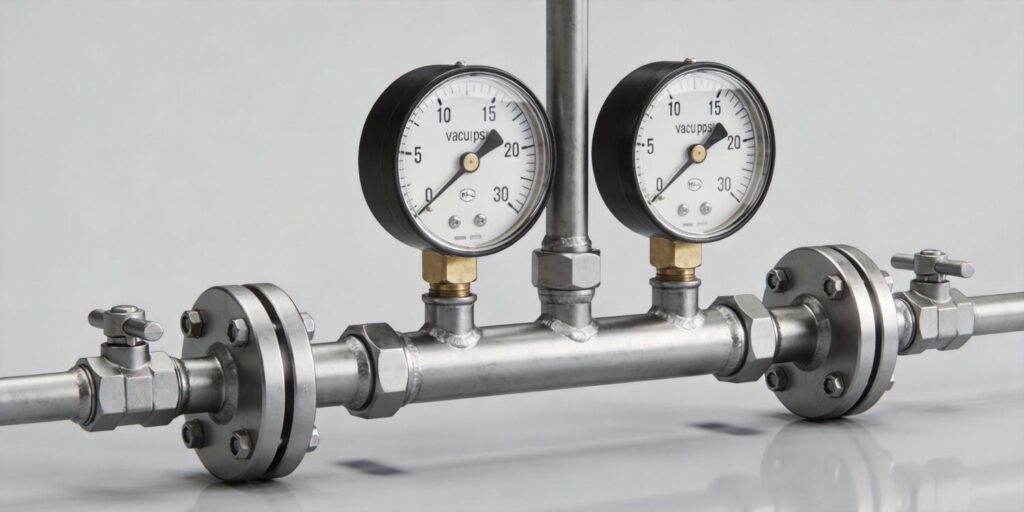
Defining Redundancy in Vacuum Measurement
In safety-critical and high-value vacuum processes, a single point of failure in pressure measurement can trigger scrap batches, unplanned downtime, or even safety incidents. Redundancy in vacuum gauge design means deploying multiple independent sensors that continuously monitor the same pressure regime, with the system automatically detecting degradation or failure in one unit and switching to the backup without interrupting the process. This concept goes beyond simple duplication: it includes independent power paths, separate signal chains, and diagnostic feedback so the controller always knows which gauge is providing the authoritative reading.
For engineers and procurement teams specifying equipment for semiconductor fabs, medical-device sterilization, aerospace vacuum chambers, or high-throughput coating lines, redundancy is no longer optional. Regulatory frameworks and internal quality systems increasingly demand it. Poseidon Scientific’s VG-SP205 Pirani Vacuum Transmitter and VG-SM225 Cold Cathode Vacuum Gauge were developed with exactly these requirements in mind. Their compact size, dual analog/digital outputs, and customizable RS232 protocol make true redundancy practical and cost-effective rather than an expensive custom engineering project.
The Dual-Gauge Strategy: Complementary or Parallel Coverage
The most robust redundancy architecture pairs the VG-SP205 Pirani (atmosphere to 10−3 Torr) with the VG-SM225 Cold Cathode (10−3 Torr to 10−7 Torr) for full-range coverage, then adds a second identical pair or a mirrored backup unit. In practice, two common implementations deliver maximum reliability:
- Complementary redundancy: Primary VG-SP205 + primary VG-SM225 for normal operation, plus a backup VG-SP205 and backup VG-SM225 mounted on the same chamber port via a tee or manifold. The controller uses the Pirani for rough vacuum and the cold cathode for high vacuum, with the backups on hot standby.
- Parallel identical redundancy: Two identical gauges (e.g., two VG-SP205 for packaging lines or two VG-SM225 for high-vacuum PVD) operating simultaneously. The system compares readings in real time; any deviation beyond a user-defined tolerance (typically 5 %) triggers an alarm and automatic switch to the healthy unit.
Both strategies leverage the gauges’ simultaneous 0-10 V analog and RS232 digital outputs. The analog line provides sub-second response for fast interlocks, while RS232 streams status codes, error flags, and full-resolution pressure every 100 ms—giving the controller complete visibility into each gauge’s health. The removable sensor head on the VG-SM225 further enhances redundancy: a contaminated unit can be cleaned in 15 minutes without breaking vacuum or swapping entire transmitters.
This dual-gauge approach adds negligible footprint (KF16/KF25 flanges fit standard ports) and less than 10 W total power, making it practical even for space- and power-constrained OEM tools.
Automatic Switching Logic: From Detection to Seamless Handover
Automatic switching eliminates human intervention and keeps the process running. Poseidon’s customizable RS232 protocol makes implementation straightforward. The controller continuously polls both gauges and evaluates three key parameters:
- Status and error codes (e.g., steady red LED mapped to a specific byte flags ignition failure or contamination).
- Pressure deviation between the two units (user-settable tolerance, typically ±5 % of reading).
- Analog output sanity check (out-of-range voltage or sudden jump).
When any fault is detected, the logic instantly switches the active signal path:
- Analog: The PLC input multiplexer or software selector routes the healthy gauge’s 0-10 V line to the control loop.
- Digital: The SCADA or recipe engine discards frames from the faulty gauge and uses the backup stream.
Switchover occurs in <50 ms—fast enough for even high-speed coating or packaging cycles. The system logs the event with timestamps for quality records and can trigger a maintenance alert without stopping the tool. Because the protocol is fully customizable at the factory (minimum 5–10 units), the exact fault codes and switching thresholds can match your existing firmware—no middleware or additional PLC modules required.
The VG-SP205’s maintenance-free platinum filament and the VG-SM225’s automatic high-voltage shutdown above 10−3 Torr (using the companion Pirani as interlock) ensure the backup gauge remains pristine until needed, maximizing mean time between interventions.
Why Redundancy Is Essential in Safety-Critical Environments
In semiconductor fabrication, aerospace component testing, pharmaceutical lyophilization, and medical-device sterilization, vacuum failure is not merely costly—it can be catastrophic. A single erroneous pressure reading might release a batch of contaminated product, damage expensive wafers, or compromise patient safety. Regulatory bodies (FDA, SEMI, AS9100) and internal risk assessments now treat vacuum measurement as a safety-critical instrument loop.
The Poseidon dual-gauge strategy meets these demands without the complexity of triple-redundant systems used in nuclear or flight-critical applications. The gauges’ galvanic isolation, low self-pumping speed (~0.01 L/s), and temperature compensation (15 °C–50 °C) keep them stable in electrically noisy, thermally cycling environments. Field-serviceable design on the VG-SM225 means the backup unit can be cleaned while the primary continues operating—zero downtime maintenance that legacy sealed gauges cannot match.
Engineers appreciate that both units share the same RJ45 connector and mounting footprint, simplifying spares inventory and qualification. Procurement teams value the 40–60 % lower capital cost versus imported wide-range gauges while gaining full diagnostic visibility and automatic failover.
Case Example: 300 mm PVD Cluster Tool in a High-Volume Fab
A leading semiconductor manufacturer running 24/7 300 mm PVD cluster tools faced recurring scrap from vacuum-gauge drift during the critical 5 × 10⁻⁶ Torr deposition phase. Single-gauge failures caused 4–6 hours of downtime per incident while technicians swapped and recalibrated units. Annual losses exceeded $1.2 million.
The team implemented parallel redundancy using two VG-SM225 Cold Cathode Gauges per chamber (plus VG-SP205 Pirani pairs for roughing). Automatic switching logic was coded into the existing tool controller using Poseidon’s custom RS232 protocol. When one gauge showed contamination offset (detected via status code and 8 % reading deviation), the system seamlessly switched to the backup within 40 ms and flagged the unit for scheduled cleaning during the next scheduled maintenance window.
Results after 18 months of operation:
- Zero unplanned downtime from gauge failure
- Scrap rate due to vacuum excursions dropped 92 %
- Electrode cleaning performed on a planned 14-month interval instead of emergency swaps
- Full audit-ready logs of every switchover event satisfied SEMI and customer traceability requirements
The fab calculated ROI in under five months and has since standardized the Poseidon redundant architecture across all new tools. The compact size required no chamber redesign, and the customizable protocol integrated in a single afternoon.
Implementing Redundancy Without Breaking the Budget
Redundancy does not require exotic hardware or triple-modular systems. With the VG-SP205 and VG-SM225, engineers achieve true continuous monitoring and automatic failover using off-the-shelf PLC logic and Poseidon’s built-in diagnostics. The combination of overlapping ranges, simultaneous analog/digital outputs, and field-serviceable design delivers safety-critical performance at a fraction of the lifetime cost of imported alternatives. Whether you are designing new OEM equipment or retrofitting existing production lines, this architecture future-proofs your vacuum measurement against both random failures and gradual degradation.
Ready to Add True Redundancy to Your Critical Vacuum Systems?
Safety-critical applications demand more than accurate vacuum measurement—they demand uninterrupted, trustworthy data. Poseidon Scientific’s VG-SP205 Pirani Vacuum Transmitter and VG-SM225 Cold Cathode Vacuum Gauge, paired with simple dual-gauge redundancy and automatic switching logic, deliver exactly that: full-range coverage, instant failover, and field-proven reliability at a cost that improves ROI from day one.
Explore the complete technical specifications and user manuals:
VG-SP205 Pirani Vacuum Transmitter – Technical Data & Manual
VG-SM225 Cold Cathode Vacuum Gauge – Technical Data & Manual
Need help designing the exact redundancy architecture for your tool, sample PLC code for automatic switching, or a custom protocol tailored to your existing controller? Our applications engineers have supported dozens of safety-critical installations and can deliver a complete proposal—including wiring diagrams, failure-mode analysis, and ROI calculation—within 48 hours. Contact us today to schedule a free redundancy review or to request evaluation units for your next critical vacuum project.
Uninterrupted vacuum data. Automatic failover. Zero surprises. That’s the Poseidon Scientific advantage for critical applications.


