Bioanalytical Sample Challenges: The Complex Landscape
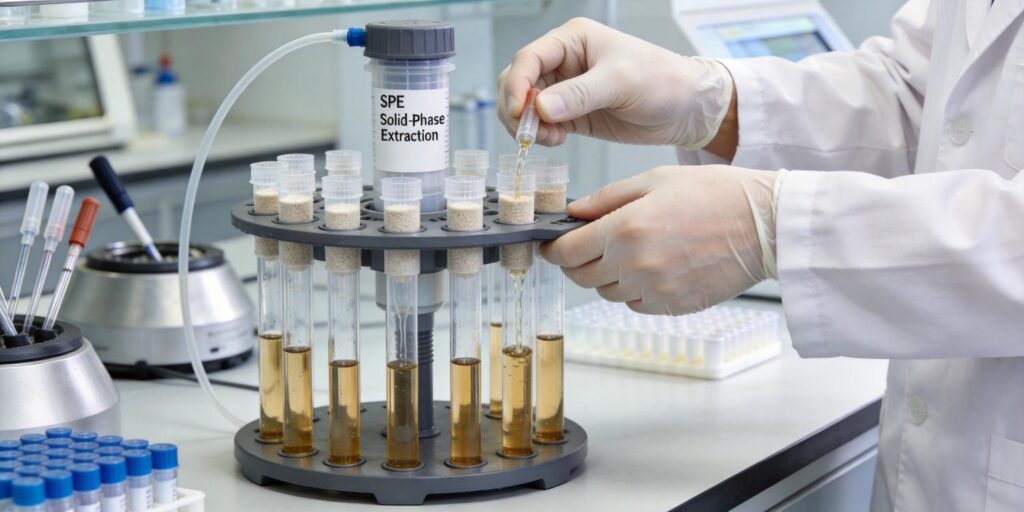
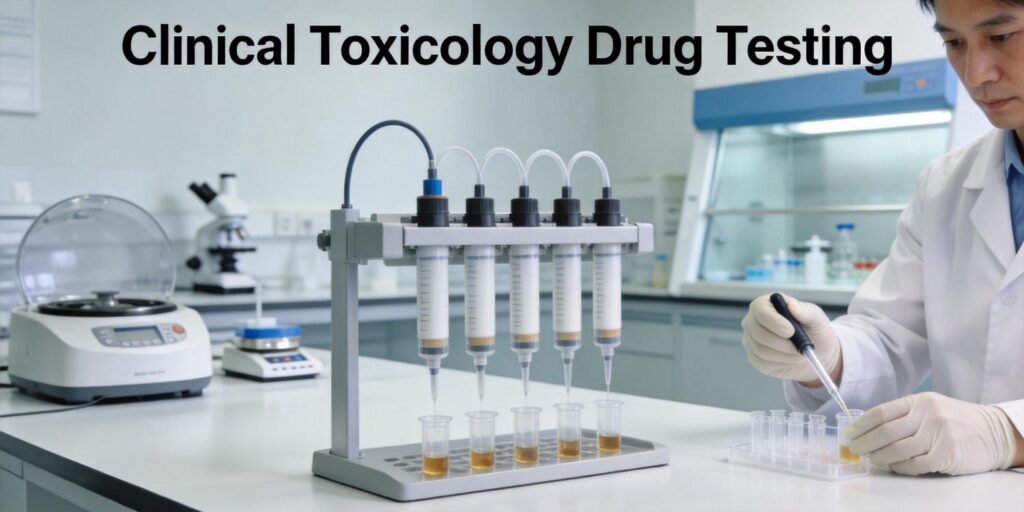
Biological samples present one of the most challenging matrices in analytical chemistry. As noted in forensic and clinical applications, “Biological samples are notoriously dirty; injecting them with minimum cleanup onto very sensitive and expensive instruments makes very little sense.” This statement captures the fundamental challenge facing modern bioanalysts.
Matrix Complexity and Interferences
Biological matrices such as plasma, urine, whole blood, and tissue samples contain thousands of chemical components that can interfere with analysis. These include:
- Proteins and peptides that can bind analytes and cause column fouling
- Lipids and phospholipids that create matrix effects in mass spectrometry
- Endogenous compounds with similar chemical properties to target analytes
- Salts and buffers that can damage analytical columns and instruments
- Cellular debris and particulates that can clog HPLC systems
Low Analyte Concentrations
Modern drug candidates are often very potent substances administered at low doses, requiring assay sensitivity high enough to allow estimation of terminal plasma half-life in vivo. As noted in pharmaceutical research, “Thus, assay sensitivity is a major goal of pharmacokinetic studies; sensitivity must be high enough to allow estimation of the terminal plasma half-life in vivo.”
Sample Volume Limitations
Clinical and preclinical studies often have strict limitations on sample volumes, particularly in pediatric or small animal studies. This requires efficient extraction methods that can work with minimal sample quantities while maintaining sensitivity.
Protein Binding Challenges
Many pharmaceutical compounds exhibit high protein binding in biological matrices, complicating their extraction and quantification. As noted in SPE applications, “Elimination of protein binding” is one of the key objectives of sample preparation for biological samples.
SPE Cleanup Advantages: The Modern Solution
Solid Phase Extraction has emerged as the gold standard for bioanalytical sample preparation due to its numerous advantages over traditional methods like liquid-liquid extraction (LLE).
Superior Recovery and Reproducibility
SPE offers significantly higher and more reproducible recoveries compared to LLE. As documented in forensic applications, “SPE recoveries should exceed 90% absolute recovery. If you don’t get that kind of recovery you are not adjusting other parameters (such as solubility, pH, and solvent strength) correctly.” This contrasts with LLE, which “not only has trouble achieving high recovery on a reliable, reproducible level but also, the more extractions you need to do, the more of your sample you lose.”
Enhanced Selectivity and Cleanliness
SPE provides tunable selectivity through various sorbent choices and solvent mixtures. Unlike LLE, which is “a general technique that extracts many compounds, whereas SPE gives the analyst the ability to extract a broad range of compounds with increased selectivity.” This selectivity results in cleaner extracts, as demonstrated in comparative studies where SPE extractions showed dramatically reduced impurity levels compared to LLE.
Reduced Solvent Consumption and Waste
SPE significantly decreases organic solvent usage and waste generation. This environmental and economic advantage is particularly important given that “it costs more to dispose of solvents today than it does to buy them.” SPE allows for elution in smaller volumes of solvent, which can be dried down quickly, further reducing environmental impact.
Prevention of Emulsions
One of the most frustrating aspects of LLE is emulsion formation, which can be completely avoided with SPE. As noted in environmental applications, “For anyone who has ever experienced the frustration of attempting to ‘break’ an emulsion formed while extracting ‘real-world’ samples by LLE, this advantage alone might make SPE attractive.”
Improved Throughput and Automation
SPE enables parallel processing versus serial processing in LLE, significantly improving throughput. Furthermore, “SPE can be automated quite easily with a variety of currently available equipment.” Automated SPE workstations provide enhanced consistency, reduced errors, and formal documentation capabilities that are increasingly important in regulated environments.
Instrument Protection and Extended Column Life
SPE has been shown to significantly increase gas chromatography (GC) and liquid chromatography (LC) column life while reducing downtime on equipment like GC-MS and LC-MS for source cleaning. By removing “column killers” and major interferences, SPE protects expensive analytical instrumentation and maintains instrument uptime.
Concentration Capabilities
Unlike LLE, SPE actually concentrates samples on the column, allowing for reproducible results at very low analyte levels. This concentration capability is particularly valuable for trace analysis in pharmacokinetic studies and environmental monitoring.
Flexibility in Solvent Selection
A significant advantage of SPE over LLE is that solvents that are miscible with the sample matrix may be used to elute analytes. This means that “a human plasma sample containing compounds that are to be analyzed by reversed-phase high-performance liquid chromatography may be retained onto a SPE sorbent from the water-based sample, and can then be eluted with a water/organic mixture.”
The Modern SPE Landscape: Advanced Sorbent Technologies
Modern SPE has evolved significantly from early C18 phases to include a wide range of specialized sorbents:
Mixed-Mode Sorbents
Mixed-mode sorbents combine multiple retention mechanisms (reversed-phase and ion-exchange) for enhanced selectivity. These sorbents provide the cleanest extracts and best reduction of matrix effects, making them ideal for challenging bioanalytical applications.
Hydrophilic-Lipophilic Balanced (HLB) Phases
HLB phases offer unique water-wettable properties and high capacity for both polar and non-polar compounds. These phases are compatible with solvents across the entire pH range (0-14) and provide excellent recovery for diverse analyte classes.
Ion-Exchange Sorbents
Specialized sorbents like MCX (mixed-mode cation exchange), MAX (mixed-mode anion exchange), WCX (weak cation exchange), and WAX (weak anion exchange) provide targeted extraction of acidic, basic, and neutral compounds with exceptional purity.
Conclusion: The Essential Role of SPE in Modern Bioanalysis
SPE has become indispensable in modern bioanalysis due to its ability to address the complex challenges presented by biological samples while providing cleaner extracts, higher recoveries, and better reproducibility than traditional methods. The technique’s flexibility, selectivity, and compatibility with automation make it ideally suited for today’s high-throughput analytical laboratories.
As bioanalytical challenges continue to evolve with increasingly potent drug candidates, smaller sample volumes, and stricter regulatory requirements, SPE technology continues to advance. Modern SPE formats, including 96-well plates and automated workstations, have transformed sample preparation from a bottleneck into an efficient, reproducible process that protects valuable analytical instrumentation and ensures data quality.
For laboratories seeking to improve their bioanalytical capabilities, implementing optimized SPE methods represents a strategic investment in data quality, laboratory efficiency, and long-term cost savings. The continued development of specialized sorbents and automated systems ensures that SPE will remain at the forefront of bioanalytical sample preparation for years to come.
Explore our comprehensive range of HLB SPE cartridges, MAX SPE cartridges, MCX SPE cartridges, WAX SPE cartridges, WCX SPE cartridges, and 96-well SPE plates to find the optimal solution for your bioanalytical challenges.