
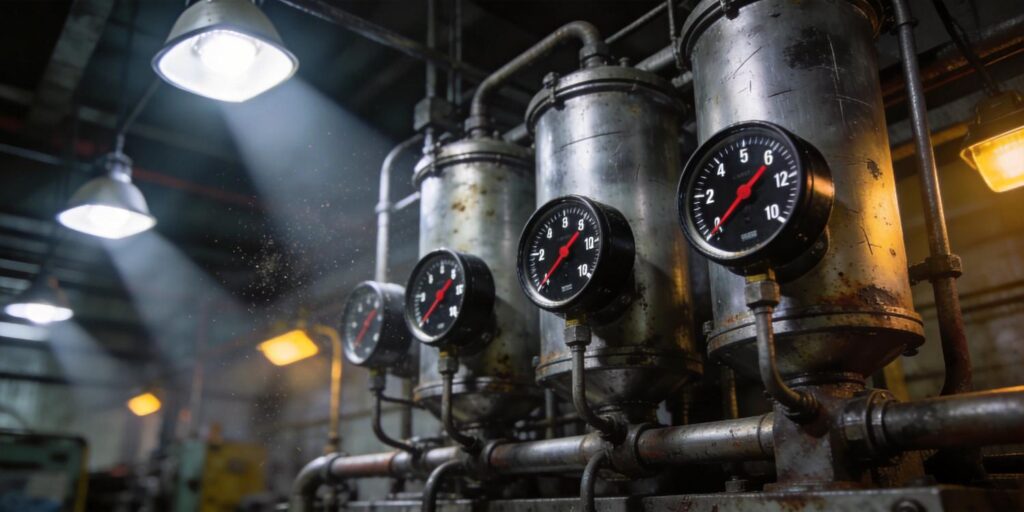
Downtime Causes
Unplanned downtime in vacuum-dependent equipment—whether vacuum furnaces, coating systems, mass spectrometers, or solar panel deposition tools—directly erodes productivity and profitability. The leading culprits almost always trace back to vacuum system issues that could have been caught early with reliable monitoring.
Common root causes include:
- Leaks and virtual leaks: O-ring damage, scratched flanges, or trapped volumes cause slow pump-down or inability to reach base pressure, forcing repeated cycle restarts.
- Pump degradation or overload: Foreline pressure spikes from backing-pump wear or contamination damage turbomolecular or diffusion pumps, requiring costly rebuilds.
- Contamination buildup: Process residues or backstreaming coat electrodes or filaments, leading to erratic readings, ignition failure, or premature gauge replacement.
- Gauge drift or failure: Temperature swings, electrical noise, or sensor aging produce false alarms or missed interlocks, shutting down entire production lines unnecessarily.
- Inadequate crossover timing: Roughing pumps run too long or high-vacuum pumps start too early, accelerating wear and extending cycle times by 20–50 %.
In high-throughput environments such as solar manufacturing or heat treatment, even one hour of downtime per shift can cost thousands of dollars in lost output. Traditional imported gauges often exacerbate the problem with rigid protocols, frequent filament burnout, or calibration drift that forces unscheduled maintenance. The result is a reactive maintenance culture instead of predictive control.
Monitoring Strategy
The most effective way to slash downtime is a dual-gauge, full-range monitoring strategy that covers every vacuum stage with complementary technologies. Poseidon Scientific’s VG-SP205 Pirani Vacuum Transmitter and VG-SM225 Cold Cathode Vacuum Gauge form the core of this approach.
The VG-SP205 handles rough vacuum—from atmosphere to 10-3 Torr—with fast response (<0.1 s) and platinum-filament thermal conductivity measurement. It monitors load locks, forelines, and initial pump-down, providing instant feedback for interlocks and leak detection. The VG-SM225 takes over for high vacuum (10-3 to 10-7 Torr) using a robust Penning discharge with positive-magnetron geometry. Its removable sensor head and automatic high-voltage protection eliminate filament-related failures.
Together they deliver continuous coverage with automatic crossover at ~10-3 Torr. Both transmitters output industry-standard 0–10 V analog plus RS232 digital communication. The RJ45 interface accepts shielded Ethernet-style cable, and Poseidon supports full protocol customization from just 5–10 units—eliminating driver development and enabling direct integration with existing PLCs or SCADA systems.
Key advantages of this strategy:
- Real-time digital trending of both gauges on a single dashboard
- Automated sequencing (e.g., start turbo only when Pirani confirms safe pressure)
- Compact footprints that fit tight OEM layouts without redesign
- 40–60 % lower cost than equivalent imported packages while matching performance
Operators gain a complete vacuum “health” view rather than isolated snapshots, turning pressure data into proactive decisions that prevent small issues from becoming production stoppers.
Why Dual Gauges Beat Single-Gauge Approaches
Relying on one gauge forces compromises: a Pirani loses accuracy below 10-3 Torr, while a cold cathode risks damage or ignition failure during roughing. The Poseidon combination eliminates these gaps, reduces false alarms, and extends pump life by ensuring optimal operating conditions at every stage.
Early Failure Detection
Reliable monitoring transforms downtime from reactive firefighting into predictive maintenance. The VG-SP205 and VG-SM225 provide early warning indicators through both analog trends and digital diagnostics.
Critical detection methods include:
- Rate-of-rise analysis: Isolate the chamber briefly; the Pirani’s fast digital output calculates leak rate in Torr·L/s within seconds. A sudden increase flags developing seal problems before base pressure is affected.
- Foreline pressure trending: The VG-SP205 watches backing-pump performance. Gradual rise or spikes warn of oil degradation or filter clogging days before pump failure.
- High-vacuum drift or ignition delay: The VG-SM225’s ion-current stability and status LEDs detect electrode contamination early. A 10–20 % decade shift or longer startup time triggers a simple field-cleaning alert—restoring performance in under 10 minutes with 500-mesh sandpaper.
- Temperature-compensated stability: Built-in compensation in both gauges flags ambient swings that would otherwise mask real issues.
- Digital error codes: RS232 streams specific fault codes (high-voltage shutdown, sensor pollution, over-range) directly to the controller for instant operator notification.
These features typically catch 70–80 % of vacuum-related failures before they halt production. Maintenance teams shift from monthly preventive schedules to condition-based interventions, reducing labor costs and extending component life.
Case Example
A mid-sized vacuum heat-treatment facility in the Midwest specializing in aerospace components recently upgraded its monitoring. The shop ran eight batch furnaces 24/7, processing titanium and nickel alloys under high vacuum. Legacy hot-cathode gauges failed every 6–9 months due to filament burnout and contamination, forcing 4–6 hours of downtime per incident for venting, replacement, and recalibration. Foreline pressure spikes from pump wear went unnoticed until turbomolecular pumps seized, adding $12,000 in repair costs over six months.
After installing VG-SP205 Pirani units on all forelines and VG-SM225 Cold Cathode gauges on process chambers, the plant achieved immediate results. Digital RS232 output fed directly into their existing PLC, enabling automated crossover sequencing and rate-of-rise alarms. Within the first month, operators caught a developing O-ring leak on one furnace via a 15 % rate-of-rise increase—fixed during a scheduled break instead of an emergency shutdown. Electrode cleaning on two cold cathode gauges restored full sensitivity without any production loss.
Over the next quarter, unplanned vacuum-related downtime dropped from 42 hours to 6 hours. Pump rebuild frequency fell 50 %, and overall throughput rose 12 %. The facility calculated a payback period under four months, with ongoing annual savings exceeding $45,000. Most importantly, process repeatability improved, reducing scrap rates and supporting tighter NADCAP certification requirements. The compact Poseidon gauges fit existing ports without modification, and custom RS232 protocol integration took less than one day.
This real-world outcome mirrors feedback from solar PECVD lines, analytical instrument OEMs, and coating shops that have standardized on Poseidon technology for the same reasons: reliable data, easy maintenance, and dramatically lower total ownership cost.
Minimize Downtime and Maximize Uptime with Poseidon Monitoring
Reliable vacuum monitoring is no longer a luxury—it is a competitive necessity. By addressing the root causes of downtime with a dual-gauge strategy, real-time digital trending, and field-serviceable designs, engineers prevent small issues from becoming costly interruptions.
Poseidon Scientific’s VG-SP205 Pirani Vacuum Transmitter and VG-SM225 Cold Cathode Vacuum Gauge deliver exactly this capability: full-range coverage, temperature-compensated stability, removable sensor heads for quick cleaning, and fully customizable RS232 communication at a fraction of imported prices.
Explore the VG-SP205 Pirani Vacuum Transmitter for robust foreline and load-lock monitoring that catches problems early.
Discover the VG-SM225 Cold Cathode Vacuum Gauge for stable high-vacuum performance with easy field maintenance.
Ready to reduce downtime in your vacuum system? Our engineering team offers free application reviews, custom protocol development, and rapid evaluation-unit shipping—typically within two weeks. Contact us today and let us show you how reliable vacuum monitoring can transform your uptime and bottom line.


