Filtration Basics: The First Line of Defense in Sample Preparation
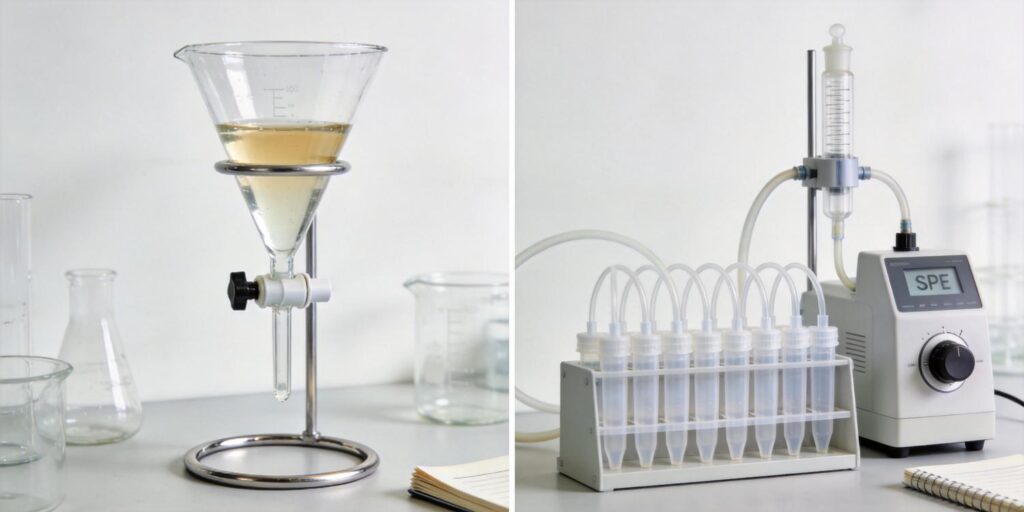
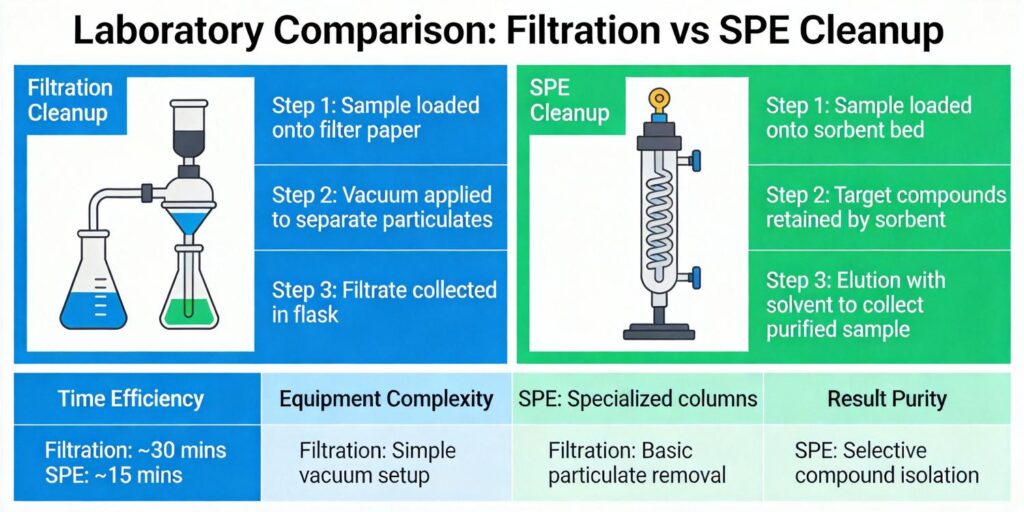
Filtration represents one of the most fundamental and widely used techniques in laboratory sample preparation. At its core, filtration involves the physical separation of particulate matter from a liquid matrix using a porous medium. This process relies on size exclusion principles, where particles larger than the filter pore size are retained while the liquid and smaller dissolved components pass through.
Modern filtration systems employ various media types, including membrane filters (typically 0.2-0.45 μm pore sizes), glass fiber filters, and depth filters. Membrane filters operate primarily through surface filtration, where particles are captured on the filter surface, while depth filters utilize a thicker matrix that traps particles throughout the filter structure. According to forensic and clinical applications literature, filtration is often employed as a preliminary step to remove macroparticulates and cellular components from biological samples before more sophisticated cleanup methods.
The process typically involves either vacuum or positive pressure to drive the sample through the filter medium. For environmental samples, researchers often employ sequential filtration through decreasing pore sizes (e.g., 0.7 μm followed by 0.45 μm) to effectively remove particulate matter that could interfere with subsequent analytical steps. In pharmaceutical laboratories, filtration serves as a critical step for removing particulates from fermentation broths and other complex matrices.
Common Filtration Applications
- Particulate removal from environmental water samples
- Clarification of biological fluids (plasma, urine, fermentation broths)
- Sterilization through 0.2 μm membrane filtration
- Pre-filtration before chromatographic analysis
- Sample clarification for spectrophotometric analysis
Limitations of Filtration: When Simple Separation Isn’t Enough
While filtration excels at removing particulate matter, it possesses significant limitations when dealing with complex analytical challenges. The primary constraint of filtration is its inability to discriminate between analytes and matrix interferences based on chemical properties rather than physical size.
Key Limitations of Filtration
1. No Chemical Selectivity
Filtration cannot separate compounds with similar physical dimensions but different chemical properties. As noted in forensic applications, this limitation becomes particularly problematic when dealing with complex matrices where target analytes and interfering substances have comparable molecular sizes.
2. Inability to Concentrate Analytes
Unlike solid phase extraction, filtration does not provide analyte concentration capabilities. In fact, filtration often dilutes samples as wash volumes are typically required to maximize analyte recovery from the filter surface.
3. Matrix Effects Persist
Dissolved organic matter (DOM), salts, and other soluble matrix components pass through filters unchanged. Research indicates that pollutants can bind to DOM such as humic or fulvic acids, creating complexes that filtration cannot separate from free analytes.
4. Limited Cleanup Capability
Filtration removes only particulate interferences, leaving behind dissolved contaminants that can interfere with analytical detection. As demonstrated in pharmaceutical applications, preservatives and other soluble additives in creams and formulations pass through filters and can interfere with UV spectrophotometric assays.
5. Potential Analyte Loss
Analytes may adsorb to filter surfaces, particularly when using certain filter materials. The literature notes that care must be taken to ensure target compounds are not bound to filter surfaces or bound to macromolecules that would be filtered.
6. No Solvent Exchange Capability
Filtration cannot change the solvent composition of samples, limiting compatibility with certain analytical techniques. Many instruments, particularly gas chromatographs, cannot handle aqueous samples directly.
SPE Advantages: The Superior Cleanup Solution
Solid Phase Extraction represents a quantum leap in sample preparation technology, offering capabilities far beyond simple filtration. SPE operates on chromatographic principles similar to HPLC, providing selective adsorption of analytes or interferences from complex matrices based on chemical interactions rather than just physical size.
Fundamental SPE Advantages Over Filtration
1. Chemical Selectivity and Tunable Separation
SPE offers multiple retention mechanisms including reversed-phase, normal-phase, ion-exchange, and mixed-mode interactions. This allows selective isolation of target analytes while removing chemically different interferences. As documented in forensic applications, SPE provides “the ability to extract a broad range of compounds with increased selectivity” compared to general techniques like liquid-liquid extraction.
2. Simultaneous Cleanup and Concentration
SPE uniquely combines cleanup with analyte concentration. Analytes are retained on the sorbent bed and then eluted in a small volume of solvent, achieving concentration factors of several hundred-fold. This dual functionality is particularly valuable for trace analysis where detection limits are critical.
3. Superior Matrix Removal
SPE effectively removes both particulate and dissolved matrix components. The technique can eliminate “column killers” and major interferences that would otherwise damage analytical instrumentation or compromise detection. Research shows SPE significantly increases gas and liquid chromatography column life while reducing instrument downtime for source cleaning.
4. High and Reproducible Recoveries
Properly developed SPE methods typically achieve recoveries exceeding 90% with excellent reproducibility. The literature emphasizes that “SPE recoveries should exceed 90% absolute recovery” when parameters are correctly adjusted, compared to liquid-liquid extraction which often struggles with reliable, reproducible recovery at low analyte levels.
5. Reduced Solvent Consumption and Waste Generation
SPE dramatically decreases organic solvent usage compared to traditional liquid-liquid extraction. This environmental and economic advantage has become increasingly important as laboratories seek to minimize their ecological footprint and reduce operating costs.
6. Automation Compatibility
SPE processes are readily automated using liquid handling workstations and 96-well plate systems. This enables high-throughput processing with improved reproducibility and reduced labor costs. Automated SPE systems can process multiple samples in parallel, significantly increasing laboratory productivity.
7. Solvent Exchange Capability
SPE allows conversion of samples into solvents compatible with analytical instruments. Aqueous samples can be converted to organic solvents suitable for GC analysis, while maintaining analyte integrity and concentration.
8. Multiple Operational Modes
SPE can operate in either analyte adsorption mode (retaining target compounds) or matrix adsorption mode (retaining interferences). This flexibility allows method development tailored to specific analytical challenges.
SPE as an Advanced Filtration Tool
Interestingly, SPE can function as a sophisticated filtration device when used in matrix adsorption mode. In this configuration, interfering substances are retained by the sorbent while analytes pass through to be collected. This approach has proven effective for applications such as removing urea from urine samples in forensic toxicology or eliminating preservatives from pharmaceutical formulations.
The evolution from simple filtration to SPE represents a fundamental shift in sample preparation philosophy. While filtration addresses physical separation based on size, SPE provides chemical separation based on molecular interactions. This chemical selectivity enables cleaner extracts, better detection limits, and more reliable analytical results.
Practical Considerations for Method Selection
When choosing between filtration and SPE, consider these factors:
- Sample complexity: Simple particulate removal requires filtration; chemical cleanup demands SPE
- Analyte concentration: Trace analysis benefits from SPE’s concentration capabilities
- Matrix effects: Complex matrices with soluble interferences require SPE cleanup
- Throughput requirements: High-throughput applications favor automated SPE systems
- Instrument compatibility: Solvent exchange needs typically require SPE
- Detection limits: Low-level analysis benefits from SPE’s cleanup and concentration
Modern laboratories often employ both techniques in sequence: filtration as a preliminary step to remove particulates, followed by SPE for chemical cleanup and concentration. This combined approach leverages the strengths of both techniques while minimizing their individual limitations.
For laboratories seeking to upgrade their sample preparation capabilities, HLB SPE cartridges offer excellent starting points for method development, while specialized products like MCX and MAX cartridges provide targeted solutions for specific analyte classes. High-throughput laboratories can benefit from 96-well SPE plates for automated processing.
The transition from filtration to SPE represents more than just a technical upgrade—it’s a strategic investment in analytical quality, laboratory efficiency, and data reliability. As analytical challenges become increasingly complex, the chemical selectivity and multifunctional capabilities of SPE make it an indispensable tool in modern laboratories.