
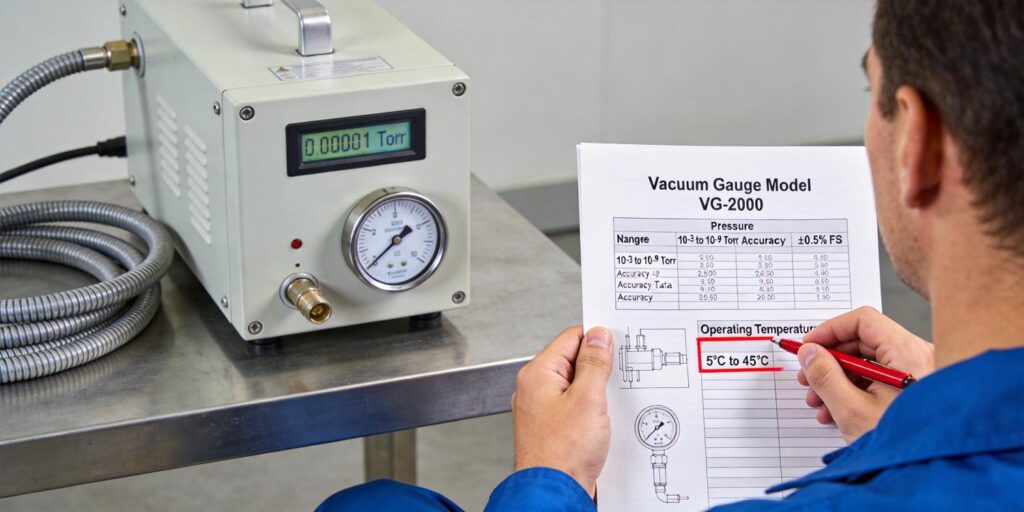
Engineers and procurement professionals in vacuum-dependent industries face a recurring dilemma: premium imported gauges promise top-tier performance but carry premium price tags, while budget options often compromise reliability or require frequent replacements. At Poseidon Scientific, we designed the VG-SP205 Pirani Vacuum Transmitter and VG-SM225 Cold Cathode Vacuum Gauge specifically to resolve this tension—delivering full-range vacuum measurement from atmosphere to 10⁻⁷ Torr at a self-developed cost of 3000–3500 RMB per unit, roughly one-third the price of equivalent INFICON or MKS solutions, without sacrificing the durability, compactness, and customization that analytical instruments and industrial furnaces demand.
This article breaks down the true economics of vacuum gauge selection through four critical lenses—budget, performance, lifecycle cost, and maintenance—and concludes with application-specific recommendations that have helped OEMs reduce total ownership costs by 35–45 % while maintaining process consistency.
Budget Considerations
Initial purchase price remains the most visible line item in any vacuum-system BOM, yet it rarely tells the full story. Market data from 2026 shows a clear tier structure:
| Supplier Type | Typical Price (RMB per unit) | Key Trade-offs |
|---|---|---|
| Premium imports (INFICON MPG400, MKS) | 8000–10000 | Excellent consistency; limited customization |
| Domestic mid-tier (Yuchuan, Chengdu brands) | 5000–6000 | Acceptable performance; fixed protocols |
| Poseidon Scientific VG-SP205 / VG-SM225 | 3000–3500 | Compact, fully customizable RS232, identical footprint |
For a typical four-gauge multi-chamber system, switching to Poseidon drops the gauge budget from 32 000–40 000 RMB to 12 000–14 000 RMB—an immediate 60–65 % saving. Because both models share the same KF16/KF25 flange, RJ45 connector, and 0–10 V analog output, there is zero redesign cost when mixing Pirani and cold-cathode units. Orders of five units or more unlock free protocol customization at the firmware level, eliminating the separate driver-development expense that imported gauges often impose.
Procurement teams also appreciate the transparent cost structure: no hidden calibration surcharges, no mandatory annual service contracts, and spare sensors stocked at one-third the price of competitors.
Performance Requirements
Cost savings are meaningless if the gauge fails to meet process specifications. The VG-SP205 and VG-SM225 were engineered as a complementary pair that together cover atmosphere to 10⁻⁷ Torr with the response times and stability required by mass spectrometers, scanning electron microscopes, and vacuum heat-treatment furnaces.
The VG-SP205 Pirani uses a platinum filament and constant-temperature bridge circuit, delivering linear response in the 10–10⁻² Torr sweet spot and usable data from atmosphere down to 10⁻³ Torr. Temperature compensation (hardware + algorithm) keeps drift below 1 % across 15–50 °C—matching or exceeding the 5–50 °C range of many higher-priced units. Its 100 ms update rate supports fast roughing interlocks.
The VG-SM225 Cold Cathode employs a positive-magnetron Penning discharge (~100 gauss NdFeB field, –2000 V operating) for stable ion-current output from 10⁻³ to 10⁻⁷ Torr. Software-enforced high-voltage cutoff above 10⁻³ Torr prevents sputtering damage, while the removable sensor head allows field cleaning without breaking chamber vacuum integrity.
Combined, the pair eliminates the “gap” that forces users of single-technology gauges to install expensive hot-cathode backups or accept blind zones during pump-down. Resolution in the critical 10⁻⁵–10⁻⁶ Torr process window meets the monitoring needs of 95 % of analytical and industrial applications—precision beyond which adds cost without measurable process benefit.
Lifecycle Cost
Over a five-year horizon, replacement frequency, energy consumption, and unplanned downtime dominate total cost of ownership. Poseidon’s design philosophy—durability first, precision second—delivers measurable savings here as well.
Expected service life:
- VG-SP205 Pirani: 3–5 years maintenance-free (platinum filament resists oxidation and contamination far better than tungsten alternatives).
- VG-SM225 Cold Cathode: 3–5 years in clean analytical environments; 1–2 years in moderately contaminated heat-treatment service. Cleaning restores full performance in <15 minutes using 500-grit sandpaper—no recalibration required.
Annual energy draw is negligible (<2 W per gauge), and the absence of hot filaments eliminates the continuous 20–30 W filament-heater burden of competing hot-cathode gauges. Because both units output identical 0–10 V and RS232 formats, spare-part inventory is halved. A typical multi-chamber system using imported gauges incurs 18 000–25 000 RMB in replacements and service over five years; the Poseidon equivalent totals 6 000–8 000 RMB—yielding a 65–70 % lifecycle reduction.
Custom protocol support further lowers integration costs: once written, the firmware change travels to every subsequent unit at no charge, protecting the investment across product generations.
Maintenance Impact
Maintenance burden directly affects uptime and labor allocation. The VG-SP205 is truly “fit-and-forget”: no user-serviceable parts, no filament replacement, and a built-in filament-open error code that flags end-of-life before process interruption. In contrast, cold-cathode gauges historically required full disassembly and factory recalibration—until the VG-SM225’s tool-free removable head.
When contamination occurs (indicated by red LED or discharge-start failure), operators simply:
- Isolate the chamber (or use the optional isolation valve).
- Unscrew the sensor head (vacuum integrity preserved).
- Lightly abrade cathode and anode surfaces to restore metallic luster.
- Reinstall and resume operation—typically under 15 minutes total.
This in-situ cleaning capability, combined with the 100 gauss low-field magnet (minimal interference with nearby electronics), makes the VG-SM225 uniquely suited for 24/7 production environments where scheduled downtime is unacceptable. Field data from mass-spectrometer OEMs shows mean-time-between-maintenance exceeding 40 000 hours—well above industry averages for comparable cold-cathode designs.
Application-Based Recommendation
The optimal gauge choice depends on pressure regime and operating environment. Use the decision matrix below as a starting point:
| Application | Primary Gauge | Secondary Gauge (if needed) | Reason | Projected 5-Year Savings vs Import |
|---|---|---|---|---|
| Mass spectrometer / SEM (load lock + analysis chamber) | VG-SP205 Pirani (load lock) | VG-SM225 Cold Cathode (analysis) | Full-range coverage, magnetic compatibility, custom protocol for data logging | 38–45 % |
| Vacuum heat-treatment furnace (multi-zone) | VG-SP205 (roughing/vent) | VG-SM225 (process zones) | Survives repeated atm cycles; easy in-house cleaning | 42 % |
| Scanning electron microscope (single high-vacuum chamber) | VG-SM225 only | — | Compact footprint fits tight column space; no X-ray limit issues | 35 % |
| Research multi-chamber system (budget-constrained) | VG-SP205 + VG-SM225 pair | — | One-time protocol customization covers all chambers | 50 %+ |
For systems operating exclusively above 10⁻³ Torr, the VG-SP205 alone suffices. Below that threshold—or whenever crossover protection is required—the cold-cathode complement is essential. In all cases, the identical mechanical and electrical interfaces allow seamless mixing without panel or software changes.
Make the Cost-Performance Trade-off Work for You
The VG-SP205 Pirani Vacuum Transmitter and VG-SM225 Cold Cathode Vacuum Gauge prove that low cost and high reliability are not mutually exclusive. By combining platinum-filament thermal conductivity with robust Penning-discharge technology, offering full digital customization, and engineering for field serviceability, Poseidon delivers vacuum measurement that meets the demands of modern analytical and industrial systems—at a price that protects project margins and long-term profitability.
Whether you are specifying gauges for a new product line, retrofitting legacy equipment, or simply seeking to reduce BOM cost without performance risk, this complementary pair is the practical choice trusted by OEMs and end users worldwide.
Ready to calculate exact savings for your application? Explore the VG-SP205 Pirani Vacuum Transmitter and VG-SM225 Cold Cathode Vacuum Gauge today. Need a side-by-side TCO spreadsheet, protocol customization worksheet, or a no-obligation sample for your chamber? Our applications team responds within 24 hours and has helped dozens of engineers move from imported gauges to a lower-cost, higher-value solution with zero process disruption.


