Lipidomics Sample Complexity
Lipidomics presents unique analytical challenges due to the immense chemical diversity and dynamic range of lipids in biological samples. A typical lipidome comprises thousands of distinct molecular species spanning multiple classes—phospholipids, glycerolipids, sphingolipids, sterols, and fatty acids—each with varying polarity, chain length, unsaturation, and functional groups. In plasma or tissue extracts, lipid concentrations can range from nanomolar to millimolar levels, often within a single sample. This complexity is compounded by the presence of abundant structural lipids (e.g., phosphatidylcholines) that can mask lower-abundance signaling lipids. Without effective sample cleanup, these issues lead to ion suppression, reduced sensitivity, and poor reproducibility in LC-MS analysis. Solid-phase extraction (SPE) has emerged as a critical tool to selectively enrich lipid classes of interest while removing interfering matrix components.
Need for Selective Lipid Extraction
While traditional liquid-liquid extraction (e.g., Folch or Bligh-Dyer methods) provides a crude lipid fraction, it often co-extracts non-lipid contaminants such as proteins, salts, and small polar metabolites. These artifacts can clog columns, cause ion suppression, and degrade MS performance. Selective SPE extraction addresses these limitations by exploiting specific interactions between lipid functional groups and sorbent chemistry. For example, reversed-phase sorbents retain lipids based on hydrophobic interactions, while ion-exchange sorbents target charged lipid classes like phosphatidic acids or lysophospholipids. Mixed-mode sorbents (e.g., those combining reversed-phase and ion-exchange) offer even greater selectivity, allowing for simultaneous retention and fractionation of multiple lipid categories. This selective approach reduces matrix effects and improves the dynamic range for low-abundance lipids.
SPE Sorbent Options for Lipid Classes
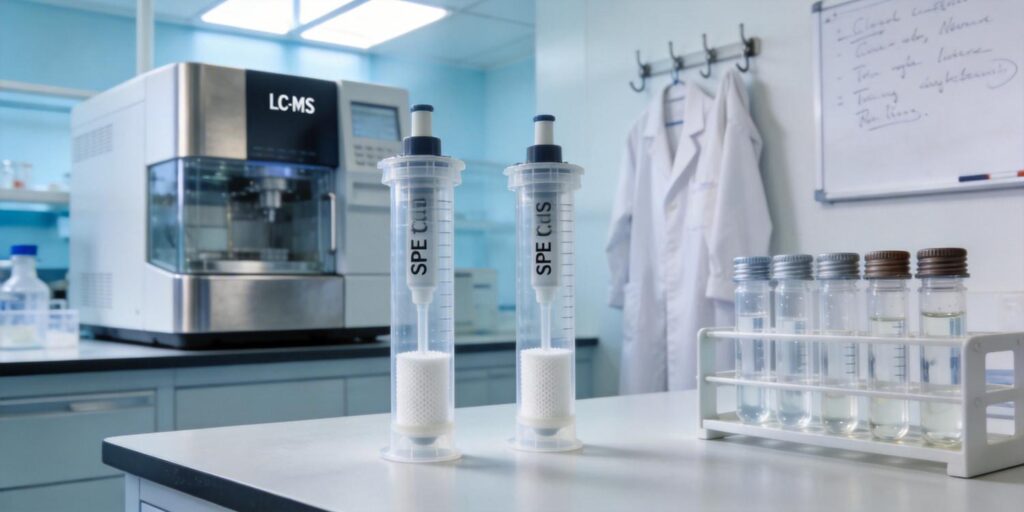
Choosing the appropriate SPE sorbent is crucial for targeting specific lipid classes. Our HLB SPE cartridges (hydrophilic-lipophilic balance) provide broad-spectrum retention for neutral and moderately polar lipids, making them ideal for total lipid extracts or when screening across multiple classes. For more selective isolation, ion-exchange sorbents are recommended: MAX SPE cartridges (mixed-mode anion exchange) efficiently retain anionic lipids such as phosphatidic acids, sulfatides, and bile acids. Conversely, MCX SPE cartridges (mixed-mode cation exchange) are suited for cationic lipids like sphingosine or lysophosphatidylcholine. For neutral lipid enrichment, WAX SPE cartridges (weak anion exchange) offer selectivity for specific acidic lipids, while WCX SPE cartridges (weak cation exchange) target basic lipids. In high-throughput workflows, our 96-well SPE plates provide parallel processing of multiple samples with reproducible retention profiles.
Plasma or Tissue Extraction
Tissue and plasma lipidomes differ significantly in composition and concentration, necessitating tailored extraction protocols. Plasma samples are typically less complex but contain high levels of phospholipids and cholesterol esters. A common approach involves protein precipitation with cold organic solvents (e.g., isopropanol), followed by SPE cleanup to remove residual proteins and polar metabolites. For tissue samples, homogenization in chloroform/methanol/water mixtures is standard, but the resulting extract often contains pigments, salts, and tissue-specific contaminants. SPE using HLB or mixed-mode sorbents effectively removes these interferences. For example, a plasma lipid extraction protocol using HLB cartridges can achieve >90% recovery for major lipid classes while reducing phospholipid carryover by 99%. Tissue extracts may benefit from a two-step SPE procedure: initial reversed-phase cleanup to remove pigments, followed by ion-exchange fractionation to separate acidic and neutral lipids.
SPE Cleanup Protocol
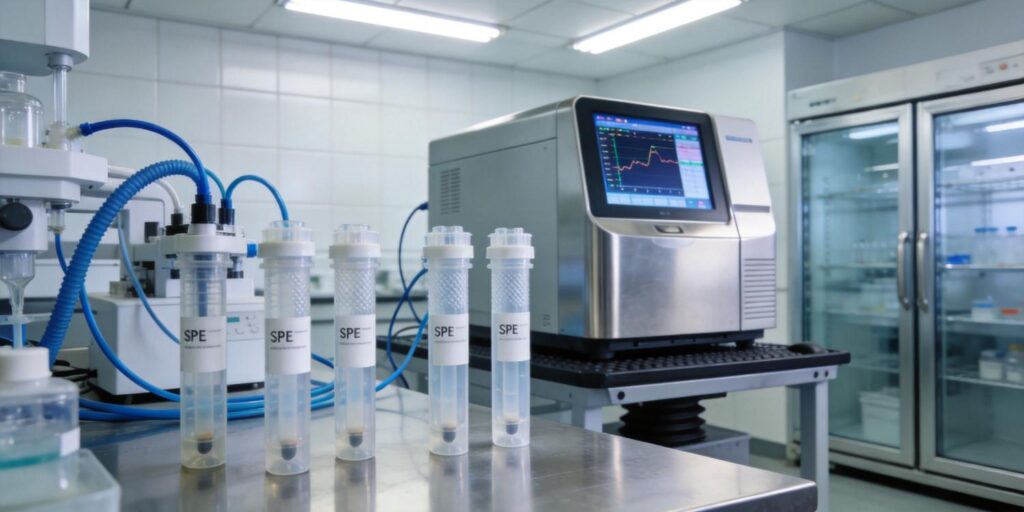
A generalized SPE cleanup workflow for lipidomics involves four key steps: conditioning, loading, washing, and elution. Conditioning with methanol or acetonitrile activates the sorbent, ensuring consistent retention. Loading the lipid extract (typically in 50–80% organic solvent) at controlled flow rates (<1 mL/min) promotes optimal binding. Washing with water or low-organic solvent removes salts and polar contaminants without eluting target lipids. Elution then selectively releases retained lipids using a solvent gradient. For example, using HLB cartridges: 1) condition with methanol, 2) load sample in 50% acetonitrile, 3) wash with water, 4) elute neutral lipids with ethyl acetate, then polar lipids with methanol. This protocol yields two fractions rich in different lipid classes. Recoveries are typically 85–110% for standards, with RSD <10% across replicates.
Fractionation Strategies
To further reduce complexity, fractionation strategies separate lipids into simpler subclasses. Sequential elution from mixed-mode sorbents allows stepwise isolation: for example, on a MAX cartridge, neutral lipids elute first with organic solvent, followed by acidic lipids with acidified methanol. WAX or WCX sorbents enables finer fractionation based on pKa differences. Alternatively, coupling orthogonal SPE phases—such as HLB followed by MCX—provides multidimensional separation. This approach has been applied to analyze over 500 lipid species from 100 µL plasma, with a 10-fold improvement in signal-to-noise for low-abundance mediators like eicosanoids. Fractionation also reduces ion suppression by distributing the lipid load across multiple LC-MS runs.
LC-MS Analysis Considerations
Post-SPE cleanup directly impacts LC-MS performance. Cleaner extracts allow for longer column lifetimes (>500 injections) and reduced source fouling. Solvent selection must match the injection solvent to the mobile phase to minimize peak distortion. For reversed-phase LC, eluates in methanol or isopropanol are preferred; for HILIC, acetonitrile-rich fractions are ideal. Ionization efficiency improves significantly after SPE: studies report a 2–5 fold increase in MS signal for most lipid classes due to reduced matrix effects. Additionally, SPE enables the use of smaller sample volumes (10–50 µL plasma), which is critical for preclinical murine models or clinical biobank samples. Internal standards should be added before SPE to correct for recovery variations.
Data Quality Improvements
Implementation of SPE cleanup in lipidomics workflows yields quantifiable improvements in data quality. Coefficient of variation (CV) for replicate measurements typically decreases from >30% to <15% after SPE. The number of detected features increases by 20–40%, with a concomitant reduction in missing values. For targeted analyses, accuracy (measured by spike-recovery) improves to ±15% of nominal values. These gains translate into better statistical power for biomarker discovery and pathway analysis. Furthermore, SPE facilitates compliance with lipidomics guidelines (e.g., Lipidomics Standards Initiative), as it standardizes sample handling and reduces batch effects. In summary, integrating SPE cartridges—from our HLB, MAX, MCX, WAX, and WCX lines, or the 96-well plate format—into your lipidomics workflow is a straightforward yet powerful strategy to elevate data quality and reproducibility.