Understanding the Complexity of Botanical Matrices
Botanical extracts present significant analytical challenges due to their complex chemical composition. These matrices often contain hundreds of compounds, including primary metabolites (sugars, proteins, lipids) and secondary metabolites (alkaloids, flavonoids, terpenes, phenolics). Such diversity leads to substantial matrix interference in LC-MS or GC-MS analyses, manifesting as ion suppression or enhancement, poor chromatography, and shortened column lifetimes. Effectively removing interferents is crucial for accurate quantification and reliable detection limits.
Types of Interfering Compounds in Botanical Samples
Key interfering species include:
- Pigments: Chlorophylls, carotenoids, and anthocyanins that co-extract with target analytes.
- Lipids and waxes: Long-chain fatty acids, sterols, and esters that can foul columns and ion sources.
- Polyphenols: Tannins and flavonoids that may chelate metals or cause ion suppression.
- Sugars and organic acids: Highly polar compounds affecting retention times and ionization efficiency.
- Alkaloids and other secondary metabolites: Structural analogs that can cause spectral interference or cross-reactivity.
Understanding these interferents guides the selection of appropriate solid-phase extraction (SPE) sorbents.
Selecting Mixed-Mode SPE Sorbents for Botanical Cleanup
Mixed-mode sorbents combine reversed-phase (RP) and ion-exchange (IEX) functionalities, offering dual retention mechanisms ideal for complex botanical extracts.
- HLB (Hydrophilic-Lipophilic Balanced): A water-wettable polymer with both hydrophilic N-vinylpyrrolidone and lipophilic divinylbenzene groups. Suitable for a broad polarity range, retaining both polar and nonpolar interferents. Often used as a generic cleanup for botanical extracts.
- MAX (Mixed-Mode Anion eXchange): Combines RP with strong anion exchange (SAX). Retains acidic compounds (e.g., phenolic acids, fatty acids) via anion exchange while RP retains neutral and basic species. Ideal for removing acidic interferents.
- MCX (Mixed-Mode Cation eXchange): Combines RP with strong cation exchange (SCX). Retains basic compounds (e.g., alkaloids, amines) through cation exchange, while RP retains neutrals and acids. Excellent for alkaloid-rich botanicals.
- WAX (Weak Anion eXchange): RP plus weak anion exchange, providing milder retention for strongly acidic analytes or selective removal of weak acids.
- WCX (Weak Cation eXchange): RP plus weak cation exchange, useful for selective retention of weak bases and zwitterionic compounds.
For a comprehensive removal of multiple interferent classes, consider combining sorbents (e.g., HLB followed by MCX) or using 96-well SPE plates for high-throughput method development.
Sample Extraction Procedures
Before SPE, botanical samples are typically extracted using solvents like methanol, ethanol, or acetonitrile/water mixtures. Common methods include ultrasonic-assisted extraction (UAE), accelerated solvent extraction (ASE), or maceration. The extract should be filtered (0.45 μm) and diluted to reduce organic solvent content below 10-20% to ensure proper retention on the SPE sorbent. Adjust pH and ionic strength to optimize ionization state of target analytes and interferents.
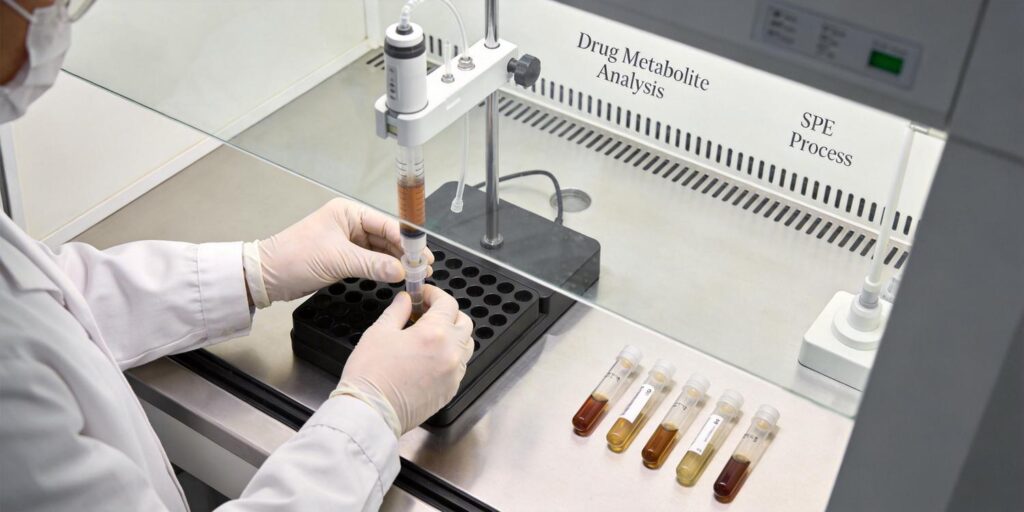
SPE Cleanup Workflow
A typical SPE protocol for botanical cleanup involves five steps:
- Conditioning: Equilibrate the sorbent with methanol (1-2 bed volumes), then water or buffer (1-2 BV). This activates the sorbent and ensures reproducible retention.
- Loading: Apply the diluted botanical extract (pH-adjusted if needed). Flow rate should be slow (1-2 mL/min) to allow efficient binding.
- Wash: Use an appropriate wash solvent to remove weakly retained interferents without eluting target analytes (see optimization below).
- Elution: Elute target analytes with a solvent that disrupts both RP and IEX interactions (e.g., methanol with acid/base).
- Post-processing: Evaporate and reconstitute in compatible solvent for LC-MS or GC-MS.
Optimization of Wash Solvents
Wash solvent composition is critical for selective interferent removal. Typical approaches:
- Weak washes: 5-10% methanol in water removes highly polar compounds (sugars, salts) without eluting analytes.
- pH-adjusted washes: For mixed-mode sorbents, a wash at pH that suppresses ionization of target analytes but keeps interferents charged can enhance cleanup. For example, on MCX, a wash with 0.1 M HCl can remove neutral and acidic interferents while analytes remain retained via cation exchange.
- Organic solvent gradient washes: Increasing methanol percentage (e.g., 20% → 40% → 60%) can fractionate interferents by polarity. Monitor each fraction by LC-MS to identify optimal wash strength.
- Ion displacement: Adding a low concentration of competing salt (e.g., 10 mM ammonium acetate) can elute weakly bound ion-exchange interferents without affecting stronger interactions.
Elution Strategies
Target analytes are eluted using solvents that overcome both RP and IEX retention:
- For MCX: Methanol with 5% ammonium hydroxide (basic) neutralizes the cation exchange interaction, eluting basic analytes.
- For MAX: Methanol with 2-5% formic acid (acidic) protonates the anion exchange sites, releasing acidic analytes.
- For HLB: Pure methanol or acetonitrile suffices, as retention is only RP-based. If interferents remain, a stepwise elution (e.g., 50% → 75% → 100% methanol) can separate analytes from later-eluting lipophilic compounds.
- Combined sorbent protocols: 96-well SPE plates allow parallel elution with different solvents across rows, expediting optimization.
Elution volume should be kept minimal (2-3 BV) to concentrate analytes. Evaporation and reconstitution in initial mobile phase is recommended before injection.
Analytical Results Improvement
Effective SPE cleanup dramatically improves analytical performance. Benefits include:
- Reduced matrix effects: Ion suppression/enhancement decreases, improving accuracy and precision. Recovery of target analytes often exceeds 85% with RSD < 10%.
- Lower detection limits: Cleaner extracts allow concentration of analytes without concentrating interferents, achieving LODs as low as 0.1 ng/mL for sensitive LC-MS methods.
- Extended column lifetime: Removal of nonvolatile and high-MW compounds prevents column fouling and maintains resolution over hundreds of injections.
- Compatibility with various detection methods: Clean extracts are suitable for UV, fluorescence, MS, and even NMR analysis.
Case study: In a medicinal herb analysis (e.g., Hypericum perforatum), using MCX SPE removed >90% of chlorophylls and flavonoids, enabling quantification of hypericin and pseudohypericin with recoveries of 92-98% and LOD of 0.5 ng/mL (Rigobello-Masini et al., 2003; modified).
For those seeking robust, scalable SPE solutions, explore Poseidon Scientific’s range of high-quality SPE products, including HLB, MAX, MCX, WAX, and WCX cartridges, as well as 96-well plates for high-throughput workflows.