Environmental Persistence of PFAS
Per- and polyfluoroalkyl substances (PFAS) have garnered significant attention due to their extreme environmental persistence, bioaccumulation potential, and adverse health effects. These synthetic chemicals are widely used in industrial applications and consumer products for their water- and grease-resistant properties. Their carbon-fluorine bonds make them exceptionally stable, resisting degradation in the environment. PFAS contamination in river water is a global concern, as these compounds can travel long distances via water currents and accumulate in aquatic ecosystems. Monitoring PFAS levels is essential for assessing ecological risks and ensuring drinking water safety. Solid-phase extraction (SPE) has become the gold standard for preconcentrating PFAS from large-volume water samples prior to analysis.
Sampling and Filtration Procedures
Proper sample collection and handling are critical for accurate PFAS quantification. River water samples are typically collected in high-density polyethylene (HDPE) or polypropylene bottles to avoid PFAS leaching from containers. Samples should be stored at 4°C and processed within 48 hours. Filtration is necessary to remove suspended solids that could clog the SPE cartridge or interfere with analysis. Use 0.45 µm or 0.7 µm glass fiber filters pre-baked at 400°C to minimize PFAS background. Filter holders and tubing should be PFAS-free, and rinsing with methanol and deionized water between samples prevents cross-contamination. Field blanks and trip blanks are essential to monitor any contamination introduced during sampling.
SPE Cartridge Selection (Anion Exchange)
PFAS compounds, such as perfluorooctanoic acid (PFOA) and perfluorooctanesulfonic acid (PFOS), exist as anions in natural water at neutral pH. Therefore, strong anion exchange (SAX) or weak anion exchange (WAX) sorbents are ideal for their retention. Among the HLB SPE cartridges from Poseidon Scientific, the WAX variant is particularly effective for PFAS due to its mixed-mode retention mechanism: reversed-phase and anion exchange. This allows efficient capture of both neutral and anionic PFAS. For more demanding applications, the MAX SPE cartridges (mixed-mode strong anion exchange) provide higher selectivity for strongly acidic PFAS. The MCX SPE cartridges (strong cation exchange) are not suitable for anionic PFAS but may be used for cationic contaminants in parallel workflows.
Loading Large Water Volumes
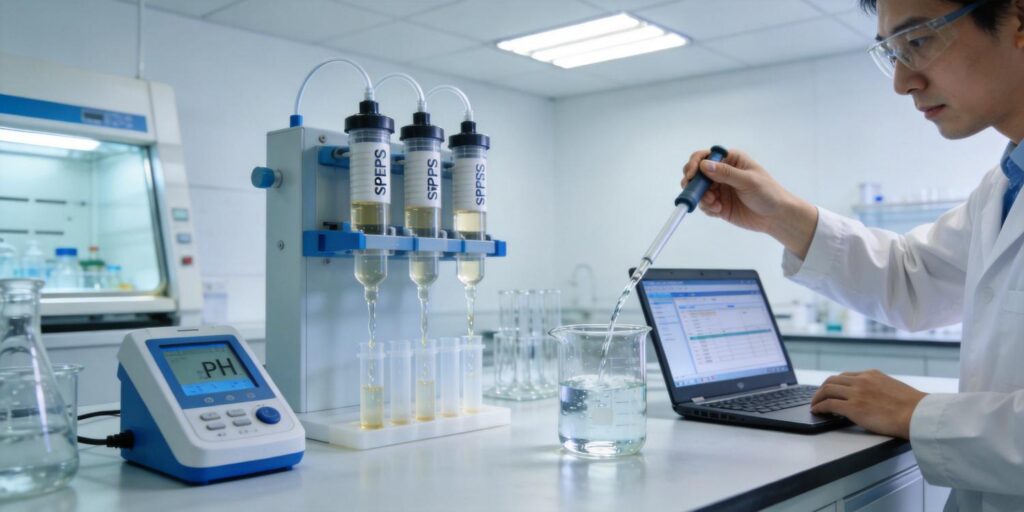
River water often contains PFAS at trace levels (ng/L), necessitating large sample volumes (250 mL to 1 L) to achieve detection limits. SPE cartridges with high capacity and flow rates are required. Poseidon’s WAX SPE cartridges are designed for high-throughput applications, handling volumes up to 1 L without breakthrough. For processing multiple samples simultaneously, 96-well SPE plates offer a convenient format, though for single large volumes, standard cartridges are preferred. Prior to loading, the cartridge must be conditioned with methanol followed by deionized water to activate the sorbent. The sample is then passed through at a flow rate of 5–10 mL/min under vacuum or positive pressure. A pH adjustment of the sample to 3–4 with formic acid can enhance retention of anionic PFAS on WAX sorbents.
Washing Protocol
After sample loading, a washing step removes matrix interferences without eluting the analytes. For PFAS on WAX cartridges, a typical wash uses 5–10 mL of deionized water or 25 mM acetate buffer (pH 4) to flush out salts and polar organic matter. A subsequent wash with 5 mL of methanol/water (40:60, v/v) can further remove non-polar interferences. However, methanol concentration should be kept below 50% to avoid premature elution of PFAS. For MAX cartridges, a more stringent wash with 0.1 M sodium hydroxide may be used to remove acidic interferences while retaining PFAS. The wash step is critical for achieving clean extracts suitable for LC-MS/MS analysis.
Elution with Basic Methanol
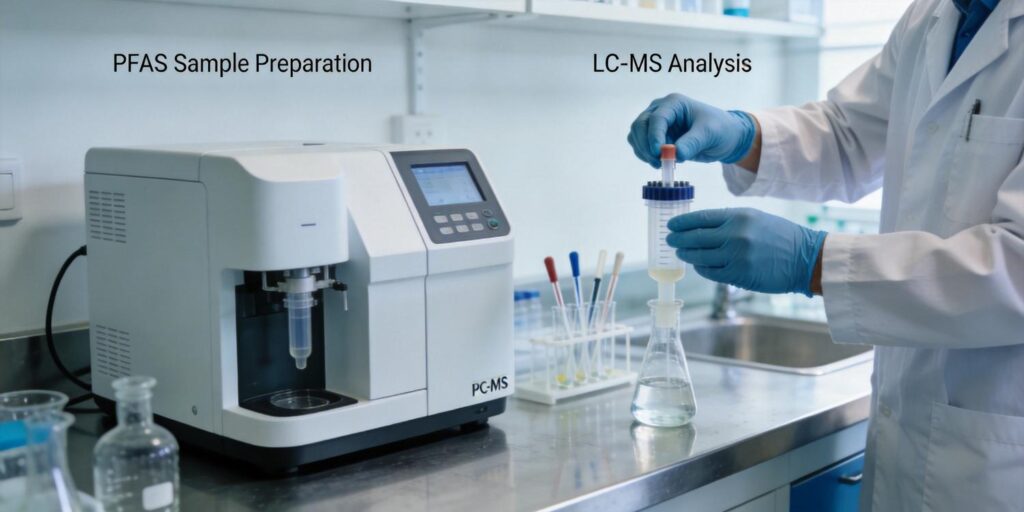
Elution of anionic PFAS from anion exchange sorbents requires a basic solvent to neutralize the ionic interaction. A typical eluent is methanol containing 0.1–1% ammonium hydroxide (NH4OH) or 0.1 M sodium hydroxide in methanol. For WAX cartridges, 5 mL of 0.1% NH4OH in methanol is sufficient to elute most PFAS. For MAX cartridges, a stronger base such as 2% NH4OH may be needed. The eluate is collected and evaporated under a gentle nitrogen stream to near dryness, then reconstituted in a small volume (e.g., 1 mL) of methanol/water (1:1, v/v) for injection. Isotope-labeled internal standards (e.g., 13C-PFOA) should be added prior to extraction to correct for recovery variations.
LC-MS/MS Detection
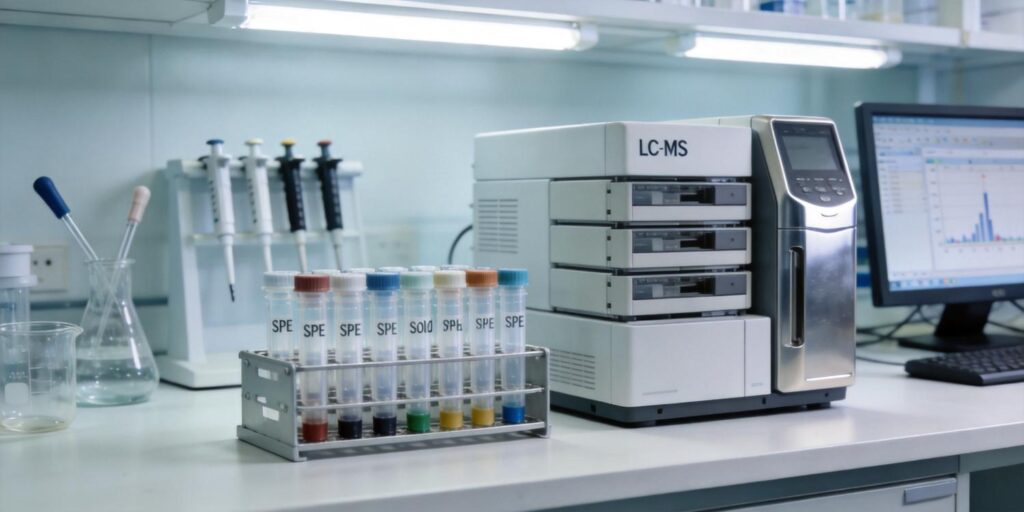
Quantification of PFAS is performed using liquid chromatography-tandem mass spectrometry (LC-MS/MS) with electrospray ionization in negative mode. A C18 reversed-phase column (e.g., 2.1 × 100 mm, 1.7 µm) with a gradient of water and methanol containing 2 mM ammonium acetate is commonly used. Multiple reaction monitoring (MRM) transitions are selected for each target PFAS. Calibration standards are prepared in solvent-matched matrix to account for matrix effects. The method detection limits typically range from 0.1 to 1 ng/L for 1 L samples. Quality control measures include procedural blanks, matrix spikes, and duplicate samples.
Environmental Data Reporting
Results are reported in ng/L (ppt) with appropriate QA/QC documentation. Concentrations of individual PFAS and total PFAS are compared to regulatory guidelines such as the EPA health advisory levels of 70 ng/L for PFOA and PFOS combined. Detection frequencies and spatial distributions across river systems provide insight into pollution sources. The HLB SPE cartridges are also widely used for broader contaminant screening. Regular monitoring programs using validated SPE methods ensure reliable data for risk assessment and mitigation strategies.