Chemical Diversity of Tea Polyphenols
Tea polyphenols represent one of the most chemically diverse classes of natural compounds found in food products. These bioactive molecules include catechins (epigallocatechin gallate, epicatechin gallate, epigallocatechin, and epicatechin), flavonols (quercetin, kaempferol, myricetin), flavones, phenolic acids, and theaflavins. The structural complexity arises from variations in hydroxylation patterns, glycosylation, and polymerization states, creating a challenging analytical landscape for comprehensive profiling.
According to solid-phase extraction principles, this chemical diversity necessitates careful consideration of extraction strategies. The phenolic hydroxyl groups present in these compounds provide both hydrogen bonding capabilities and pH-dependent ionization characteristics that significantly influence their interaction with SPE sorbents. The presence of multiple hydroxyl groups increases water solubility while reducing hydrophobicity, requiring specialized approaches for effective retention and elution.
Matrix Challenges in Tea Infusions
Tea infusions present a complex matrix that complicates polyphenol analysis. The aqueous extract contains not only the target phenolic compounds but also interfering substances including caffeine, theanine, proteins, polysaccharides, pigments, and various metal ions. These matrix components can compete for binding sites on SPE sorbents, reduce recovery efficiency, and interfere with subsequent chromatographic analysis.
As noted in SPE literature, “The high or variable water and fat contents of citrus fruit, berries and nuts can present capacity problems” (Simpson & Wells, 2000), and similar challenges exist with tea matrices. The presence of tannins and other polymeric compounds can lead to non-specific binding and column fouling if not properly addressed during sample preparation. Additionally, the pH of tea infusions (typically 5.0-6.5) affects the ionization state of phenolic compounds, influencing their retention characteristics on various SPE phases.
SPE Sorbent Selection for Phenolic Compounds
Reversed-Phase Sorbents
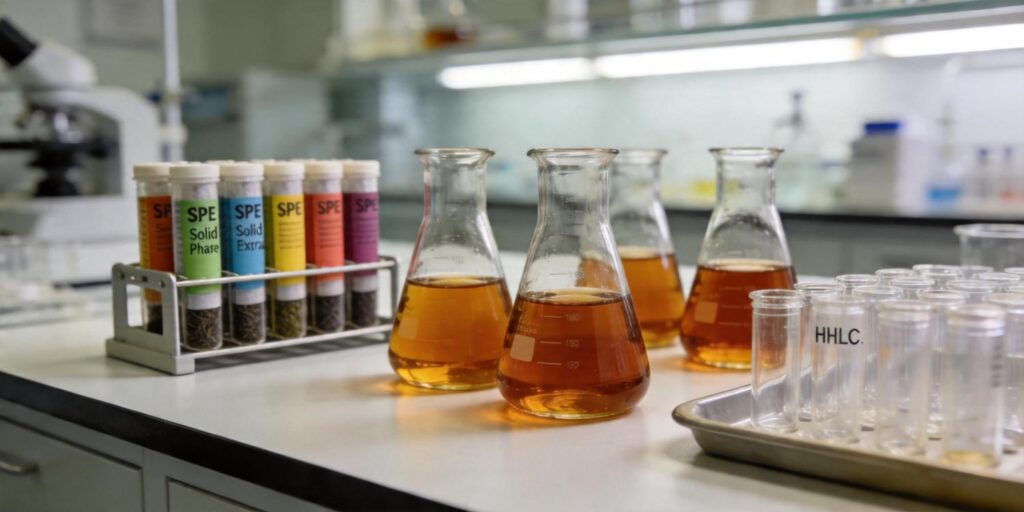
Reversed-phase sorbents, particularly C18 and C8 phases, are commonly employed for polyphenol extraction due to their ability to retain moderately polar compounds. The hydrophobic interactions between the alkyl chains and the aromatic rings of polyphenols provide effective retention. However, as SPE research indicates, “C18 will extract a large number of compounds with differing chemical properties” (Forensic and Clinical Applications of Solid Phase Extraction), making it suitable for broad-spectrum polyphenol capture.
Mixed-Mode and Polymeric Sorbents
For more selective extraction, polymeric sorbents like polystyrene-divinylbenzene (PS-DVB) offer advantages for phenolic compounds. Research demonstrates that “PS-DVB SPE material for environmental applications provides high recovery of phenols in water – wide range of polarities and solubilities” (Agilent SPE Guide). These sorbents exhibit higher capacity for polar compounds compared to traditional silica-based materials and are less susceptible to pH variations.
Ion-Exchange and Specialized Phases
Weak anion exchange (WAX) and mixed-mode sorbents can be particularly effective for acidic polyphenols. The combination of hydrophobic and ionic interactions allows for selective retention based on both molecular structure and ionization state. For catechins and other compounds with specific functional groups, specialized phases like phenylboronic acid can provide covalent bonding capabilities for selective extraction.
Example Workflow for Tea Sample Purification
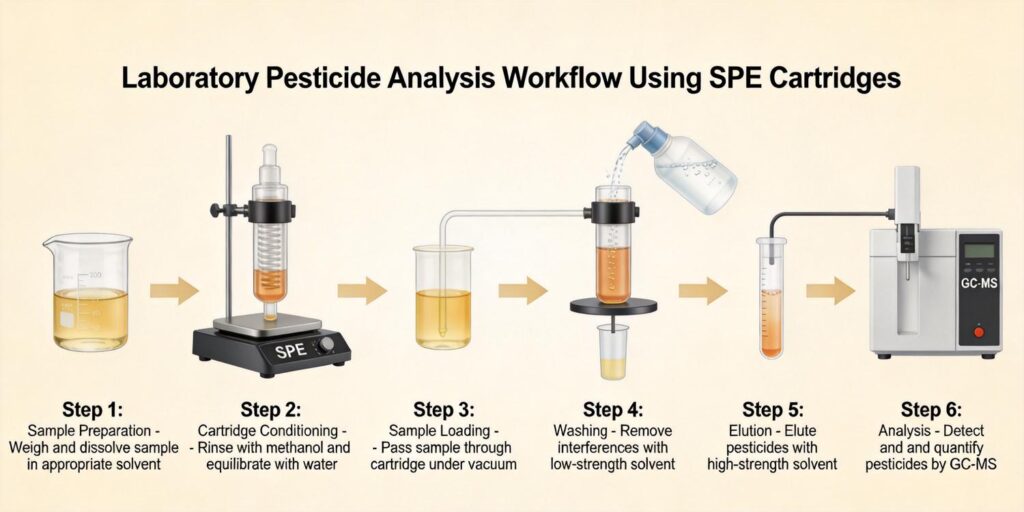
A comprehensive SPE workflow for tea polyphenol analysis typically follows these optimized steps:
- Sample Preparation: Tea infusion is filtered through 0.45μm membrane to remove particulate matter. The sample pH is adjusted to 2.5-3.0 using formic acid or phosphoric acid to suppress ionization of phenolic acids and enhance retention on reversed-phase sorbents.
- SPE Cartridge Conditioning: The selected sorbent (typically 500mg C18 or equivalent polymeric phase) is conditioned with 5-10mL methanol followed by 5-10mL acidified water (pH 3.0). This ensures proper wetting and activation of binding sites.
- Sample Loading: 10-50mL of prepared tea infusion is loaded at controlled flow rates (1-3mL/min) to ensure adequate contact time and maximize polyphenol retention.
- Washing: The cartridge is washed with 5-10mL of acidified water (pH 3.0) containing 5-10% methanol to remove interfering compounds while retaining target polyphenols.
- Drying: The cartridge is dried under vacuum or nitrogen stream for 5-10 minutes to remove residual water, which is critical for efficient elution with organic solvents.
- Elution: Polyphenols are eluted with 5-10mL of methanol or acetonitrile, often acidified with 0.1% formic acid to improve recovery of acidic compounds. For comprehensive profiling, sequential elution with solvents of increasing polarity may be employed.
- Concentration and Reconstitution: The eluate is evaporated under nitrogen at 40°C and reconstituted in mobile phase compatible solvent for HPLC analysis.
HPLC and LC-MS Analysis
Following SPE purification, tea polyphenols are typically analyzed using reversed-phase HPLC with UV-Vis or photodiode array detection. Common conditions include C18 columns (250 × 4.6mm, 5μm), gradient elution with water-acetonitrile or water-methanol mixtures acidified with 0.1% formic acid, and detection at 280nm (catechins) and 360nm (flavonols).
For more comprehensive profiling and identification, LC-MS systems provide superior capabilities. Electrospray ionization in negative mode is particularly effective for polyphenol analysis, as most compounds form stable deprotonated molecules [M-H]⁻. High-resolution mass spectrometry enables accurate mass determination for compound identification and differentiation of isomers.
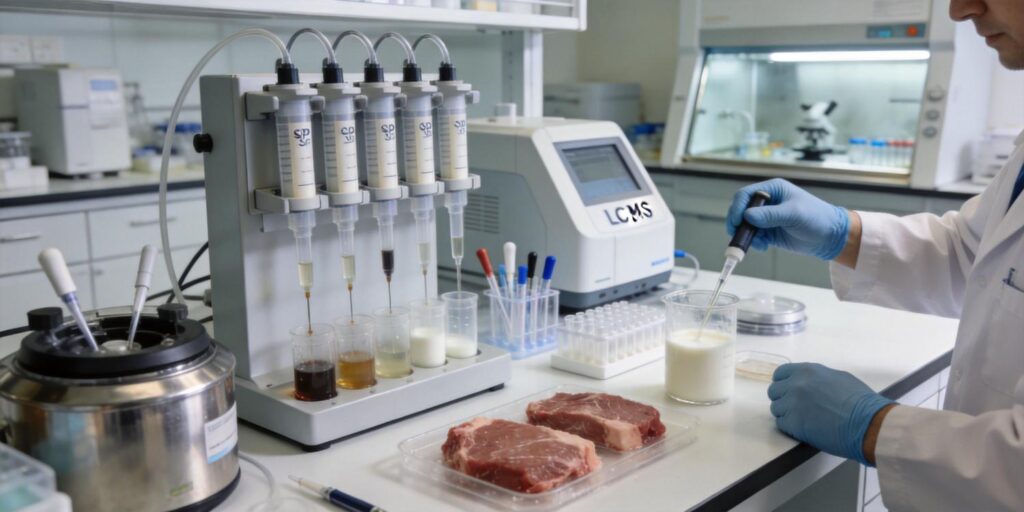
The SPE clean-up significantly enhances LC-MS performance by reducing matrix effects, improving ionization efficiency, and extending column lifetime. As noted in SPE applications, “SPE allows extraction under mild conditions of pH, thereby limiting the incidence of decomposition or rearrangement of labile compounds” (Simpson & Wells, 2000), which is particularly important for sensitive polyphenol analysis.
Applications in Quality Evaluation and Research
Quality Control and Authentication
SPE-based polyphenol profiling serves as a powerful tool for tea quality evaluation. The characteristic fingerprint of phenolic compounds can authenticate tea varieties, geographical origins, and processing methods. Quantitative analysis of key markers like EGCG provides objective measures of tea quality and potential health benefits.
Processing Optimization
Monitoring polyphenol profiles during tea processing (withering, rolling, fermentation, drying) helps optimize conditions to maximize desirable compounds while minimizing degradation. SPE sample preparation enables rapid analysis of processing intermediates for real-time quality control.
Bioavailability and Metabolism Studies
In nutritional and pharmacological research, SPE facilitates the analysis of polyphenol metabolites in biological fluids. The technique’s ability to concentrate trace analytes while removing interfering matrix components makes it invaluable for pharmacokinetic studies and bioavailability assessments.
Antioxidant Capacity Correlation
Comprehensive polyphenol profiling enables correlation studies between specific compound profiles and antioxidant capacity measurements. This research supports structure-activity relationship studies and helps identify the most potent antioxidant compounds in different tea varieties.
The integration of SPE sample preparation with advanced analytical techniques provides researchers and quality control laboratories with robust methods for tea polyphenol analysis. By addressing the unique challenges of tea matrices through optimized sorbent selection and workflow design, SPE enables accurate, reproducible, and comprehensive profiling that supports both basic research and applied quality evaluation.
For laboratories seeking to implement or optimize tea polyphenol analysis, Poseidon Scientific offers a range of HLB SPE cartridges, MCX mixed-mode cartridges, and 96-well SPE plates specifically designed for challenging phenolic compound extractions from complex matrices.