Environmental Persistence of Antibiotic Metabolites
Antibiotic metabolites represent a significant environmental concern due to their persistence in wastewater effluent systems. Unlike parent compounds, these metabolites often exhibit modified chemical structures that can maintain biological activity while resisting conventional wastewater treatment processes. The environmental persistence of these compounds creates selective pressure for antimicrobial resistance development in environmental bacteria, which can subsequently transfer resistance genes to human pathogens.
Research indicates that antibiotic metabolites can persist in aquatic environments for extended periods, with half-lives ranging from days to months depending on environmental conditions. Their polar nature and water solubility facilitate transport through water systems, making wastewater treatment plants critical points for monitoring and intervention. The continuous discharge of these compounds, even at trace concentrations, contributes to the environmental reservoir of antimicrobial resistance determinants.
Sample Preparation Challenges in Wastewater Effluent
Wastewater effluent presents unique challenges for analytical chemists targeting antibiotic metabolites. The matrix complexity includes high concentrations of dissolved organic matter, salts, particulates, and competing organic compounds that can interfere with analysis. Traditional sample preparation methods often prove inadequate for these complex environmental samples, necessitating specialized approaches.
Key challenges include:
- Matrix Effects: High concentrations of humic acids, fulvic acids, and other dissolved organic matter can cause ion suppression in mass spectrometry analysis
- Particulate Matter: Suspended solids can clog extraction cartridges and interfere with analyte recovery
- Competing Compounds: Similar pharmaceuticals, personal care products, and industrial chemicals may co-extract with target metabolites
- Low Concentration Levels: Antibiotic metabolites typically exist at ng/L to μg/L concentrations, requiring effective enrichment strategies
- pH and Ionic Strength Variability: Wastewater characteristics fluctuate significantly, affecting extraction efficiency
SPE Enrichment for Trace Compounds
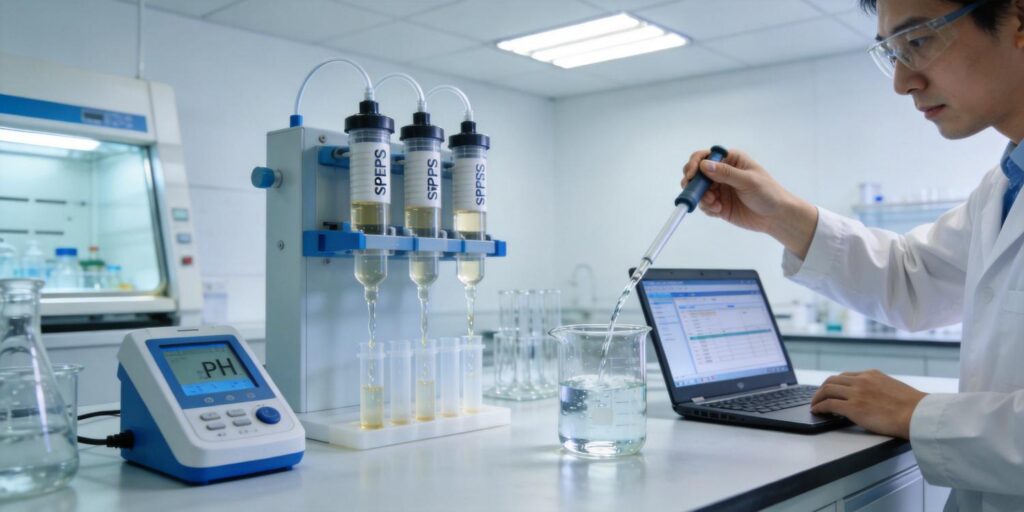
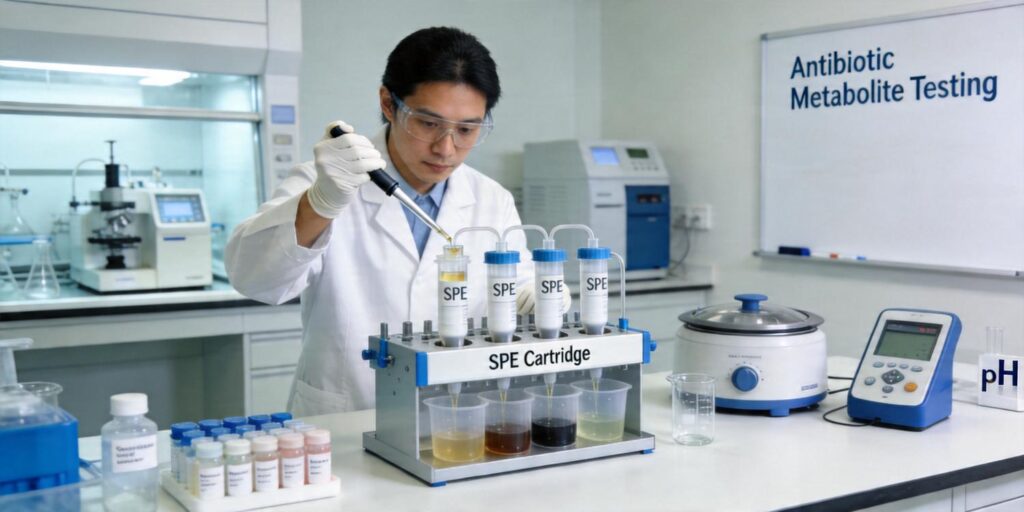
Solid-phase extraction (SPE) has emerged as the gold standard for concentrating trace antibiotic metabolites from wastewater effluent. The technique offers several advantages over traditional liquid-liquid extraction, including improved throughput, decreased organic solvent usage, higher recoveries, cleaner extracts, and tunable selectivity through phase choices and solvent mixtures.
The fundamental SPE process involves five critical steps:
- Prewash: Removal of contaminants that could elute with analytes
- Precondition: Preparation of cartridge to accept sample
- Load: Sample application and reservoir rinsing
- Wash: Removal of matrix components without eluting analytes
- Elute: Recovery of analytes in smallest possible volume
For antibiotic metabolites, mixed-mode cartridges providing both hydrophobic and cation exchange interactions have proven particularly effective. These cartridges can be combined with pH-dependent sample application and extraction to achieve high recoveries from complex matrices like wastewater effluent.
SPE Phase Selection for Antibiotic Metabolites
The choice of SPE phase depends on the chemical properties of target metabolites:
- HLB (Hydrophilic-Lipophilic Balance): Ideal for broad-spectrum extraction of polar and non-polar compounds
- MAX (Mixed-mode Anion Exchange): Suitable for acidic metabolites and compounds with carboxyl groups
- MCX (Mixed-mode Cation Exchange): Effective for basic metabolites and compounds with amine groups
- WAX (Weak Anion Exchange): Useful for strongly acidic compounds
- WCX (Weak Cation Exchange): Appropriate for strongly basic compounds
Example Extraction Protocol for Large Sample Volumes
For comprehensive monitoring of antibiotic metabolites in wastewater effluent, large sample volumes (typically 500 mL to 1 L) are often required to achieve adequate detection limits. The following protocol demonstrates an effective approach using mixed-mode SPE cartridges:
Materials and Equipment
- Mixed-mode SPE cartridges (500 mg, 6 mL bed volume)
- Vacuum manifold system
- pH meter and buffers
- Organic solvents (methanol, acetonitrile, ethyl acetate)
- Sample collection bottles (1 L)
- Centrifuge tubes (15 mL)
Procedure
- Sample Collection and Preservation: Collect 1 L wastewater effluent samples in amber glass bottles. Adjust to pH 3.0 using hydrochloric acid and store at 4°C until extraction (within 24 hours).
- Sample Pretreatment: Filter samples through 0.45 μm glass fiber filters to remove particulates. Centrifuge at 4000 × g for 10 minutes if necessary to clarify samples.
- SPE Cartridge Conditioning:
- Condition with 6 mL methanol
- Follow with 6 mL deionized water
- Do not allow sorbent bed to dry
- Sample Loading: Load 500 mL filtered sample at controlled flow rate of 5-10 mL/min. Maintain consistent flow to ensure optimal analyte retention.
- Wash Step: Wash cartridge with 5 mL 5% methanol in water to remove weakly retained matrix components.
- Drying: Apply vacuum for 10 minutes to remove residual water from sorbent bed.
- Elution: Elute analytes with 6 mL methanol containing 2% formic acid (for acidic metabolites) or 6 mL methanol containing 5% ammonium hydroxide (for basic metabolites). Collect eluate in 15 mL centrifuge tubes.
- Concentration: Evaporate eluate to dryness under gentle nitrogen stream at 40°C. Reconstitute in 1 mL mobile phase compatible with LC-MS/MS analysis.
Quality Control Measures
Include procedural blanks, matrix spikes, and duplicate samples to monitor extraction efficiency and method precision. Recovery rates should typically exceed 80% with relative standard deviations below 15% for reliable quantitative analysis.
LC-MS/MS Detection of Metabolites
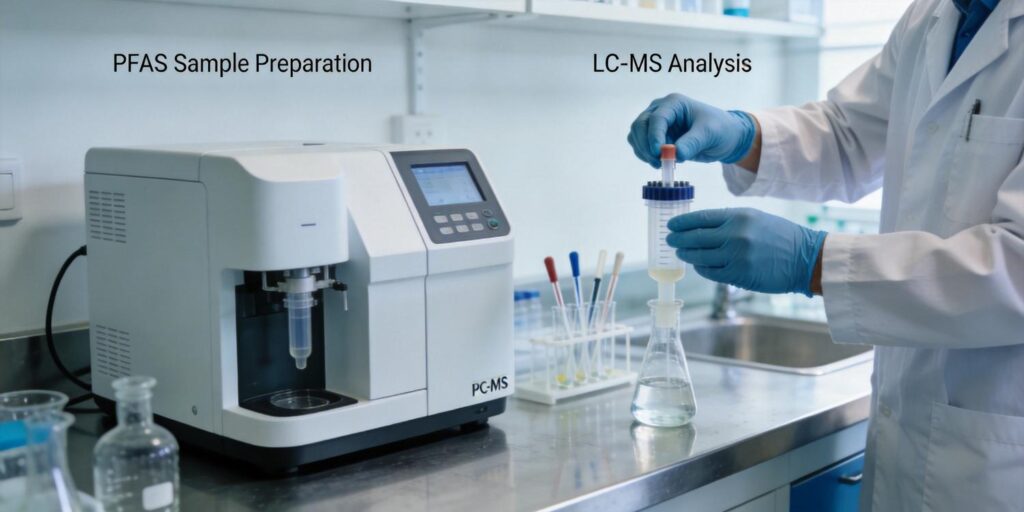
Liquid chromatography coupled with tandem mass spectrometry (LC-MS/MS) provides the sensitivity and selectivity required for antibiotic metabolite detection in wastewater effluent. The technique offers several advantages for environmental monitoring:
Chromatographic Conditions
Optimal separation typically involves:
- Column: C18 or equivalent reversed-phase column (100 × 2.1 mm, 1.7 μm particle size)
- Mobile Phase: Gradient elution with water and methanol/acetonitrile containing 0.1% formic acid
- Flow Rate: 0.3-0.5 mL/min
- Column Temperature: 40°C
- Injection Volume: 10-20 μL
Mass Spectrometry Parameters
Electrospray ionization (ESI) in positive or negative mode, depending on metabolite properties:
- Ion Source Temperature: 150°C
- Desolvation Temperature: 400°C
- Cone Gas Flow: 50 L/hr
- Desolvation Gas Flow: 800 L/hr
- Collision Energy: Optimized for each metabolite
Multiple Reaction Monitoring (MRM)
MRM transitions should be established for each target metabolite, typically monitoring two transitions per compound for confirmation. Quantification is performed using internal standards (preferably isotopically labeled analogs) to correct for matrix effects and instrument variability.
Monitoring Antimicrobial Resistance Indicators
The presence of antibiotic metabolites in wastewater effluent serves as an important indicator of antimicrobial resistance development. Monitoring programs should consider several key aspects:
Resistance Gene Detection
Molecular methods can complement chemical analysis by detecting resistance genes in wastewater samples. Quantitative PCR (qPCR) and metagenomic sequencing provide insights into the genetic potential for resistance development.
Bioassay Approaches
Biological assays using indicator bacteria can assess the selective pressure exerted by antibiotic residues and metabolites. These assays provide functional information about the biological activity of complex mixtures.
Risk Assessment Framework
Develop comprehensive risk assessment models that integrate:
- Chemical concentration data
- Ecotoxicity information
- Resistance gene prevalence
- Environmental fate and transport modeling
- Human exposure pathways
Regulatory Considerations
Emerging regulations worldwide are beginning to address pharmaceutical residues in wastewater. Monitoring programs should align with regulatory frameworks such as the EU Watch List under the Water Framework Directive and US EPA guidelines for contaminants of emerging concern.
Conclusion
The extraction and analysis of antibiotic metabolites in wastewater effluent represents a critical component of environmental monitoring programs aimed at understanding and mitigating antimicrobial resistance development. Solid-phase extraction, particularly using mixed-mode cartridges, provides an effective means of concentrating these trace compounds from complex matrices. When coupled with sensitive LC-MS/MS detection, these methods enable comprehensive monitoring programs that can inform regulatory decisions and public health interventions.
As product manager at Poseidon Scientific, I recommend our MCX SPE cartridges for basic antibiotic metabolites and MAX SPE cartridges for acidic metabolites. For high-throughput applications, our 96-well SPE plates offer automation compatibility and improved workflow efficiency.
Continued method development and validation will be essential as new antibiotic metabolites are identified and regulatory requirements evolve. The integration of chemical analysis with biological assays and molecular methods provides the most comprehensive approach to understanding the complex relationship between antibiotic residues, metabolite formation, and antimicrobial resistance development in aquatic environments.