
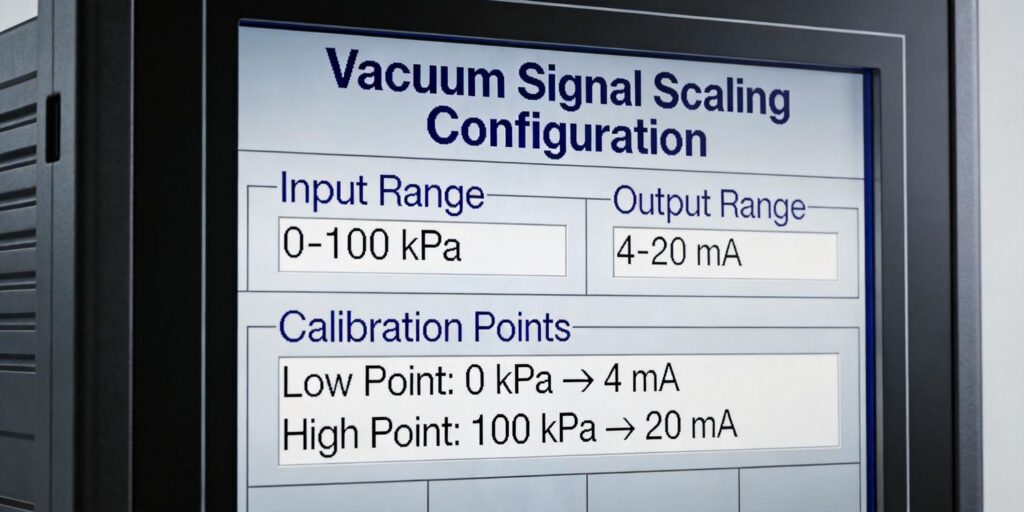
Scaling Raw Signal into mbar
Vacuum gauge analog and digital outputs rarely deliver pressure directly in engineering units. Instead, they provide a raw voltage (typically 0–10 V) or a serial data packet that must be scaled to a meaningful pressure value. For laboratory, semiconductor, and thin-film applications, millibar (mbar) is the preferred unit in many European and Asian control systems because it aligns directly with SI-derived vacuum standards. Poseidon Scientific’s VG-SP205 Pirani Vacuum Transmitter and VG-SM225 Cold Cathode Vacuum Gauge both output a 0–10 V analog signal (effective linear range 2–8 V) and RS232 digital data, giving engineers two clean paths to accurate mbar scaling.
The VG-SP205 Pirani uses thermal conductivity to generate a voltage proportional to gas heat loss across atmosphere to 10−3 Torr. The VG-SM225 Cold Cathode relies on Penning discharge ion current, producing a voltage that tracks 10−3 to 10−7 Torr. In both cases, the factory calibration curve (established against NIST-traceable standards) is the foundation for scaling. Poseidon provides the exact voltage-to-pressure relationship with every unit, enabling direct conversion without guesswork.
Converting to Torr or Pa
Once the raw signal is scaled to mbar, conversion to Torr or Pa is a simple multiplication using internationally accepted constants:
1 mbar = 0.75006 Torr (often rounded to 0.75 Torr for field work)
1 mbar = 100 Pa
These relationships are exact for practical purposes in vacuum technology. For highest precision, use the full conversion factors and maintain floating-point arithmetic throughout the PLC or data-acquisition system. Poseidon’s RS232 digital output already transmits pressure in the customer-chosen unit when the protocol is customized at the factory—eliminating on-site conversion entirely for 5–10 unit orders.
Example: If a scaled reading is 5.0 × 10⁻⁴ mbar, the equivalent Torr value is 3.75 × 10⁻⁴ Torr and the Pa value is 0.05 Pa. These conversions are critical when integrating with legacy equipment calibrated in Torr or when exporting data to international partners.
PLC Engineering Unit Configuration
Modern PLCs (Siemens, Allen-Bradley, Mitsubishi, etc.) handle vacuum gauge signals through analog input modules or serial communication blocks. For the 0–10 V analog output of Poseidon transmitters, map the raw ADC counts to voltage, then apply the manufacturer-supplied scaling equation or lookup table. The effective 2–8 V range corresponds to the full pressure span of each gauge, leaving headroom for over-range detection.
Digital integration via RS232 is even simpler. Poseidon’s customizable protocol lets the gauge transmit pressure already scaled in mbar, Torr, or Pa at 1-second intervals. No additional math blocks are required in the PLC. This native engineering-unit output reduces ladder logic complexity and improves scan times—especially valuable in high-speed vacuum control loops.
Recommended PLC tags:
- Raw_Voltage (REAL)
- Pressure_mbar (REAL)
- Pressure_Torr (REAL)
- Pressure_Pa (REAL)
Use the same scaling routine for both the Pirani and Cold Cathode gauges; only the voltage-to-pressure constants differ between the two models.
Avoiding Rounding Errors
Rounding errors accumulate quickly in vacuum systems where pressures span six or more orders of magnitude. Always perform scaling in double-precision floating-point (REAL or FLOAT64) rather than integer or single-precision formats. Avoid intermediate rounding when converting between mbar, Torr, and Pa—complete all math in one step using the exact conversion factors.
Example pseudocode for analog scaling (Pirani gauge):
Pressure_mbar = 10^( (V_out - 2.0) * 0.5 - 3.0 ) // simplified log-linear approximation; use factory table for production accuracy
For the VG-SM225 Cold Cathode, a piecewise linear or polynomial fit is applied across the discharge curve. Poseidon supplies the precise coefficients or lookup table with each shipment, ensuring sub-1% deviation from true pressure when implemented correctly.
Verification Process
After scaling is programmed, verification prevents costly process excursions. The standard method uses a calibrated reference gauge (e.g., capacitance manometer) mounted on the same chamber. Evacuate the system stepwise and compare displayed values at three or more points across the operating range.
Step-by-step verification:
- Power the Poseidon transmitter and confirm stable 0–10 V output at atmosphere (Pirani) or base pressure (Cold Cathode).
- Log raw voltage and scaled pressure simultaneously with the PLC.
- Introduce known gas loads or use a leak valve to reach target pressures.
- Record data for at least 60 seconds at each setpoint to average out noise.
- Calculate deviation: (Scaled – Reference) / Reference × 100 %. Acceptance is typically ±10 % for Pirani in non-linear regions and ±15 % for Cold Cathode at the lowest decades.
Repeat after any PLC firmware update or cable change. Poseidon’s cleanable Cold Cathode design allows electrode maintenance without recalibration, further simplifying long-term verification.
Example Scaling Table
The table below illustrates a typical analog scaling example for the VG-SP205 Pirani (atmosphere to 10−3 Torr range). Actual values are supplied with each unit; this is representative only.
| Voltage (V) | Pressure (mbar) | Pressure (Torr) | Pressure (Pa) |
|---|---|---|---|
| 2.0 | 1.0 × 10⁻³ | 7.5 × 10⁻⁴ | 0.1 |
| 3.5 | 1.0 | 0.75 | 100 |
| 5.0 | 10 | 7.5 | 1000 |
| 8.0 | 1013 (atm) | 760 | 101325 |
For the VG-SM225 Cold Cathode, the lower decades follow a near-linear ion-current relationship; Poseidon provides the corresponding 2–8 V table for 10−3 to 10−7 Torr. Use linear interpolation or the supplied polynomial for intermediate values.
Commissioning Checklist
Use this checklist to ensure error-free integration:
- Confirm flange compatibility (KF16/KF25 standard) and leak-tight installation.
- Verify power supply meets 24 V DC requirement with <1 % ripple.
- Connect RJ45 (or adapter) and test RS232 communication at 9600 baud default.
- Load factory scaling constants into PLC and validate at three pressure points.
- Enable high-voltage protection logic on the VG-SM225 (auto-shutdown >10−3 Torr).
- Document as-built scaling equations and calibration certificate serial numbers.
- Perform 24-hour stability test under normal process gas load.
- Train operators on electrode cleaning procedure for the Cold Cathode gauge.
Completing this checklist typically reduces commissioning time from days to hours compared with non-customizable legacy gauges.
Optimize Your Vacuum Control Integration
Accurate signal scaling is the foundation of reliable vacuum process control. Poseidon Scientific’s VG-SP205 Pirani Vacuum Transmitter and VG-SM225 Cold Cathode Vacuum Gauge combine factory-calibrated outputs, customizable digital protocols, and compact design to simplify scaling into mbar, Torr, or Pa while eliminating rounding errors and unnecessary PLC complexity.
Whether you are commissioning a new system or retrofitting existing PLC logic, our applications team provides the exact scaling tables, sample code snippets, and on-site support you need for seamless integration.
Learn more about the VG-SP205 Pirani Vacuum Transmitter | Discover the VG-SM225 Cold Cathode Vacuum Gauge
Contact our engineering support team today for a no-obligation integration review. Share your PLC model, desired engineering units, and process range, and we will return a complete scaling package and quotation within 24 hours. Reliable vacuum measurement starts with the right signal—let Poseidon help you get it right the first time.


