Chemical Composition of Energy Drinks
Energy drinks represent a complex analytical matrix containing both active ingredients and numerous excipients. The primary active compounds include caffeine (a xanthine alkaloid), taurine (2-aminoethanesulfonic acid), and various B-group vitamins (notably B3, B6, and B12). Caffeine, being a weakly basic to neutral molecule, presents unique extraction challenges as its acid salts dissociate rapidly in aqueous solution. Taurine, an amino sulfonic acid, exhibits zwitterionic properties with pKa values of 1.5 (sulfonic acid) and 8.74 (amino group), making it amenable to ion-exchange mechanisms.
According to established literature, beverages with moderate alcohol or sugar content are relatively straightforward to process by SPE, provided the sugar content remains consistent. The presence of these active ingredients alongside complex matrices necessitates careful method development to ensure accurate quantification and reliable analytical results.
Matrix Interference from Sugars and Additives
Energy drinks contain significant concentrations of sugars (sucrose, glucose, fructose), preservatives (sodium benzoate, potassium sorbate), colorants (caramel, synthetic dyes), and flavoring agents. These matrix components can severely interfere with LC-MS analysis by causing ion suppression, column fouling, and detector saturation.
Research demonstrates that SPE provides effective matrix removal and concentration of target analytes. For instance, studies on soft drink analysis using C8 and SCX cartridges successfully removed caffeine, aspartame, sodium benzoate, and caramel color acids from the sample matrix. The high sugar content in energy drinks can lead to viscosity issues during sample loading, requiring appropriate dilution or pretreatment strategies.
SPE Sorbent Selection for Active Ingredients
Selecting the appropriate SPE sorbent is critical for successful energy drink analysis. Based on the chemical properties of target analytes:
Mixed-Mode Sorbents
Mixed-mode cartridges combining hydrophobic (C8/C18) and cation exchange (SCX) interactions offer optimal recovery for energy drink components. These sorbents provide pH-dependent sample application and extraction, yielding high recoveries from complex beverage matrices. The resulting SPE eluates show minimal interference from endogenous matrix components, facilitating subsequent LC-MS analysis.
Reversed-Phase Sorbents
C18 bonded phases effectively retain caffeine and other neutral compounds. However, they may require careful pH adjustment to optimize taurine recovery due to its zwitterionic nature. Studies show that C18 sorbents can extract caffeine from hydrolyzed urine with good recovery, though they may co-extract interfering species like endogenous urinary acids and plant phenolics.
Ion-Exchange Sorbents
Strong cation exchange (SCX) sorbents are particularly effective for taurine extraction at acidic pH, where the amino group is protonated. For B-vitamins with acidic functional groups, strong anion exchange (SAX) sorbents may be appropriate. The choice between reversed-phase and ion-exchange methodologies depends on the acidic-basic properties of the target compounds and the nature of excipients.
Example Sample Preparation Workflow
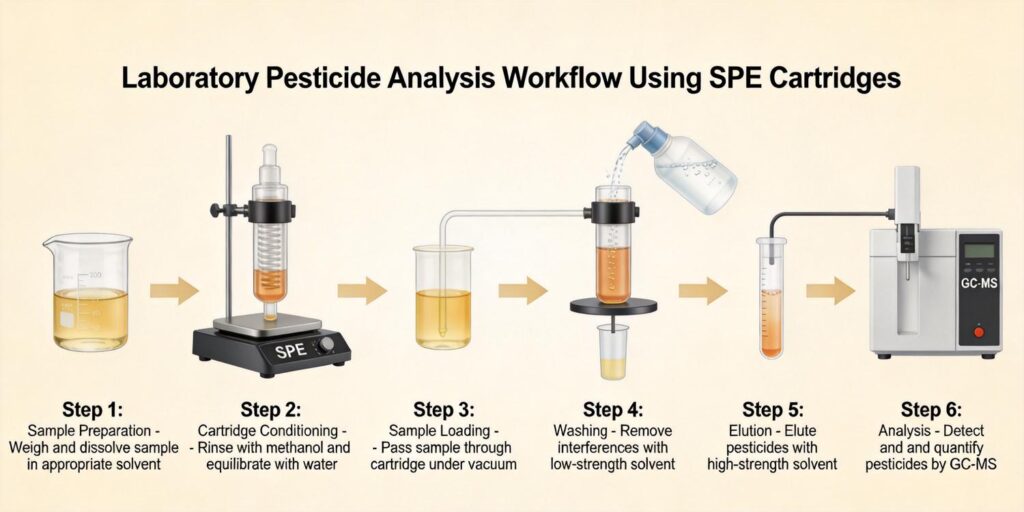
A comprehensive SPE cleanup protocol for energy drink analysis typically follows these steps:
1. Sample Pretreatment
Dilute 1 mL of energy drink with 4 mL of appropriate buffer (pH 4.5 acetate buffer for cation exchange or pH 8.0 phosphate buffer for anion exchange). For high-sugar samples, additional dilution may be necessary to reduce viscosity and prevent cartridge clogging.
2. SPE Cartridge Conditioning
Condition mixed-mode cartridges sequentially with 6 mL methanol followed by 3 mL of buffer solution matching the sample pH. For C18 sorbents, condition with 6 mL methanol followed by 3 mL water or buffer.
3. Sample Loading
Apply the diluted sample at a controlled flow rate of 1-3 drops per second. Recovery is inversely proportional to flow rate, so maintaining consistent flow is essential for reproducible results.
4. Washing Steps
Wash with 3 mL of water to remove sugars and polar interferences. Follow with 3 mL of 20% methanol in water to remove moderately polar compounds while retaining target analytes. For mixed-mode cartridges, include a wash with 20% acetonitrile in water to eliminate polar interfering species without affecting basic analyte recovery.
5. Elution
Elute caffeine and neutral compounds with 3 mL of methanol or acetonitrile. For taurine and other ionic compounds, use 3 mL of methanol with 2% ammonium hydroxide or appropriate acidic/basic modifiers. Collect eluates in clean tubes and evaporate to dryness if concentration is required.
6. Reconstitution
Reconstitute dried extracts in mobile phase compatible solvent (typically 1 mL of water:methanol 90:10) for LC-MS analysis.
LC-MS Analysis of Active Compounds
Following SPE cleanup, LC-MS analysis provides sensitive and specific quantification of energy drink components:
Chromatographic Conditions
Use reversed-phase C18 columns (150 × 2.1 mm, 3.5 μm) with mobile phases consisting of 0.1% formic acid in water (A) and 0.1% formic acid in acetonitrile (B). Gradient elution from 5% to 95% B over 15 minutes effectively separates caffeine, taurine, and B-vitamins.
Mass Spectrometric Detection
Electrospray ionization in positive mode for caffeine (m/z 195→138) and negative mode for taurine (m/z 124→80) provides optimal sensitivity. Multiple reaction monitoring (MRM) transitions should be optimized for each compound to ensure specificity in complex matrices.
Method Validation
Validate the method for linearity (1-1000 ng/mL), precision (<10% RSD), accuracy (85-115% recovery), and limit of detection (typically 1-10 ng/mL depending on compound). Include matrix-matched calibration standards to account for any residual matrix effects.
Quality Control Applications
SPE cleanup plays a crucial role in quality control laboratories for energy drink manufacturers and regulatory agencies:
Batch Consistency Testing
Regular monitoring of active ingredient concentrations ensures product consistency and compliance with label claims. SPE-LC-MS methods provide the sensitivity and specificity required for accurate quantification at low concentration levels.
Contaminant Screening
SPE methods can be adapted to screen for potential contaminants including pesticide residues, mycotoxins, or unauthorized additives. The concentration effect of SPE enhances detection limits for trace contaminants.
Stability Studies
Monitor degradation products during shelf-life studies. SPE cleanup removes matrix interferences that could mask degradation peaks or cause false positives in stability-indicating methods.
Regulatory Compliance
For regulatory submissions and compliance testing, validated SPE-LC-MS methods provide the necessary data quality for safety assessments and labeling requirements. The consistency of automated SPE platforms ensures reproducible results across multiple laboratories.
High-Throughput Applications
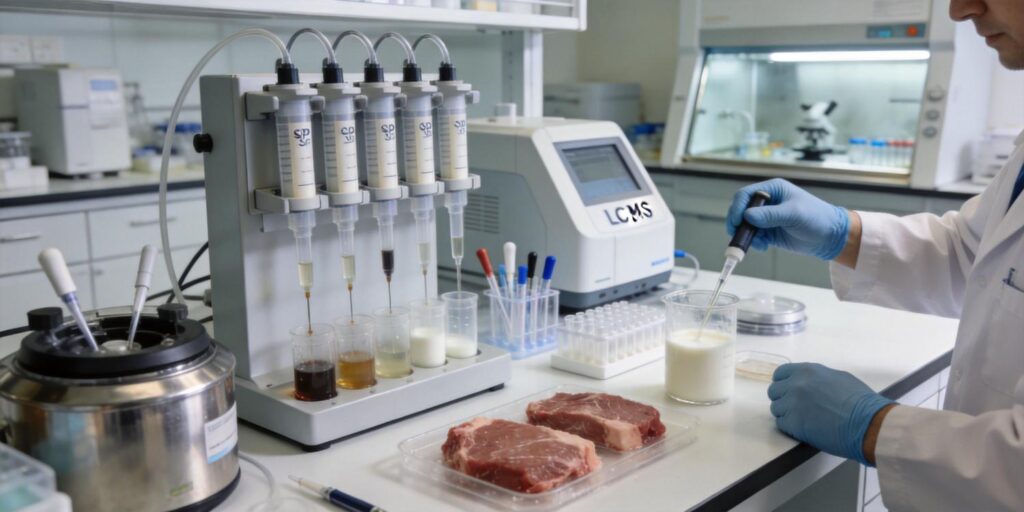
For quality control laboratories processing large sample volumes, 96-well SPE plates offer significant throughput advantages. Automated SPE workstations can process up to 96 samples simultaneously, with cycle times as low as 5-7 minutes per sample when coupled with LC-MS analysis.
The integration of SPE cleanup with LC-MS analysis represents a robust solution for energy drink characterization, combining the selectivity of solid-phase extraction with the sensitivity of mass spectrometric detection. This approach ensures accurate quantification of active ingredients while effectively managing the complex matrix challenges presented by modern energy drink formulations.