
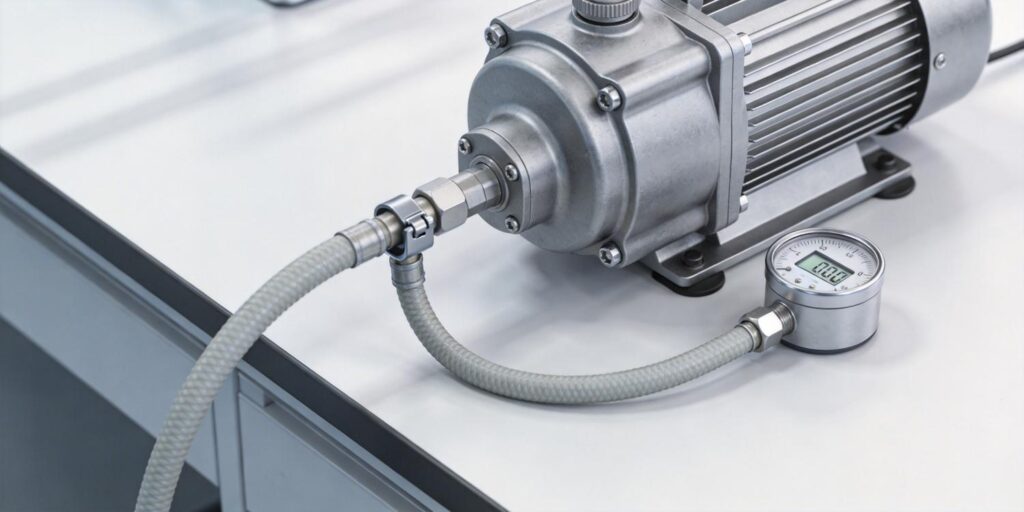
Lab Pump Applications Overview
Laboratory vacuum pumps power a wide range of scientific and research workflows, from simple rotary vane pumps used for filtration and degassing to sophisticated turbomolecular and cryopump systems supporting analytical instruments. In university labs, contract research organizations, and R&D facilities, these pumps enable critical processes such as sample preparation for mass spectrometry, electron microscopy, thin-film deposition, and vacuum drying. Accurate vacuum measurement is essential—not only to verify pump performance but also to protect sensitive equipment, ensure reproducible results, and maintain operator safety.
Selecting the right vacuum gauge for a laboratory vacuum pump system involves balancing measurement range, physical size, integration ease, and long-term reliability. Poseidon Scientific’s VG-SP205 Pirani Vacuum Transmitter and VG-SM225 Cold Cathode Vacuum Gauge were developed specifically to address these needs. Designed in-house for cost-sensitive yet performance-driven lab environments, both transmitters deliver the compact footprint, robust construction, and flexible output options that engineers and lab managers appreciate most.
Required Pressure Range for Laboratory Vacuum Pumps
Laboratory applications span a broad pressure spectrum. Roughing pumps (rotary vane or scroll) typically operate from atmosphere down to 10−3 Torr for initial pump-down and backing stages. High-vacuum pumps—turbomolecular, diffusion, or ion pumps—then achieve 10−6 to 10−9 Torr for ultra-clean environments required in surface science or mass spectrometry.
A single gauge rarely covers the entire range reliably. Thermal conductivity gauges excel in the rough vacuum regime, while ionization gauges provide the sensitivity needed at lower pressures. Poseidon’s complementary pair covers atmosphere to 10−7 Torr with seamless handoff: the VG-SP205 handles atmospheric to 10−3 Torr, and the VG-SM225 takes over from 10−3 to 10−7 Torr. This combination eliminates the need for multiple specialized instruments while preventing measurement gaps that could compromise experimental integrity or pump protection.
Pressure stability directly affects lab outcomes. Even small drifts can alter mean free paths, contaminate samples, or trigger false alarms in safety interlocks. Both Poseidon transmitters incorporate temperature compensation circuitry, ensuring consistent readings across the 15–50 °C ambient conditions typical of laboratory settings.
Compact Transmitter Advantages in Laboratory Settings
Space is always at a premium in labs. Traditional vacuum gauges often feature bulky sensor heads and separate controllers that crowd already-limited chamber ports or bench space. Poseidon’s transmitters integrate the sensor, electronics, and display interface into a single compact module measuring just a fraction of legacy units.
The VG-SP205 Pirani and VG-SM225 Cold Cathode both utilize positive magnetron-style or optimized thermal designs that minimize footprint without sacrificing performance. Their KF16/KF25 flange compatibility allows direct mounting on most laboratory vacuum manifolds, load locks, or pump inlets. This small size reduces virtual leaks, improves conductance, and simplifies retrofits on existing pump skids—advantages repeatedly validated in university core facilities and startup R&D labs.
Beyond size, compactness translates to easier handling during installation and maintenance. The entire assembly weighs under 500 grams, making it ideal for portable vacuum carts or modular experimental setups where quick reconfiguration is routine.
Easy Wiring and System Integration
Laboratory instrumentation must integrate cleanly with existing control architectures. Poseidon transmitters support industry-standard outputs: 0–10 V analog (usable 2–8 V range) for direct PLC or data-logger connection, plus RS232 digital communication with fully customizable protocols. For quantities as small as five units, the protocol can be tailored to match a specific lab’s SCADA or instrument software—no additional converters required.
Wiring is straightforward via a single RJ45 connector (field-changeable to DB9/DB15 if needed). No separate controller box or high-voltage cabling hassles. The VG-SM225 includes built-in high-voltage protection that automatically shuts down above 10−3 Torr, safeguarding both the gauge and connected electronics. Setup typically takes under 10 minutes: mount the flange, plug in the cable, apply power, and the unit begins transmitting calibrated pressure data.
Calibration Simplicity for Busy Lab Environments
Frequent recalibration disrupts lab schedules and adds hidden costs. Poseidon gauges ship fully factory-calibrated against NIST-traceable standards using dedicated vacuum test chambers. The VG-SP205 Pirani establishes its power-versus-pressure curve across the full range, while the VG-SM225 maps ion current to pressure in its Penning discharge regime.
In the field, no user-adjustable potentiometers or complex software are required. The built-in temperature compensation algorithm maintains accuracy without periodic tweaks. For the VG-SM225 Cold Cathode, any long-term drift from electrode contamination is resolved through simple on-site maintenance—disassemble, lightly abrade the electrodes with 500-mesh sandpaper to remove carbon deposits, and reinstall. Performance returns to within specification in minutes, without factory return or recalibration downtime.
The VG-SP205 Pirani is essentially maintenance-free, with a robust platinum filament offering 3–5 years of service life even under repeated cycling. This “set-and-forget” reliability is particularly valued in teaching labs and shared facilities where technical staff time is limited.
Budget Considerations When Selecting Lab Vacuum Gauges
Laboratory procurement teams face constant pressure to control costs without compromising data quality. Imported gauges from established brands often carry price tags of $800–$1,000 per unit, plus ongoing controller and cable expenses. Poseidon’s self-designed transmitters achieve equivalent or superior performance at roughly half the cost—typically $300–$350 per unit in moderate volumes—thanks to streamlined domestic manufacturing and elimination of unnecessary features.
Long-term ownership costs are equally compelling. Lower spare-parts pricing, reduced maintenance labor, and the ability to clean rather than replace the VG-SM225 electrodes deliver measurable savings. Custom protocol support at low volumes eliminates the need for expensive middleware or software rewrites, further protecting budgets. For labs running multiple pump stations, standardizing on Poseidon transmitters can reduce total vacuum instrumentation spend by 30–40 % while maintaining full traceability and performance documentation.
Example Configuration for a Typical Laboratory Vacuum Pump Setup
Consider a standard rotary vane roughing pump backing a turbomolecular pump on a benchtop mass spectrometer system. Install the VG-SP205 Pirani on the foreline (roughing side) to monitor pump-down from atmosphere to crossover pressure (~10−3 Torr). Pair it with the VG-SM225 Cold Cathode on the high-vacuum chamber port to track base pressure and process conditions down to 10−7 Torr.
Both units connect via RJ45 to a shared data logger or PLC using the same RS232 protocol. Analog outputs feed directly into the pump controller for automatic interlocks. Total installed cost for the pair stays under $700, with full-range coverage, digital logging capability, and minimal panel space. The configuration has been deployed successfully in similar university analytical labs, delivering stable readings, rapid response to pressure excursions, and zero unplanned downtime related to gauge failure.
Optimize Your Laboratory Vacuum System Today
Choosing the right vacuum gauges for laboratory vacuum pumps doesn’t have to involve trade-offs between performance, size, and price. Poseidon Scientific’s VG-SP205 Pirani Vacuum Transmitter and VG-SM225 Cold Cathode Vacuum Gauge combine proven measurement principles with practical engineering tailored to real-world lab demands—compact size, effortless integration, straightforward maintenance, and exceptional value.
Whether you manage a single pump station or an entire core facility, our team is ready to recommend the ideal configuration. We offer rapid quotations, application engineering support, and prototype units for validation on your specific pump and chamber setup.
Explore the VG-SP205 Pirani Vacuum Transmitter | Discover the VG-SM225 Cold Cathode Vacuum Gauge
Contact our applications engineers today for a no-obligation lab vacuum gauge quotation. Simply share your pump type, target pressure range, and chamber details, and we’ll deliver a tailored recommendation within 24 hours. Your next reliable, budget-friendly vacuum monitoring solution starts here.


