Thin Film Deposition Process Overview
Thin film solar cell production relies on vacuum-based physical vapor deposition (PVD) techniques, primarily magnetron sputtering, to create high-efficiency photovoltaic layers. The process begins with a glass or flexible substrate entering a multi-chamber vacuum system. Layers such as transparent conductive oxides (TCO), absorber materials (e.g., CIGS or perovskite), buffer layers, and back contacts are deposited sequentially under controlled vacuum conditions. Sputtering involves bombarding a target material with argon ions in a low-pressure plasma, ejecting atoms that condense onto the substrate to form uniform, dense films typically 0.1–2 μm thick.
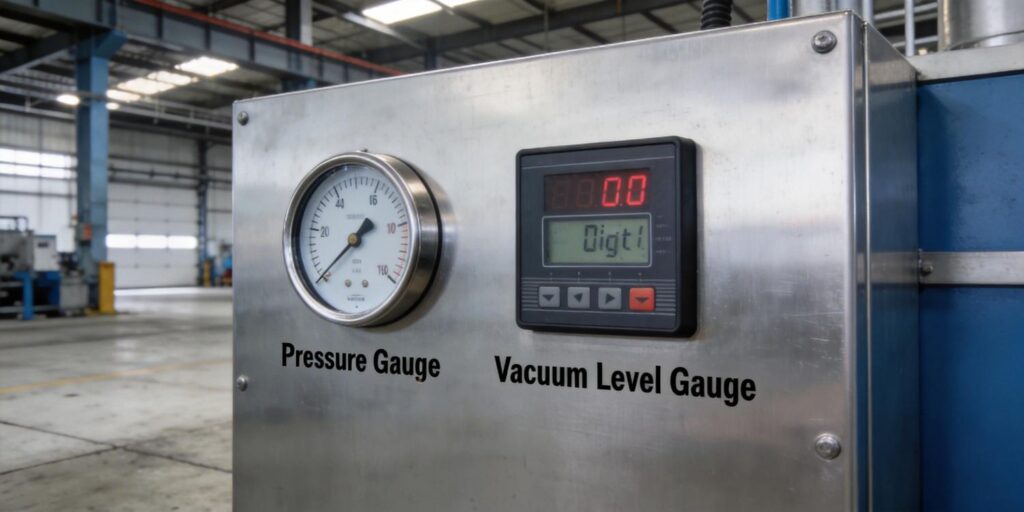
Each stage demands precise vacuum control to minimize contamination from residual gases, water vapor, or particulates. Without reliable vacuum monitoring, defects like pinholes, poor adhesion, or non-uniform thickness can reduce cell efficiency by 10–20% or more. Poseidon Scientific’s VG-SP205 Pirani Vacuum Transmitter and VG-SM225 Cold Cathode Vacuum Gauge were engineered specifically for these demanding environments, offering compact, cost-effective solutions that deliver the stability engineers need without the premium price of legacy instrumentation.
Required Pressure Stability in Thin Film Solar Production
Pressure stability is non-negotiable in thin film deposition. Base pressures must typically reach 10−6 Torr or lower before sputtering begins to ensure ultra-clean surfaces. During reactive or non-reactive sputtering, process pressures are maintained between 1–10 mTorr (approximately 10−3 to 10−2 Torr) to sustain stable plasma and achieve optimal deposition rates of 0.1–1 nm/s.
Even minor fluctuations—such as a 20% pressure spike—can alter mean free paths, ion energies, and film stoichiometry, leading to reduced open-circuit voltage or fill factor in the final solar cell. Industry standards (e.g., IEC 61215) emphasize vacuum integrity because pressure variations directly impact layer crystallinity and interface quality. Our gauges address this by providing continuous, real-time feedback with proven temperature compensation and customizable digital protocols that integrate seamlessly with existing PLC or SCADA systems.
Monitoring Vacuum Levels During Sputtering
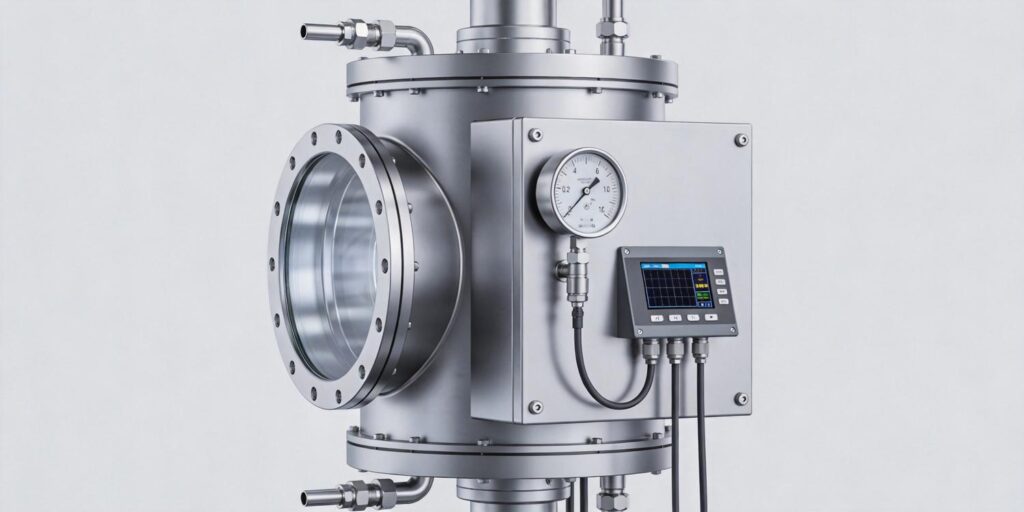
Effective monitoring requires a two-stage approach: rough vacuum for pump-down and high vacuum for the actual coating phase. Poseidon’s dual-gauge strategy—combining the VG-SP205 Pirani and VG-SM225 Cold Cathode—delivers full-range coverage from atmosphere to 10−7 Torr while maintaining the compact footprint critical for modern inline solar production lines.
The Role of Pirani Gauges in the Roughing Stage
During initial evacuation from atmospheric pressure, the VG-SP205 Pirani Vacuum Transmitter excels. Operating on the proven thermal conductivity principle, it measures from atmosphere down to 10−3 Torr by maintaining a constant filament temperature and correlating power input with gas density. Platinum filament construction ensures excellent chemical stability and resistance to oxidation, delivering 3–5 year lifetimes even in production environments.
In solar cell manufacturing, the roughing stage typically lasts 10–30 minutes per chamber cycle. The VG-SP205’s 0–10 V analog output (effective range 2–8 V) and RS232 digital interface allow direct integration with roughing pumps and load-lock controls. Its compact design minimizes chamber intrusion, and factory calibration against NIST-traceable standards guarantees ±15% accuracy in the linear region (10–10−2 Torr), sufficient for reliable transition to high-vacuum pumping.
Cold Cathode Gauges for High-Vacuum Coating Phase
Once rough vacuum is achieved, the VG-SM225 Cold Cathode Vacuum Gauge takes over for the critical coating phase (10−3 to 10−7 Torr). Based on the Penning discharge principle, it uses a crossed electric (–2000 V working voltage) and magnetic (~100 Gauss) field to generate a self-sustaining plasma. Positive ion current collected at the cathode is directly proportional to gas density, providing fast response and inherent gas-independence for argon-dominated sputtering atmospheres.
The VG-SM225’s positive magnetron (“工”-shaped) structure enables a remarkably compact sensor head—ideal for tight solar deposition chambers—while its removable electrode design allows on-site cleaning with 500-mesh sandpaper to restore performance after carbon buildup. Unlike hot-cathode gauges, it eliminates filament burnout and outgassing risks, ensuring uninterrupted operation during long coating runs typical of thin film solar production (often 24/7).
Preventing Pressure Spikes and Process Disruptions
Pressure spikes in sputtering systems often stem from outgassing, virtual leaks, or sudden gas bursts. The VG-SP205 and VG-SM225 work in tandem to detect anomalies instantly. The Pirani gauge flags early rises during roughing, while the cold cathode’s software-protected high-voltage cutoff (>10−3 Torr) prevents electrode contamination during inadvertent pressure excursions.
Key preventive features include:
- Temperature compensation circuits that maintain accuracy across 15–50 °C operating ranges common in production cleanrooms.
- Real-time digital output with customizable protocols, enabling automated interlocks that pause deposition if pressure deviates beyond ±5% of setpoint.
- Maintenance-friendly design: Cold cathode electrodes can be cleaned in minutes without breaking vacuum integrity, reducing downtime compared to sealed competitor units.
These capabilities directly translate to higher throughput and lower scrap rates—critical when each solar panel represents significant material and energy investment.
Industry Case Example: Yield Improvement in CIGS Production
A leading Asian thin film solar manufacturer recently integrated Poseidon’s VG-SP205 and VG-SM225 pair into their inline sputtering line for CIGS absorber deposition. Facing inconsistent film uniformity due to undetected pressure drifts from chamber wall outgassing, the team replaced aging imported gauges costing nearly twice as much.
Within the first quarter, they recorded a 12% increase in module efficiency uniformity across 1.2 m × 0.6 m panels. The VG-SM225’s rapid response (<1 s) allowed tighter process control at 3 mTorr, while the Pirani’s reliable roughing monitoring reduced load-lock cycle time by 15%. Maintenance intervals extended from monthly to quarterly thanks to the cleanable cold cathode design. Total vacuum-related costs dropped 35% while maintaining full compatibility with existing KF25 flanges and PLC systems.
This outcome aligns with broader industry data from vacuum science literature, where stable pressure control in the 10−3–10−6 Torr range has been shown to improve grain size and reduce defect density in sputtered photovoltaic films.
Optimize Your Thin Film Solar Production Today
Whether you are scaling pilot lines or optimizing gigawatt-scale manufacturing, precise vacuum monitoring with cost-effective, maintainable instrumentation is a competitive advantage. Poseidon Scientific’s VG-SP205 Pirani Vacuum Transmitter and VG-SM225 Cold Cathode Vacuum Gauge deliver the performance engineers trust—backed by in-house design, rigorous factory calibration, and full customization support for as few as five units.
Ready to reduce costs, improve yield, and simplify integration? Contact our applications team for a no-obligation consultation tailored to your solar deposition process. We’ll review your chamber layout, gas chemistry, and control requirements to recommend the optimal gauge configuration.
Learn more about the VG-SP205 Pirani Vacuum Transmitter | Discover the VG-SM225 Cold Cathode Vacuum Gauge
email info@poseidon-scientific.com to schedule your vacuum audit today. Your next efficiency milestone starts with reliable pressure control.