The Critical Role of Mycotoxin Monitoring in Animal Feed Safety
Mycotoxin contamination in animal feed represents one of the most significant challenges facing modern agriculture and food safety. These toxic secondary metabolites produced by fungi, particularly Aspergillus, Fusarium, and Penicillium species, pose serious health risks to livestock and can ultimately enter the human food chain through animal products. The European Union has established stringent regulations, with maximum limits of 5 μg/kg for aflatoxin B1 and 10 μg/kg for total aflatoxins (G2, G1, B2, and B1) in maize and maize products, while Brazil sets limits at 20 μg/kg for total aflatoxins in corn.
Beyond regulatory compliance, mycotoxin monitoring is essential for protecting animal health and productivity. These toxins can cause immunosuppression, reduced growth rates, reproductive issues, and even mortality in livestock. The economic impact extends beyond animal health to include reduced feed efficiency, increased veterinary costs, and potential trade restrictions on contaminated products.
Navigating the Matrix Complexity of Feed Samples
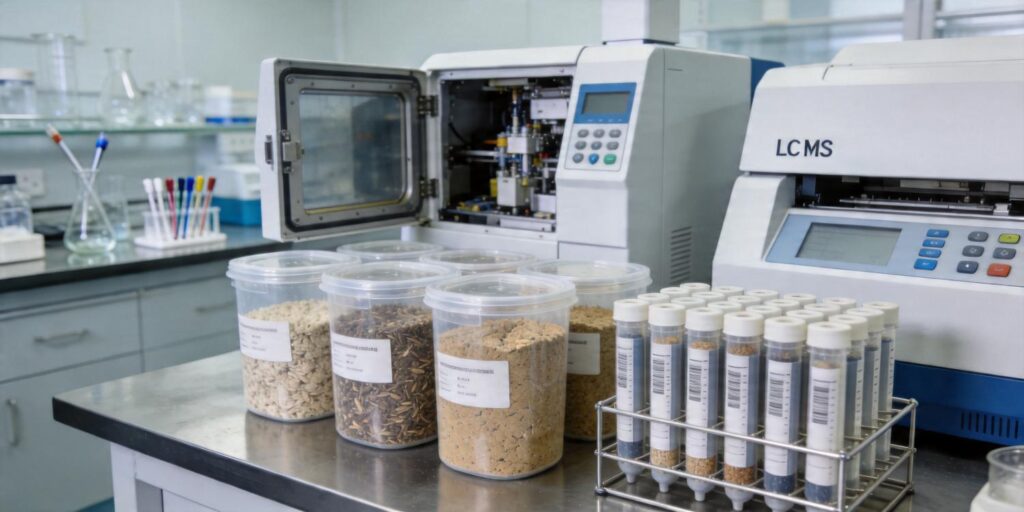
Animal feed presents one of the most challenging matrices for analytical chemistry due to its heterogeneous composition. Feed samples typically contain complex mixtures of grains, proteins, fats, vitamins, minerals, and various additives, each contributing potential interferences during analysis. The presence of proteins, sugars, lipids, and pigments can significantly impact extraction efficiency and analytical accuracy.
Research by Massarolo et al. (2018) demonstrated that proteins and sugars act as primary interferers in aflatoxin extraction from cornmeal, with multivariate correlation analysis showing strong negative correlations (r = -0.99) between these matrix components and aflatoxin G2 and G1 recovery. This highlights the importance of understanding matrix effects when developing SPE methods for feed analysis.
SPE Sorbent Selection for Different Mycotoxin Classes
Reversed-Phase Sorbents for Aflatoxins
C18 sorbents remain the gold standard for aflatoxin extraction from feed matrices. Their lipophilic characteristics allow excellent disruption, dispersion, and retention of these relatively nonpolar compounds. Studies have shown that C18 provides superior recovery (85.7-114.8%) for aflatoxins G2, G1, B2, and B1 when used in matrix solid-phase dispersion (MSPD) applications.
Mixed-Mode Sorbents for Multi-Mycotoxin Analysis
For laboratories monitoring multiple mycotoxin classes simultaneously, mixed-mode sorbents combining reversed-phase and ion-exchange functionalities offer significant advantages. These sorbents can simultaneously extract acidic, basic, and neutral mycotoxins, including fumonisins, zearalenone, ochratoxins, and trichothecenes.
Specialized Sorbents for Polar Mycotoxins
Hydrophilic-lipophilic balanced (HLB) sorbents are particularly effective for extracting more polar mycotoxins like fumonisins and deoxynivalenol. Their unique chemistry allows retention of compounds across a wide polarity range without requiring pH adjustment.
Comprehensive Extraction and SPE Purification Workflow
Sample Preparation and Extraction
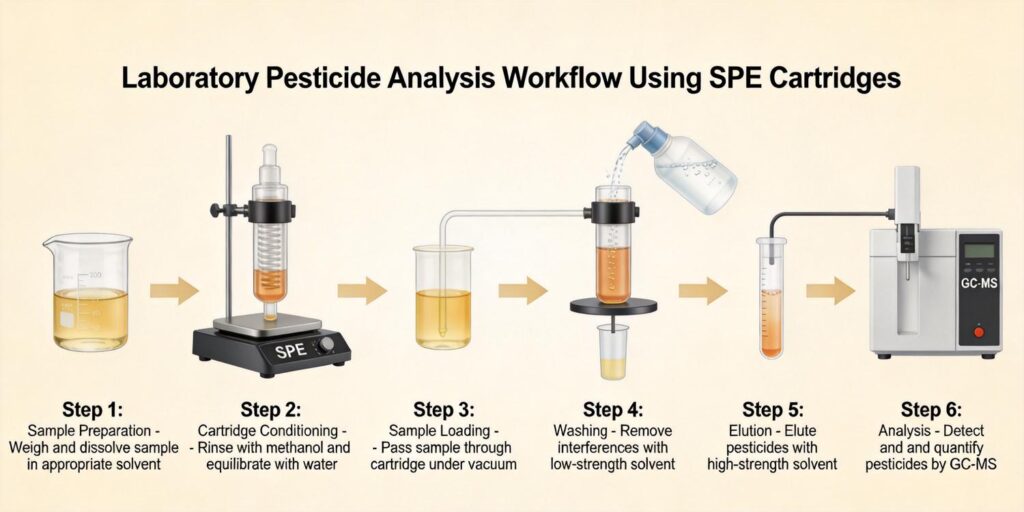
The initial extraction step is critical for successful mycotoxin analysis. For feed samples, a combination of mechanical disruption and solvent extraction is typically employed. The optimized MSPD method developed by Massarolo et al. uses 1 g sample, 25 mg C18 sorbent, and 10 mL of acetonitrile/methanol (50:50, v/v) as extraction solvent. Vortex-assisted elution has been shown to reduce packing time and variations compared to traditional column-based methods.
SPE Cartridge Conditioning and Loading
Proper SPE cartridge conditioning is essential for reproducible results. For C18 cartridges, typical conditioning involves sequential treatment with methanol (or acetonitrile) followed by water or buffer. Sample loading should be performed at controlled flow rates (1-3 drops/second) to ensure optimal analyte retention.
Wash and Elution Optimization
Wash steps should be carefully optimized to remove matrix interferences while retaining target mycotoxins. For aflatoxins, water or water with low percentages of organic solvent (5-10% methanol) effectively removes polar interferences. Elution is typically performed with acetonitrile, methanol, or mixtures thereof, with volumes minimized to concentrate analytes effectively.
LC-MS/MS Detection Methods for Mycotoxin Analysis
Liquid chromatography-tandem mass spectrometry has become the method of choice for mycotoxin analysis due to its superior sensitivity, selectivity, and ability to perform multi-mycotoxin screening. Modern LC-MS/MS systems can detect mycotoxins at levels as low as 0.01-0.04 ng/g, well below regulatory limits.
Chromatographic separation is typically achieved using reversed-phase C18 columns with mobile phases consisting of water and methanol or acetonitrile, often with formic acid or ammonium formate additives to enhance ionization. Multiple reaction monitoring (MRM) transitions provide the specificity needed for accurate quantification in complex feed matrices.
Method Validation for Feed Safety Laboratories
Validation Parameters and Acceptance Criteria
Feed safety laboratories must validate their mycotoxin methods according to international guidelines such as SANTE/11945/2015. Key validation parameters include:
- Recovery: Should fall within 70-110% for concentrations between 1-10 μg/kg, and 50-120% for concentrations below 1 μg/kg according to European Commission regulations
- Precision: Relative standard deviations should be <20% for repeatability studies
- Matrix Effects: Signal suppression or enhancement should be <20% for acceptable methods
- Linearity: Typically demonstrated over at least two orders of magnitude
- Limits of Detection and Quantification: Should be sufficiently below regulatory limits
Quality Control Measures
Routine quality control should include analysis of certified reference materials, participation in proficiency testing schemes, and implementation of internal quality control samples with each batch. Method comparison studies, such as those comparing MSPD with immunoaffinity column cleanup, provide valuable information about method performance relative to established techniques.
Automation and High-Throughput Considerations
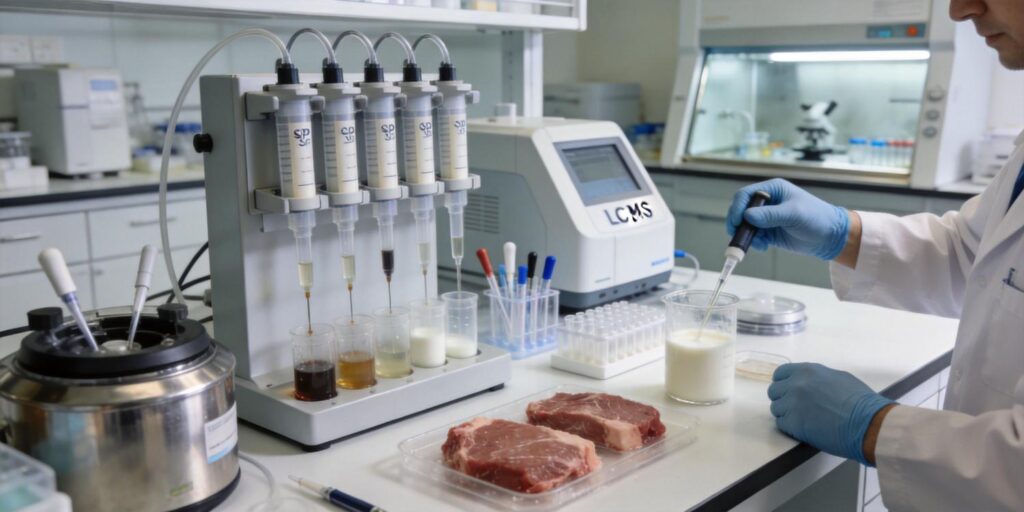
For laboratories processing large numbers of samples, automation of SPE procedures using 96-well plate formats can significantly increase throughput while improving reproducibility. Automated systems can process 320-960 samples per day while maintaining excellent sensitivity down to 50 pg/mL levels.
The integration of automated SPE with LC-MS/MS systems creates powerful analytical platforms for feed safety monitoring. These systems not only improve laboratory efficiency but also enhance data quality through reduced manual intervention and improved consistency.
Effective mycotoxin monitoring in animal feed requires careful consideration of matrix complexity, appropriate sorbent selection, optimized extraction protocols, sensitive detection methods, and rigorous validation procedures. By implementing robust SPE-based sample preparation methods, feed safety laboratories can ensure accurate, reliable results that protect animal health and support regulatory compliance.