Urine Matrix Challenges in Forensic Toxicology
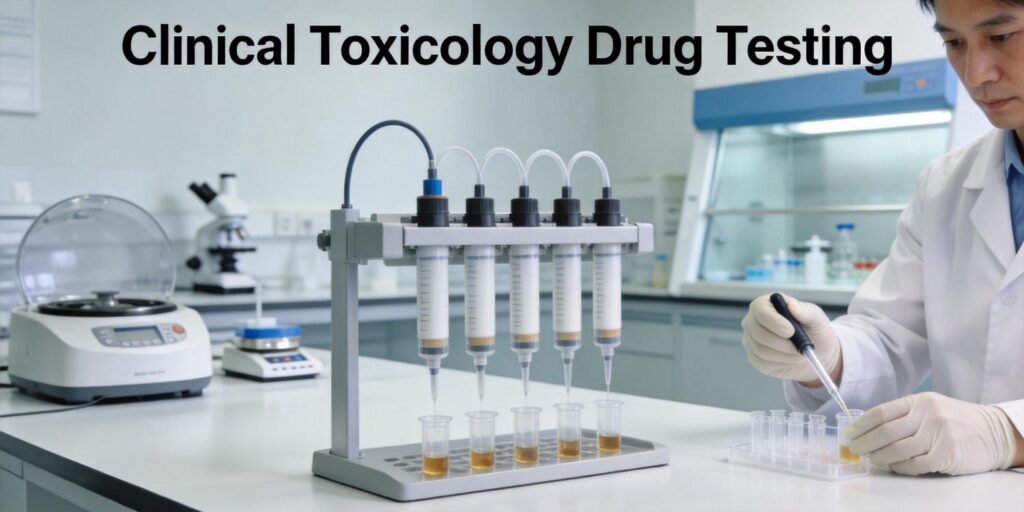
Urine presents unique analytical challenges in forensic toxicology that demand sophisticated sample preparation techniques. As the most common biological matrix tested in racing and human forensic applications, urine contains a complex mixture of endogenous compounds including urea, creatinine, uric acid, electrolytes, and various metabolites that can interfere with drug detection. The relatively high viscosity of urine samples, particularly from dehydrated individuals, can complicate extraction procedures and lead to cartridge clogging if not properly addressed.
According to forensic literature, horse urine presents an analytical challenge for the extraction of all drugs because of the relatively high viscosity of the samples, particularly where the animal was dehydrated by exercise prior to sample collection. This challenge extends to human urine samples as well, where hydration status significantly affects matrix composition. The presence of plant alkaloids, phenolic compounds, cholesterol, fatty acids, and other endogenous substances can create significant background interference in chromatographic analyses.
Forensic laboratories must contend with the chemico-legal requirements that demand unequivocal analytical data. As positive results invariably must be defended in some form of tribunal or court, analytical data must be unequivocal. Confirmation of the presence of drugs or their metabolites is carried out almost exclusively by mass spectrometry, as no other methods can produce unequivocal identification of a compound with sufficient sensitivity at biological concentrations.
Target Metabolites for Drug Screening
Modern forensic toxicology focuses not only on parent drugs but increasingly on their metabolites, which often provide longer detection windows and more definitive evidence of drug administration. The detection of drug metabolites has become more important following the realization that they allow positives to be called when no parent drug is excreted, thereby establishing that administration of the drug has occurred.
Key target metabolites in urine drug screening include:
- Benzoylecgonine: The primary metabolite of cocaine, detectable for 2-4 days after use
- 11-nor-9-carboxy-Δ9-tetrahydrocannabinol (THC-COOH): The major urinary metabolite of cannabis
- Morphine-3-glucuronide and morphine-6-glucuronide: Metabolites of heroin and morphine
- Hydroxy metabolites of amphetamines: Including hydroxylated methamphetamine metabolites
- Nor-metabolites: Such as norcocaine, nordiazepam, and norcodeine
Research demonstrates that SPE methods can successfully extract a wide range of metabolites, including hydroxylated and N-dealkylated products that are difficult to recover using traditional solvent extraction methods. These polar metabolites require extraction conditions that balance recovery with clean background results.
SPE Sorbent Selection for Broad Analyte Coverage
The selection of appropriate SPE sorbents is critical for achieving broad analyte coverage in forensic urine analysis. Mixed-mode sorbents combining hydrophobic and ion-exchange interactions have proven particularly effective for comprehensive drug screening.
Mixed-Mode Sorbents
Mixed-mode cartridges providing hydrophobic and cation exchange interactions, combined with pH-dependent sample application and extraction, can give high recoveries of analytes from urine, plasma, whole blood, and tissues. The resulting SPE eluates are easily amenable to subsequent GC- and HPLC-analysis, with chromatograms showing almost no interference from endogenous matrix components.
Copolymeric vs. Traditional Sorbents
Comparative studies show significant advantages of copolymeric SPE columns over traditional C8 or C18 columns. For example, extractions of opiates from urine using high-efficiency copolymeric SPE columns demonstrate cleaner backgrounds and higher recoveries compared to both liquid-liquid extraction and C18 SPE methods. Similarly, barbiturate extractions show superior performance with copolymeric columns versus C8 columns.
Specialized Sorbents for Specific Applications
Different sorbent chemistries offer advantages for specific analyte classes:
- MCX (Mixed-mode Cation Exchange): Ideal for basic drugs and their metabolites
- MAX (Mixed-mode Anion Exchange): Suitable for acidic compounds
- WCX (Weak Cation Exchange): Effective for compounds with weak basic properties
- WAX (Weak Anion Exchange): Useful for weakly acidic analytes
- HLB (Hydrophilic-Lipophilic Balance): Versatile for a wide range of compounds
Example Urine Extraction and SPE Cleanup Workflow
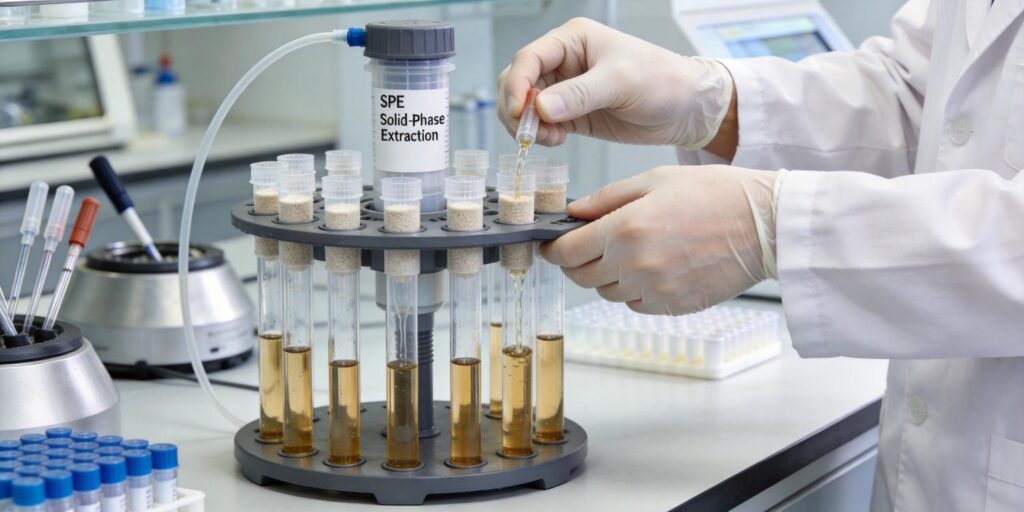
A standardized SPE workflow for forensic urine analysis typically follows these steps:
1. Sample Preparation
For urine samples: To 5 mL of urine add 50-300 μL of 1.0 M acetic acid to adjust sample pH to between 4.8 and 5.5. For whole blood: To 2 mL of blood add 8 mL of deionized water, mix/vortex and let stand 5 minutes, then add 150-300 μL of 1.0 M acetic acid to adjust pH to 4.8-5.5, followed by centrifugation and pellet discard.
2. Cartridge Conditioning
Condition the CLEAN SCREEN extraction column with:
- 3 mL of methanol; aspirate
- 3 mL of deionized water; aspirate
- 1 mL of 0.1 M acetic acid; aspirate
Note: Aspirate at approximately 3 inches Hg to prevent sorbent drying.
3. Sample Application
Apply the prepared sample to the conditioned cartridge at a controlled flow rate of 1-2 mL per minute.
4. Wash Steps
Implement sequential wash steps to remove interfering compounds while retaining analytes:
- 2 mL of deionized water
- 2 mL of 0.1 N HCl (for basic drug retention)
- Optional: 2 mL of hexane for lipid removal
- Optional: 20% acetonitrile/80% water wash for polar interference removal
5. Elution
Elute analytes using appropriate solvent mixtures:
- For basic drugs: 3 mL of methylene chloride/isopropyl alcohol/ammonium hydroxide (78:20:2)
- For acidic/neutral drugs: 3 mL of ethyl acetate with 2% ammonium hydroxide
6. Concentration and Derivatization
Evaporate eluates to dryness at 40°C and derivatize as needed for GC-MS analysis. Common derivatization reagents include BSTFA with 1% TMCS or PFAA for amphetamine analysis.
LC-MS/MS Detection Improvements
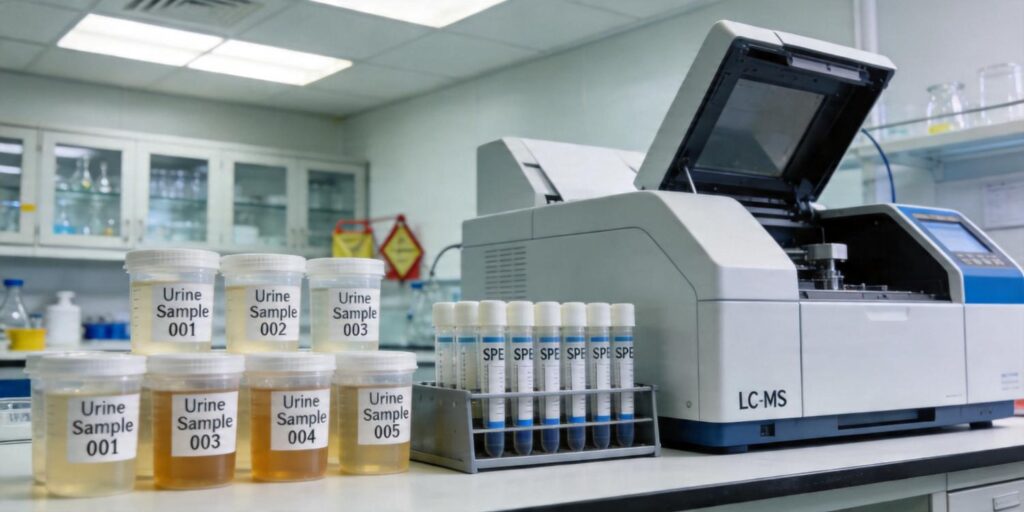
The integration of SPE with LC-MS/MS has revolutionized forensic toxicology by enabling sensitive detection of polar metabolites and reducing sample preparation time.
Ion Suppression Mitigation
An undesirable feature of atmospheric pressure ionization-MS analysis is suppression of ionization by co-extracted endogenous interferences from biofluids. To avoid false negatives, selective SPE extraction applications are required. SPE-LC-MS has been successfully demonstrated to remove compounds that cause ion suppression while maintaining analyte recovery.
Reduced HPLC Requirements
Modern LC-MS/MS systems allow for drastically shortened HPLC separations and in some cases, elimination of the HPLC step entirely. The SPE cartridge alone can provide sufficient clean-up and solvent exchange, with perhaps a little elution chromatography down its short length. This approach has been successfully demonstrated in pharmaceutical development and environmental monitoring applications.
Enhanced Sensitivity and Specificity
SPE clean-up prior to LC-MS/MS analysis significantly increases sensitivity by removing matrix components that can interfere with ionization. Studies show that SPE extracts are virtually free from abundant neutral compounds such as equol and other plant-derived phenolic compounds that are endogenous to urine. The method also eliminates compounds such as cholesterol, vitamin E, and fatty acids that can interfere with analysis.
Validation for Forensic Laboratories
Comprehensive validation of SPE methods is essential for forensic laboratories to ensure reliable, defensible results.
Recovery and Reproducibility Studies
Validation studies demonstrate that mixed-mode SPE methods can achieve recoveries exceeding 80% for a wide range of drugs with relative standard deviations less than 8.2%. For example, basic drug recoveries of over 80% with relative standard deviations of less than 7.3% have been obtained using optimized SPE procedures.
Lot-to-Lot Reproducibility
Studies of lot-to-lot reproducibilities of mixed-mode SPE columns in the extraction of drugs from whole blood show consistent performance across manufacturing batches, ensuring reliable method transfer between laboratories.
Matrix Effects Evaluation
Comprehensive validation includes assessment of matrix effects across different urine samples, accounting for variations in pH, specific gravity, and endogenous compound concentrations. The use of isotopically labeled internal standards helps correct for any remaining matrix effects.
Automation Validation
For laboratories implementing automated SPE systems, validation must demonstrate equivalent performance to manual methods. Automated systems can increase throughput and substantially reduce the amount of manual labor while maintaining extraction efficiency and cleanliness.
Legal Defensibility
Forensic validation must address the legal requirements for unequivocal identification. This includes demonstrating specificity through mass spectral confirmation, establishing detection limits well below cutoff concentrations, and maintaining chain of custody documentation throughout the SPE process.
The combination of optimized SPE clean-up with advanced detection technologies like LC-MS/MS represents the current gold standard in forensic urine analysis for illicit drug metabolites. By addressing matrix challenges through selective extraction and providing clean extracts for sensitive detection, SPE methods enable forensic laboratories to meet increasingly stringent analytical requirements while maintaining efficiency and reliability in high-throughput environments.