Regulatory Concerns About Hormone Residues in Meat
The detection and quantification of veterinary hormone residues in animal tissue is a critical public health and regulatory concern worldwide. Regulatory agencies such as the FDA, USDA, and European Commission have established strict maximum residue limits (MRLs) for anabolic steroids, corticosteroids, and other hormonal growth promoters in meat products. These regulations are designed to protect consumers from potential health risks associated with hormone residues, including endocrine disruption, carcinogenic effects, and antibiotic resistance development.
According to veterinary drug abuse literature, the primary goal of testing is to “dissuade participants from using performance-altering drugs in competition and to maintain a standard of animal health” while ensuring food safety. The target analytes are typically small organic molecules with molecular weights under 1000 Daltons, often administered at sub-therapeutic doses to avoid detection while still achieving physiological effects.
Compliance monitoring requires robust analytical methods capable of detecting hormone residues at parts-per-billion (ppb) or even parts-per-trillion (ppt) levels in complex biological matrices like muscle, liver, kidney, and fat tissues.
Tissue Sample Homogenization and Extraction
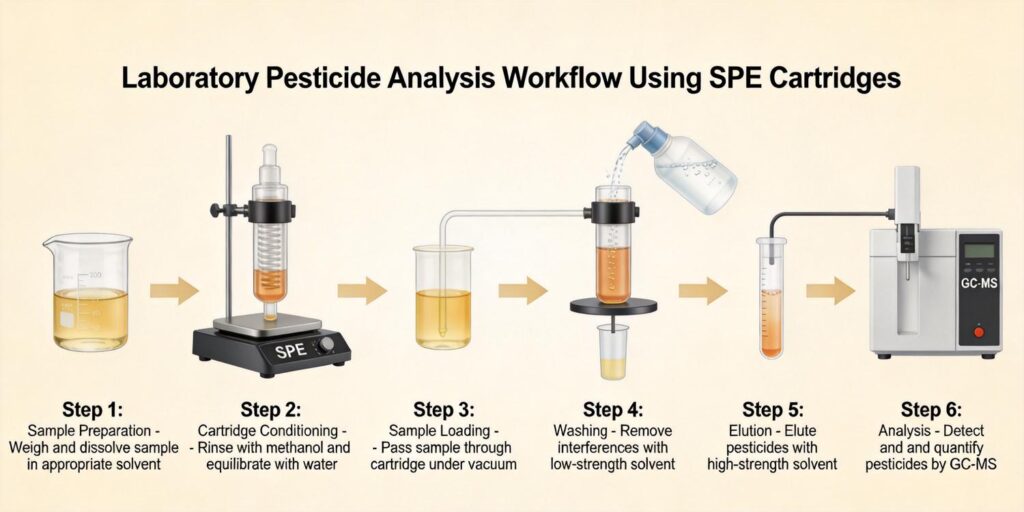
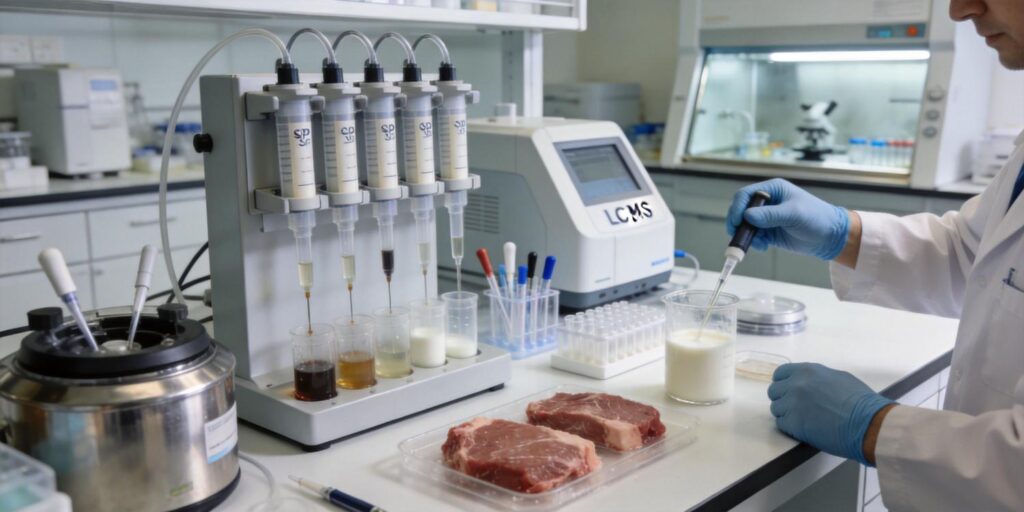
Effective hormone extraction from animal tissue begins with proper sample preparation. Traditional SPE requires the sample to be liquefied or at least have analytes solubilized and stripped from the bulk matrix solids. For tissue samples, this typically involves homogenization in appropriate extraction buffers.
Research demonstrates that “adipose or muscle tissue is usually analyzed with the intent to determine the health effects of consumption of that tissue” focusing on drug residues. A typical approach involves homogenizing tissue in a slurrying buffer such as metaphosphoric acid/methanol (3:2 v/v) to deproteinize the sample. Following filtration and roto-evaporation, the homogenate yields a liquid suitable for SPE cartridge application.
Alternative approaches include hydrolysis with ethanolic potassium hydroxide solution for certain compounds, followed by extraction with petroleum ether and concentration in aqueous ethanol. The high protein and lipid content of tissue samples makes them prone to emulsification during liquid-liquid extraction, making SPE particularly valuable for handling such hydrolysates.
SPE Sorbent Selection for Steroid Hormones
Selecting the appropriate SPE sorbent is crucial for successful hormone extraction from tissue matrices. The functionality of anabolic steroids is quite diverse—some like testosterone are relatively non-polar, while others such as stanozolol and its metabolites are more highly functionalized and water-soluble.
Most methods for separating anabolic steroids employ C18 phase SPE cartridges for desalting and crude extraction. As noted in veterinary drug analysis literature, “the use of selective elution solvents to separate a fraction from other urinary products is unwise when the extracted material is to be screened for as many anabolic agents as possible.”
For corticosteroids, two different phases have found equal application. Like anabolic steroids, corticosteroids are well recovered by retention on C18 phases, from which they may be eluted with dichloromethane, methanol, or ethyl acetate. An alternative method using silica cartridges allows more selective retention, with corticosteroids eluted by varying the ratio of dichloromethane (wash solvent) and ethyl acetate (elution solvent).
Mixed-mode sorbents combining hydrophobic and cation exchange interactions have proven particularly effective for veterinary drug analysis, allowing rapid recovery of diverse compound groups while minimizing matrix interferences.
Conditioning and Loading Extracts
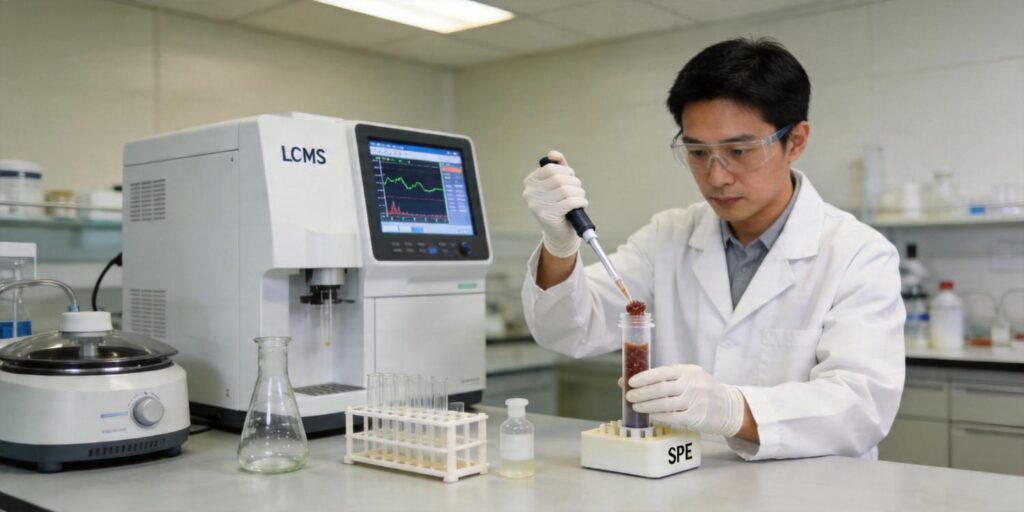
Proper SPE cartridge conditioning is essential for reproducible hormone recovery from tissue extracts. The conditioning process typically involves sequential washing with methanol (or another strong solvent) followed by water or buffer to activate the sorbent and create an optimal environment for analyte retention.
When loading tissue extracts, careful pH adjustment is often necessary. For basic drugs and hormones, samples are typically loaded at neutral or slightly basic pH to ensure proper retention. As research indicates, “bases may be isolated from urine at neutral pH, allowing the extraction of compounds that may be otherwise unstable.”
The loading process must account for the complex nature of tissue extracts, which contain high levels of proteins, lipids, and other matrix components that can interfere with analyte retention. Proper dilution and pH adjustment of the tissue homogenate before loading onto the SPE cartridge are critical steps that significantly impact method performance.
Washing to Remove Lipids and Proteins
Effective washing steps are crucial for removing interfering lipids and proteins from tissue extracts while retaining target hormones. The washing strategy depends on the specific sorbent and analytes involved.
For C18-based extractions, typical washing protocols involve water to remove salts and other soluble material, followed by hexane to remove non-polar material and aid in drying the cartridge. As described in veterinary applications, “the cartridge is washed with water to remove salts and other soluble material and with hexane to both remove some non-polar material and aid in drying.”
Mixed-mode sorbents allow more selective washing. For example, in gabapentin extraction from serum, researchers used water, ethyl acetate, and hexane as washing solvents since “the protonated form of gabapentin was known to have little solubility in them.”
The washing step is particularly important for tissue samples due to their high lipid content. Proper washing removes fatty acids, cholesterol, and other lipid interferences that could otherwise compromise chromatographic separation and detection sensitivity.
Elution Solvents for Hormones
Selective elution of hormones from SPE cartridges requires careful solvent selection based on analyte polarity and functional groups. For steroid hormones, common elution solvents include methanol, ethyl acetate, dichloromethane, and mixtures thereof.
Anabolic steroids are typically eluted from C18 cartridges with solvents like dichloromethane, methanol, or ethyl acetate prior to derivatization and analysis. The literature notes that “selective elution of analytes from a C18 SPE cartridge by variation of the elution solvent polarity is employed routinely for anabolic steroid analysis.”
For more polar hormones and metabolites, modified elution conditions may be necessary. Some methods employ methanol containing 2% ammonia for elution of certain analytes. The choice of elution solvent must balance complete analyte recovery with minimal co-elution of matrix interferences.
It’s important to note that for broad screening applications, “selective elution is of limited value” since diverse structures require all analytes to be eluted into the same fraction with a general elution mixture.
LC-MS/MS Detection Workflow
Liquid chromatography-tandem mass spectrometry (LC-MS/MS) has become the gold standard for hormone residue analysis in animal tissue due to its exceptional sensitivity, specificity, and ability to analyze multiple compounds simultaneously (multiplexing).
The LC interface allows introduction of aqueous samples into the mass spectrometer and may reduce the need for derivatization of some compounds. As noted in veterinary applications, “the method has found significant application in the analysis of water-soluble compounds (sulfonates, phosphates, and quaternary ammonium compounds), sulfonamides, and carboxylates for which HPLC is the preferred chromatographic method.”
Typical LC-MS/MS workflows for hormone analysis involve:
- Chromatographic separation using reversed-phase columns (C18 or similar)
- Electrospray ionization (ESI) in positive or negative mode depending on analyte properties
- Multiple reaction monitoring (MRM) for targeted quantification
- Internal standardization using stable isotope-labeled analogs
The combination of SPE clean-up with LC-MS/MS detection provides the sensitivity needed to meet regulatory MRLs while maintaining the specificity required for unambiguous compound identification.
Validation Parameters
Comprehensive method validation is essential for regulatory acceptance of hormone residue analysis methods. Key validation parameters include:
Specificity and Selectivity
Demonstration that the method can distinguish target hormones from matrix components and other potentially interfering substances. This is particularly important for tissue samples given their complex composition.
Linearity and Range
Establishment of linear response over the concentration range from the limit of quantification (LOQ) to well above the expected maximum residue limits.
Accuracy and Precision
Evaluation through recovery studies at multiple concentration levels and assessment of within-run and between-run variability.
Limit of Detection (LOD) and Quantification (LOQ)
Determination of the lowest concentrations that can be reliably detected and quantified, typically requiring LOQs at or below established MRLs.
Robustness and Ruggedness
Assessment of method performance under varying conditions and between different analysts, instruments, and laboratories.
As emphasized in SPE literature, “SPE can be highly reproducible if a rugged method is developed, and provides clean extracts for analysis by GC/NPD, HPLC, GC/MS, LC/MS and many other analytical techniques.” Proper validation ensures that SPE-based methods meet the “scientific and legal scrutiny” required for regulatory compliance monitoring.
Conclusion
SPE extraction of veterinary hormones from animal tissue represents a critical analytical challenge at the intersection of food safety, regulatory compliance, and public health. The complexity of tissue matrices demands careful method development encompassing appropriate homogenization techniques, strategic sorbent selection, optimized conditioning and washing protocols, and selective elution conditions. When combined with sensitive detection techniques like LC-MS/MS and comprehensive validation, SPE-based methods provide the robustness and reliability needed for regulatory monitoring of hormone residues in meat products. As analytical technology continues to evolve, SPE remains a cornerstone technique for ensuring the safety and quality of animal-derived food products worldwide.