Types of Marine Toxins and Their Health Impact
Marine toxins represent a significant public health concern worldwide, particularly in regions where shellfish consumption is prevalent. These naturally occurring compounds are produced by various marine microorganisms, primarily dinoflagellates and diatoms, and accumulate in filter-feeding shellfish through bioaccumulation processes. The health impacts range from mild gastrointestinal distress to severe neurological effects and even fatalities in extreme cases.
The major classes of marine toxins include:
Paralytic Shellfish Poisoning (PSP) Toxins
Saxitoxin and its analogs are potent neurotoxins that block voltage-gated sodium channels, leading to respiratory paralysis. PSP toxins are responsible for numerous fatalities worldwide and have no known antidote.
Diarrhetic Shellfish Poisoning (DSP) Toxins
Okadaic acid and its derivatives inhibit protein phosphatases, causing severe gastrointestinal symptoms including diarrhea, nausea, and vomiting. While rarely fatal, DSP toxins pose significant economic impacts on shellfish industries.
Amnesic Shellfish Poisoning (ASP) Toxins
Domoic acid and its isomers act as glutamate receptor agonists, leading to neurological symptoms including memory loss, seizures, and in severe cases, permanent brain damage or death.
Neurotoxic Shellfish Poisoning (NSP) Toxins
Brevetoxins activate voltage-sensitive sodium channels, causing neurological and gastrointestinal symptoms similar to ciguatera poisoning.
Azaspiracid Shellfish Poisoning (AZP) Toxins
Azaspiracids cause severe gastrointestinal damage and have been implicated in long-term health effects, though their exact mechanism of action remains under investigation.
According to food safety monitoring data, these toxins can accumulate in shellfish tissues at levels far exceeding regulatory limits during harmful algal blooms, necessitating robust extraction and detection methodologies for effective monitoring programs.
Extraction of Toxins from Shellfish Tissues
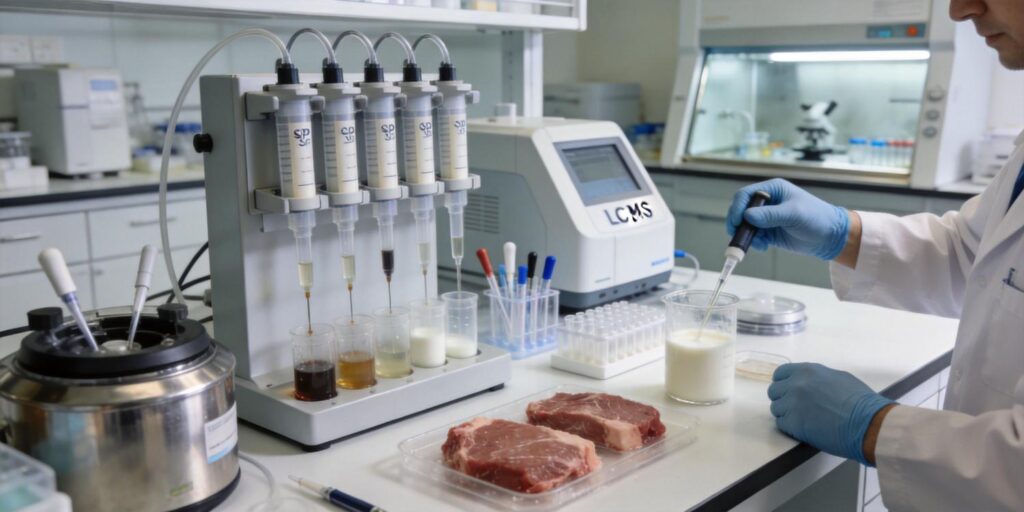
The extraction of marine toxins from shellfish tissues presents unique challenges due to the complex matrix composition, which includes proteins, lipids, carbohydrates, and various interfering compounds. Traditional liquid-liquid extraction (LLE) methods have been largely superseded by solid-phase extraction (SPE) techniques due to their superior recovery rates and cleaner extracts.
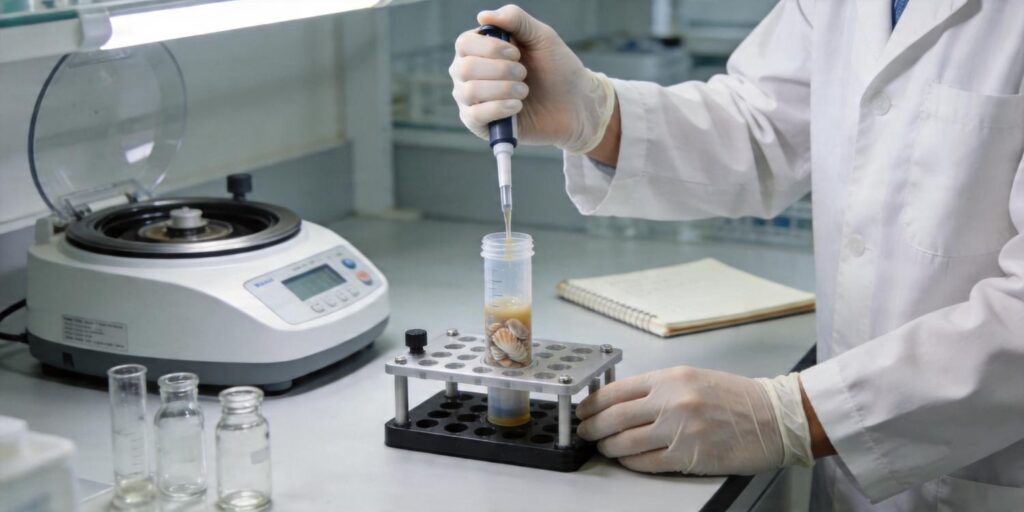
The extraction process typically begins with homogenization of shellfish tissue in appropriate solvents. As noted in veterinary drug extraction studies, “homogenizing the meconium in methanol, centrifuging the homogenate, drying down the supernate to a volume of less than 1 mL and then diluting this in the same phosphate buffer that would have been used for diluting a urine sample” provides an effective approach for complex biological matrices.
For shellfish tissues, common extraction protocols involve:
- Homogenization in methanol/water or acetonitrile/water mixtures
- Centrifugation or filtration to remove particulate matter
- Evaporation or dilution to appropriate volumes
- pH adjustment to optimize SPE retention
The choice of extraction solvent depends on the toxin class being targeted. Methanol/water mixtures (typically 50-80% methanol) are commonly used for PSP toxins, while acetonitrile/water mixtures may be preferred for lipophilic toxins like DSP and AZP compounds.
SPE Sorbent Selection for Toxin Classes
Selecting the appropriate SPE sorbent is critical for successful marine toxin extraction. Different toxin classes require specific sorbent chemistries based on their physicochemical properties:
Reversed-Phase Sorbents (C18, C8, HLB)
Hydrophilic-lipophilic balanced (HLB) sorbents are particularly effective for broad-spectrum toxin extraction due to their ability to retain both polar and non-polar compounds. As demonstrated in pharmaceutical applications, “mixed-mode cartridges providing hydrophobic and cation exchange interactions, combined with a pH-dependent sample application and extraction, can give high recoveries of analytes from plasma, urine, whole blood, and tissues.”
Ion-Exchange Sorbents (WAX, WCX, MAX, MCX)
Weak anion exchange (WAX) and strong anion exchange (SAX) sorbents are ideal for acidic toxins like okadaic acid and domoic acid. Weak cation exchange (WCX) and strong cation exchange (SCX) sorbents effectively retain basic compounds such as saxitoxin analogs.
Mixed-Mode Sorbents
Combination sorbents offering both reversed-phase and ion-exchange interactions provide comprehensive extraction capabilities for multiple toxin classes in a single step, significantly improving laboratory efficiency.
Research indicates that “SPE recoveries should exceed 90% absolute recovery. If you don’t get that kind of recovery you are not adjusting other parameters (such as solubility, pH, and solvent strength) correctly.” This benchmark is particularly relevant for marine toxin analysis where regulatory limits are often in the low parts-per-billion range.
Conditioning and Loading Extracts
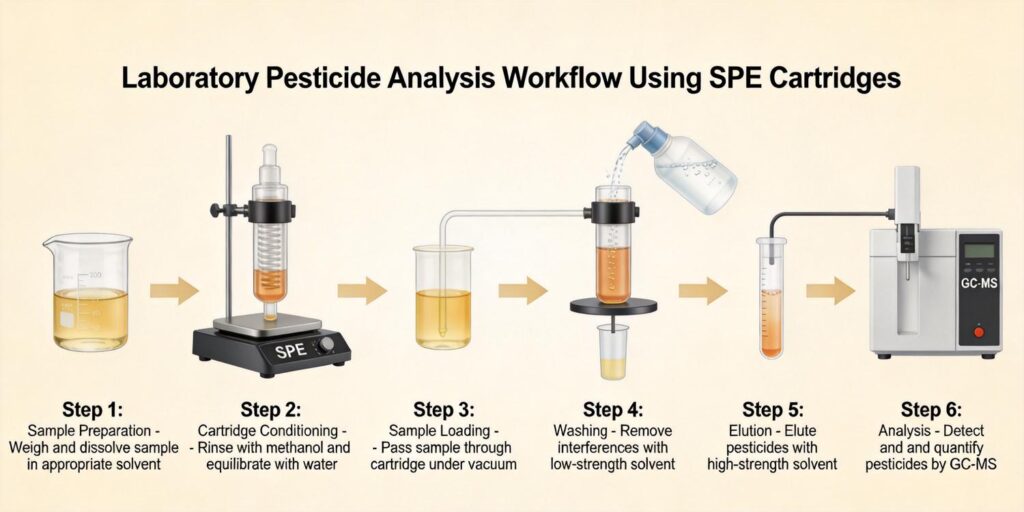
Proper conditioning of SPE cartridges is essential for reproducible toxin recovery. The conditioning process typically involves:
- Solvent activation (methanol or acetonitrile)
- Equilibration with aqueous solution matching the sample matrix
- Maintenance of sorbent wetness throughout the process
For marine toxin extraction, conditioning volumes should be sufficient to completely wet the sorbent bed (typically 3-5 bed volumes). The equilibration solution should match the pH and ionic strength of the sample extract to prevent premature elution or poor retention.
Sample loading conditions must be optimized for each toxin class. Flow rates should be controlled (typically 1-5 mL/min) to ensure adequate interaction time between analytes and sorbent. As noted in environmental applications, “sample loading and elution rates and elution solvent strength were each tested to optimize conditions.”
For complex shellfish extracts, pre-filtration through 0.45 μm membranes or centrifugation at high speeds (10,000 × g) is recommended to prevent cartridge clogging and ensure consistent flow rates.
Washing Steps for Matrix Cleanup
Effective washing protocols are crucial for removing matrix interferences while retaining target toxins. The washing strategy depends on the sorbent chemistry and toxin properties:
Reversed-Phase Sorbents
Typically washed with 5-20% methanol or acetonitrile in water to remove polar interferences while retaining lipophilic toxins. For acidic toxins, addition of 0.1-1% formic acid to the wash solution can improve selectivity.
Ion-Exchange Sorbents
Washed with appropriate buffer solutions to remove neutral and oppositely charged interferences. For anion exchange sorbents, ammonium acetate or formate buffers (pH 4-6) are commonly used.
As emphasized in LC-MS applications, “by washing the cartridge with pure water excess ions will be eliminated and this will, in turn, improve system performance.” This is particularly important for marine toxin analysis where salt residues from shellfish extracts can suppress ionization in mass spectrometric detection.
The washing volume should be sufficient to remove interferences without causing analyte breakthrough. Typically, 3-10 bed volumes are used, with the exact volume determined through method optimization studies.
Elution Solvent Systems
Elution conditions must be carefully optimized to achieve quantitative recovery of target toxins while minimizing co-elution of matrix components. The choice of elution solvent depends on the sorbent chemistry and toxin properties:
Reversed-Phase Elution
High organic content solvents (70-100% methanol or acetonitrile) are typically used. For acidic toxins, addition of 0.1-1% formic acid can improve recovery. As noted in pharmaceutical applications, “elution using a pure organic solvent, without modifiers or buffer ions is desirable.”
Ion-Exchange Elution
High ionic strength buffers or pH-adjusted organic solvents are employed. For anion exchange sorbents, ammonium hydroxide in methanol or acetonitrile is commonly used for acidic toxin elution.
Elution volumes should be sufficient to completely displace all retained toxins (typically 2-5 bed volumes). Collection in silanized glass vials or polypropylene tubes is recommended to prevent adsorption losses.
Post-elution treatment may include evaporation under nitrogen stream and reconstitution in mobile phase compatible solvents for LC-MS/MS analysis. As demonstrated in food analysis, “the waxes are typically insoluble in methanol, the solvent can be used to redissolve an SPE eluate after evaporation with the resultant precipitation of the waxes.”
LC-MS/MS Detection of Marine Toxins
Liquid chromatography coupled with tandem mass spectrometry (LC-MS/MS) has become the gold standard for marine toxin detection due to its superior sensitivity, selectivity, and ability to analyze multiple toxin classes simultaneously. The integration of SPE with LC-MS/MS offers significant advantages for marine toxin monitoring.
As noted in analytical toxicology, “the new goals are to strip out inorganic compounds that may affect the ion sources that induce ionization/fragmentation and eliminate large molecules that may foul up the interfaces between the sample introduction port and the mass spectrometer.” This is particularly relevant for shellfish extracts which contain high levels of salts, proteins, and lipids.
Key considerations for LC-MS/MS analysis of marine toxins include:
Chromatographic Separation
Reversed-phase columns (C18 or C8) with gradient elution using water/acetonitrile or water/methanol mobile phases containing volatile buffers (ammonium formate or acetate) provide excellent separation of toxin analogs.
Mass Spectrometric Detection
Multiple reaction monitoring (MRM) using electrospray ionization (ESI) in positive or negative mode provides the necessary sensitivity and specificity for regulatory compliance monitoring. Typical detection limits range from 0.1-10 ng/mL depending on the toxin class.
Matrix Effects
Ion suppression or enhancement must be addressed through proper sample cleanup and use of isotope-labeled internal standards. As emphasized in bioanalytical applications, “an undesirable feature of atmospheric pressure ionization-MS analysis is suppression of ionization by co-extracted endogenous interferences from biofluids. To avoid false negatives, selective SPE extraction applications are required.”
The development of high-throughput methods using 96-well SPE plates has significantly improved laboratory efficiency. Research shows that “automated SPE and tandem MS without HPLC columns, for quantifying drugs at the picogram level” demonstrates the potential for streamlined analysis of marine toxins.
Food Safety Monitoring Applications
SPE-based extraction methods play a critical role in national and international food safety monitoring programs for marine toxins. Regulatory agencies worldwide have established maximum permitted levels for various toxin classes in shellfish products, necessitating robust analytical methods for compliance testing.
As highlighted in food and beverage applications, “SPE applications for food and beverages are usually developed either for quality control purposes or for the detection or identification of drug and pesticide residues or microbial toxins. The goal is to ensure the safety of the consumer.”
Key applications include:
Routine Monitoring Programs
Regular testing of shellfish harvesting areas for early detection of harmful algal blooms and implementation of harvesting closures when toxin levels exceed regulatory limits.
Import/Export Control
Verification of shellfish product safety for international trade, ensuring compliance with destination country regulations.
Epidemiological Investigations
Analysis of implicated shellfish samples during poisoning outbreaks to identify causative toxins and implement appropriate public health measures.
Method Validation and Proficiency Testing
Participation in inter-laboratory comparison studies to ensure method accuracy and reliability across different testing facilities.
The economic impact of effective monitoring cannot be overstated. As demonstrated in various studies, “SPE has been shown to significantly increase gas (GC) and liquid chromatography (LC) column life while reducing the downtime on equipment like gas chromatography and liquid chromatography mass spectrometers (GCMS and LCMS) for source cleaning.”
Future developments in SPE technology for marine toxin analysis will likely focus on increased automation, miniaturization, and the development of novel sorbent materials with enhanced selectivity for specific toxin classes. As the field evolves, SPE will continue to play a vital role in protecting public health through effective monitoring of marine toxins in shellfish products.
For laboratories seeking to implement or optimize marine toxin monitoring programs, Poseidon Scientific offers a comprehensive range of SPE products including HLB, MAX, MCX, WAX, and WCX cartridges, as well as 96-well SPE plates for high-throughput applications. Our products are designed to deliver the high recoveries and clean extracts necessary for reliable LC-MS/MS detection of marine toxins at regulatory levels.