1. Tea Matrix Challenges: Polyphenols and Pigments
Tea presents one of the most challenging matrices for pesticide residue analysis due to its complex composition. The primary interferences stem from high concentrations of polyphenols (catechins, flavonoids, tannins) and pigments (chlorophylls, carotenoids, theaflavins). These compounds can co-extract with target pesticides, leading to matrix effects, ion suppression in mass spectrometry, and chromatographic interferences.
According to comprehensive studies on fruit and vegetable matrices, the high or variable water and fat contents of plant materials can present capacity problems for SPE cartridges. The Luke method (1995) explores the extraction of a large range of pesticides from these matrices, indicating considerable sample manipulation is required. Tea’s polyphenol content (15-30% dry weight) and pigment load create additional challenges beyond typical agricultural commodities.
The presence of these matrix components necessitates specialized cleanup strategies. As noted in SPE literature, “the goal is to ensure the safety of the consumer” through effective matrix removal and concentration of target analytes. Tea’s complex matrix requires more sophisticated approaches than simpler beverages like wine, where SPE has been successfully applied to extract pigments (anthocyanins) while leaving sugars in the effluent.
2. Extraction of Pesticide Residues from Tea Leaves
Effective extraction begins with proper sample preparation. Tea leaves should be ground to a fine powder (≤1 mm) to maximize surface area for extraction. The most common extraction methods include:
Acetonitrile-Based Extraction
Modified QuEChERS (Quick, Easy, Cheap, Effective, Rugged, and Safe) methods have become standard for multi-residue pesticide analysis. For tea, typical protocols involve:
- 10g homogenized tea sample
- 10mL water (to rehydrate dry tea)
- 10mL acetonitrile with 1% acetic acid
- Salting out with magnesium sulfate and sodium chloride
Research shows that QuEChERS methods can process 6-12 samples in 30-40 minutes by a single analyst, with material costs of approximately $1-3 per sample, generating <12 mL waste and requiring only one centrifuge tube for cleaning.
Acetone-Based Extraction
Traditional methods like the Luke procedure use acetone extraction followed by partitioning with dichloromethane. This approach, while more labor-intensive, provides excellent recovery for a wide range of pesticide classes.
Matrix Solid Phase Dispersion (MSPD)
For particularly challenging matrices, MSPD offers advantages. As described in SPE literature, MSPD is “a low-tech process that can be applied as easily in the field as at the laboratory bench” and achieves disruption and extraction of solid samples. The process involves blending 0.5g tea with 2g C18 sorbent, then packing this blend into an SPE column for subsequent elution.
3. SPE Cartridge Selection for Cleanup
Proper SPE cartridge selection is critical for effective tea matrix cleanup. Based on pesticide properties and tea matrix characteristics:
Primary Sorbent Choices
HLB (Hydrophilic-Lipophilic Balanced): Ideal for broad-spectrum pesticide recovery. HLB cartridges contain N-vinylpyrrolidone and divinylbenzene copolymers that retain both polar and non-polar compounds. For tea analysis, HLB provides excellent recovery for pesticides ranging from polar organophosphates to non-polar organochlorines.
PSA (Primary Secondary Amine): Particularly effective for removing organic acids, pigments, and sugars. PSA sorbents are excellent for tea cleanup as they effectively remove polyphenols and pigments through anion exchange and other interactions. Studies show PSA in combination with other sorbents can remove plant sugars and acids while allowing analytes to pass through unretained.
Florisil: Traditional choice for pesticide cleanup, especially for organochlorine pesticides. Certified Florisil cartridges provide specific cleanup for chlorinated pesticides, with quantitative removal of polar probes like trichlorophenol expected under proper SPE conditions.
Sorbent Combinations
For comprehensive cleanup, stacked cartridge systems often provide superior results:
- PSA + C18: PSA removes pigments and organic acids while C18 retains non-polar interferences
- SAX + PSA: For acidic pesticides requiring derivatization before cleanup
- Multi-layer cartridges: Commercial products combining multiple sorbents in single cartridges
4. Conditioning and Loading Extracts
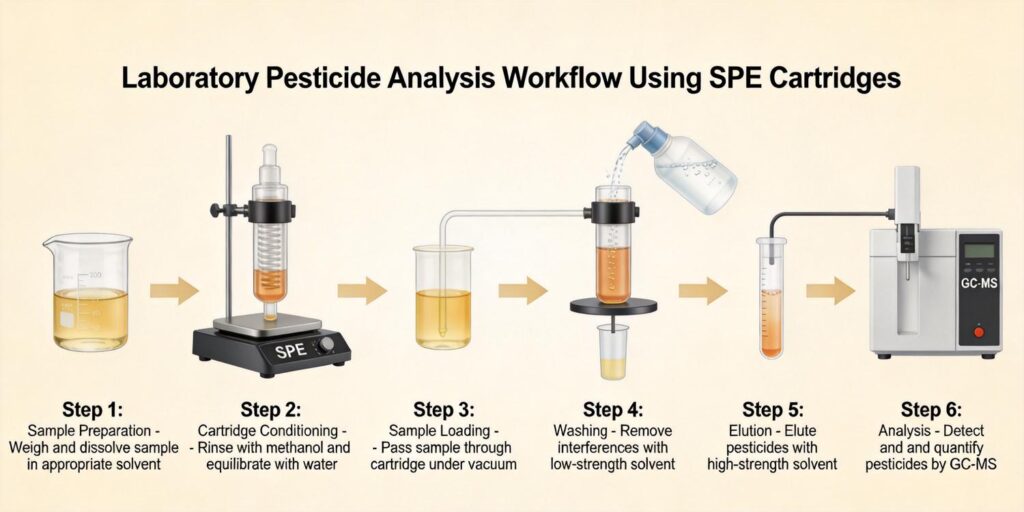
Proper SPE conditioning ensures optimal sorbent activation and reproducible results:
Conditioning Protocol
- Methanol or Acetonitrile: 3-5 mL to activate sorbent surface
- Water or weak buffer: 3-5 mL to create aqueous layer compatible with sample
- Maintain sorbent wetness: Never let sorbent dry between conditioning and sample loading
Sample Loading Considerations
For tea extracts:
- Dilute acetonitrile extracts with water (typically 1:1) to reduce solvent strength
- Maintain flow rate at 1-3 drops/second for optimal recovery
- Load volume typically 5-10 mL for 10g tea equivalent
- pH adjustment may be necessary for ionizable pesticides
As noted in SPE fundamentals, “sample loading often gravity fed” for matrix adsorption mode, while analyte adsorption mode requires controlled flow rates for optimal recovery.
5. Washing Steps to Remove Pigments
Strategic washing removes pigments while retaining target pesticides:
Wash Solvent Selection
Water with 5-10% methanol: Removes polar pigments and polyphenols while retaining most pesticides on HLB or C18 sorbents.
Hexane or hexane-dichloromethane mixtures: For Florisil cleanup, 5 mL of 90:10 hexane/acetone (v/v) effectively washes while maintaining pesticide retention.
Acetonitrile-water mixtures: Varying ratios can selectively remove different pigment classes while preserving pesticide recovery.
Wash Volume Optimization
Typical wash volumes:
- 2-3 mL weak wash solvent
- Additional 2-3 mL intermediate strength solvent if needed
- Complete drying of cartridge after washing (vacuum or centrifugation)
Research indicates that careful selection of solvents for reconstitution can eliminate co-extracted waxes, which are often problematic in fruit analysis. Since waxes are typically insoluble in methanol, this solvent can be used to redissolve an SPE eluate after evaporation with resultant precipitation of waxes.
6. Elution Solvent Choices
Elution solvent selection depends on pesticide polarity and sorbent chemistry:
Common Elution Solvents
Acetonitrile: Excellent for broad-spectrum pesticide elution from HLB cartridges. Typically 5-8 mL provides >90% recovery for most pesticides.
Acetone: Effective for Florisil cartridges, often used in mixtures with hexane (e.g., 90:10 hexane/acetone).
Methanol: Strong elution solvent for reversed-phase sorbents. May require acidification (0.1% formic acid) for acidic pesticides.
Dichloromethane: Traditional solvent for pesticide elution from normal-phase sorbents.
Elution Volume Optimization
Minimum elution volume should be determined experimentally:
- Start with 5 mL and test recovery
- Increase volume if recovery <90%
- Consider fractionated elution for pesticide classes with different polarities
As demonstrated in SPE applications, “the opportunity to concentrate the target analytes offers enhanced sensitivity that may facilitate detection.” Proper elution in minimal volume provides this concentration effect.
7. GC-MS or LC-MS Pesticide Analysis
The choice of analytical instrumentation depends on pesticide properties:
GC-MS Analysis
Ideal for volatile and semi-volatile pesticides:
- Organochlorine pesticides: Excellent sensitivity with electron capture detection (ECD)
- Organophosphorus pesticides: Nitrogen-phosphorus detection (NPD) or MS detection
- Pyrethroids: Require high-temperature GC conditions
Instrument parameters typically include:
- Column: 30m × 0.25mm × 0.25μm (5% phenyl methyl siloxane)
- Temperature program: 50°C (1 min) to 320°C at 10°C/min
- Injection: 2μL splitless at 250°C
LC-MS/MS Analysis
Preferred for polar, thermally labile, or non-volatile pesticides:
- Carbamates: Require LC separation due to thermal degradation
- Neonicotinoids: Highly polar, ideal for LC-MS/MS
- Phenylurea herbicides: Better suited for LC analysis
Modern approaches include “automated on-line SPE-HPLC” systems that provide high sample throughput for LC-MS/MS analysis.
Multi-Residue Methods
Comprehensive studies have demonstrated analysis of 229 pesticides using both GC-MS and LC-MS/MS, achieving recoveries of 80-110% with RSDs <5% for most compounds.
8. Recovery Optimization
Method optimization ensures accurate quantification:
Recovery Assessment
Spike recovery experiments should include:
- Low (10 ng/g), medium (50 ng/g), and high (100 ng/g) fortification levels
- Matrix-matched calibration standards
- Internal standards for compensation of matrix effects
Optimization Parameters
pH adjustment: Critical for ionizable pesticides. Most pesticides show optimal recovery at neutral pH, but some require acidic or basic conditions.
Ionic strength: Addition of salts can improve recovery of polar pesticides through salting-out effects.
Solvent composition: Optimize loading solvent strength to balance pesticide retention and matrix removal.
Flow rates: Controlled flow (1-3 mL/min) improves mass transfer and recovery.
Troubleshooting Low Recovery
If recovery <70%:
- Check sorbent capacity – tea matrix may overload cartridge
- Optimize wash solvent strength – may be too strong
- Verify elution solvent compatibility with pesticides
- Ensure proper pH control throughout process
Quality Control Measures
Implement comprehensive QC:
- Method blanks with each batch
- Continuing calibration verification
- Matrix spike duplicates
- Reference material analysis when available
Conclusion
SPE sample preparation for pesticide residues in tea requires careful consideration of the unique matrix challenges posed by polyphenols and pigments. Through strategic sorbent selection, optimized conditioning and washing protocols, and proper elution strategies, laboratories can achieve reliable quantification of pesticide residues at trace levels. The integration of SPE with modern analytical techniques like GC-MS and LC-MS/MS provides the sensitivity and selectivity needed for regulatory compliance and food safety monitoring.
As demonstrated in extensive SPE research, “SPE recoveries should exceed 90% absolute recovery” when parameters are properly adjusted. For tea analysis, this level of performance is achievable through methodical optimization of all SPE parameters, from extraction through final analysis. The continued development of specialized sorbents and automated SPE systems promises to further improve the efficiency and reliability of pesticide residue analysis in complex matrices like tea.