Sources of Endocrine Disrupting Chemicals in Water
Endocrine disrupting chemicals (EDCs) represent a diverse class of contaminants that can interfere with hormonal systems in humans and wildlife at trace concentrations. These compounds enter drinking water sources through multiple pathways, creating complex analytical challenges for water quality monitoring. Industrial effluents discharge synthetic chemicals like bisphenol A (BPA), phthalates, and alkylphenols directly into waterways. Agricultural runoff contributes pesticides, herbicides, and veterinary pharmaceuticals that can persist in aquatic environments. Urban wastewater treatment plants release personal care products, pharmaceuticals, and synthetic hormones that conventional treatment processes may not completely remove.
Natural organic matter (NOM) plays a crucial role in the environmental fate of EDCs. As noted in environmental chemistry literature, analytes can exist in free form or complexed with particulate or dissolved organic matter. This association state significantly influences transport, degradation, and bioavailability of contaminants. The presence of dissolved organic carbon (DOC) can complicate SPE analyses by changing retention properties of bound analytes compared to free analytes. Research indicates that DOC poses greater problems as its concentration increases and as analyte hydrophobicity increases.
Selection of SPE Sorbents for Trace Contaminants
Choosing appropriate SPE sorbents is critical for successful extraction of EDCs from drinking water. For hydrophobic compounds with log Pow values below approximately 4, alkyl-bonded silica sorbents like C18 provide excellent recovery. For more hydrophobic analytes or when using polystyrene sorbents, the threshold decreases to log Pow below 3 to avoid detrimental effects from humic acid interference. Waters Oasis HLB sorbents, based on hydrophilic-lipophilic balanced polymers, offer broad-spectrum retention for EDCs across varying polarities.
Research by Pfaab and Jork (1994) established that 1 g of reversed-phase octadecyl bonded sorbent per liter of water effectively prevents breakthrough of phenylurea herbicides during SPE from drinking water. This ratio has become a standard starting point for SPE method development using reversed-phase sorbents, as well as for cation and anion exchange sorbents. For large-volume samples, Foreman et al. (1993) successfully isolated multiple classes of pesticides from 10L water samples using octadecyl bonded sorbent cartridges containing 10 g of sorbent.
Specialized Sorbents for Specific Applications
For acidic EDCs like phenoxyacid herbicides, mixed-mode sorbents combining reversed-phase and anion exchange mechanisms provide superior selectivity. Waters Oasis MAX (mixed-mode anion exchange) cartridges are specifically designed for acidic compounds. Conversely, basic compounds benefit from mixed-mode cation exchange sorbents like Waters Oasis MCX. These specialized sorbents enable cleaner extracts by selectively retaining target analytes while allowing interfering compounds to pass through during washing steps.
Sample Collection and Preservation
Proper sample handling begins at the collection site to ensure analytical integrity. Drinking water samples for EDC analysis should be collected in pre-cleaned glass containers to minimize contamination from plasticizers. Samples must be protected from light exposure, as many EDCs are photolabile. Immediate preservation with appropriate additives is essential – typically acidification to pH 2-3 for acidic compounds or addition of sodium azide to inhibit microbial degradation.
Prefiltering samples through 0.45 μm glass-fiber filters without organic binders removes suspended solids that could clog SPE cartridges. However, analysts must verify that target analytes don’t adsorb to the filter material. For samples with high particulate content, centrifugation followed by filtration provides effective clarification. When filter aids are used, care must be taken to elute analytes from the filter surface, though this may increase overall elution volume.
Cartridge Conditioning and Large-Volume Loading
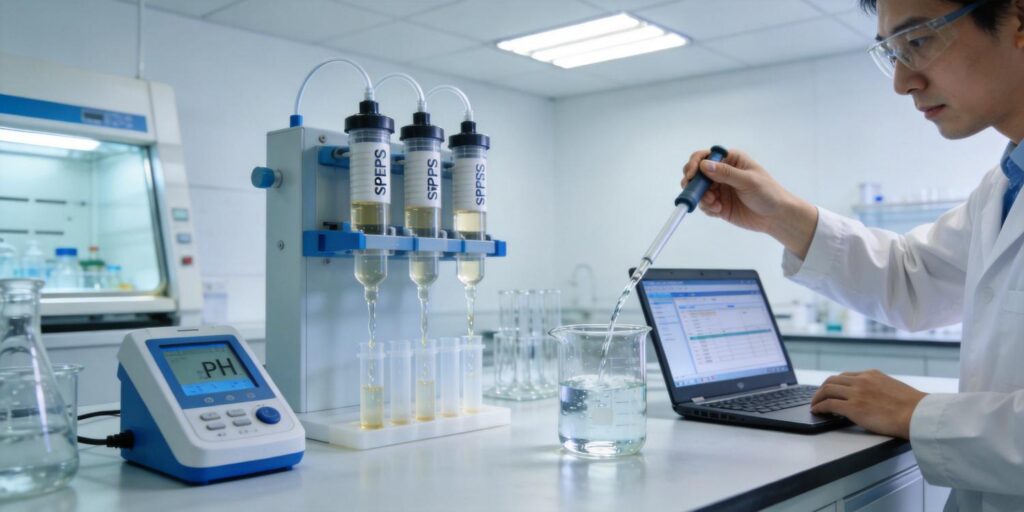
Proper conditioning activates the sorbent surface and ensures consistent analyte recovery. For reversed-phase sorbents, conditioning typically involves sequential washing with methanol (or acetonitrile) followed by water or buffer. The methanol solvates the hydrophobic ligands, while the aqueous solution removes excess organic solvent and prepares the sorbent for sample loading. For ion-exchange sorbents, conditioning with appropriate pH-adjusted buffers establishes the proper ionic form of the functional groups.
Large-volume loading requires careful flow rate control to prevent breakthrough. Research indicates that a sorbent mass of 1 g with sample volumes of 100-200 mL and solute concentrations around 100 ppb provides reasonable starting parameters for method development. Many compounds will be retained from a liter of water by 1 g of sorbent. For wastewater containing complex matrices like dyes and surfactants, a 1 g-to-100 mL ratio prevents breakthrough of hydrophilic components.
Flow Rate Optimization
Optimal flow rates balance throughput with retention efficiency. Gravity flow typically provides adequate retention for most applications, while vacuum or pressure-assisted loading increases throughput for high-volume samples. Studies by Van Elteren et al. (1990) demonstrate the importance of flow rate optimization for complexation-based extractions, where both retention and recovery depend on proper contact time between analytes and sorbent.
Washing Steps to Remove Dissolved Solids
Effective washing removes matrix interferences while retaining target analytes. For reversed-phase extractions, water or dilute aqueous buffers (5-10% methanol) effectively remove salts and polar compounds without eluting hydrophobic EDCs. The presence of dissolved organic matter (DOM) requires special consideration, as humic substances can co-extract with analytes and cause matrix effects during LC-MS/MS analysis.
Nakamura et al. (1996) studied the influences of humic acid and surfactants on SPE behavior, establishing guidelines for dealing with these interferences. For analytes with log Pow below 4 using alkyl-bonded silicas, or below 3 using polystyrene sorbents, recovery is not significantly influenced by 1 ppm of humic acid. For more hydrophobic compounds, recovery decreases, though polystyrene sorbents show less sensitivity to this effect.
Advanced Washing Strategies
For samples with high DOC content, specialized washing protocols can improve extract cleanliness. Altenbach and Giger (1995) used strongly positively charged, graphitized carbon black to permanently retain negatively charged humic substances. Bonifazi et al. (1994) employed chemical oxidation with potassium permanganate to destroy humic acids prior to SPE extraction of PCDDs and PCDFs from particle-free water containing DOC.
Elution Solvents and Concentration
Selective elution recovers target analytes while leaving interfering compounds on the sorbent. For reversed-phase extractions, organic solvents like methanol, acetonitrile, or acetone provide effective elution. Mixed-mode sorbents require elution solvents that disrupt both hydrophobic and ionic interactions – typically organic solvents with added acid (for anion exchange) or base (for cation exchange).
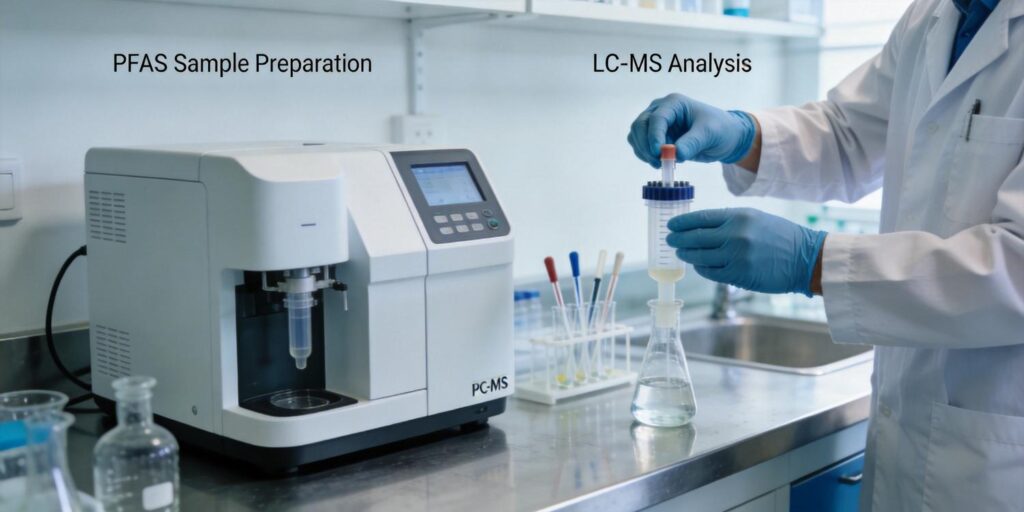
After elution, solvent evaporation concentrates analytes to detectable levels. Gentle nitrogen evaporation at controlled temperatures prevents loss of volatile compounds. For thermolabile EDCs, centrifugal evaporation or Kuderna-Danish concentration provides gentler alternatives. Final reconstitution in mobile phase-compatible solvents (typically methanol-water or acetonitrile-water mixtures) prepares extracts for LC-MS/MS analysis.
Elution Volume Optimization
Research indicates that 5-10 mL of elution solvent typically provides complete recovery for 1 g sorbent cartridges. For example, certified Sep-Pak Florisil cartridges use 5 mL of 90:10 hexane/acetone (v/v) for elution of organochlorine pesticides. Smaller elution volumes reduce subsequent evaporation time but may compromise recovery for strongly retained compounds.
LC-MS/MS Analysis Workflow
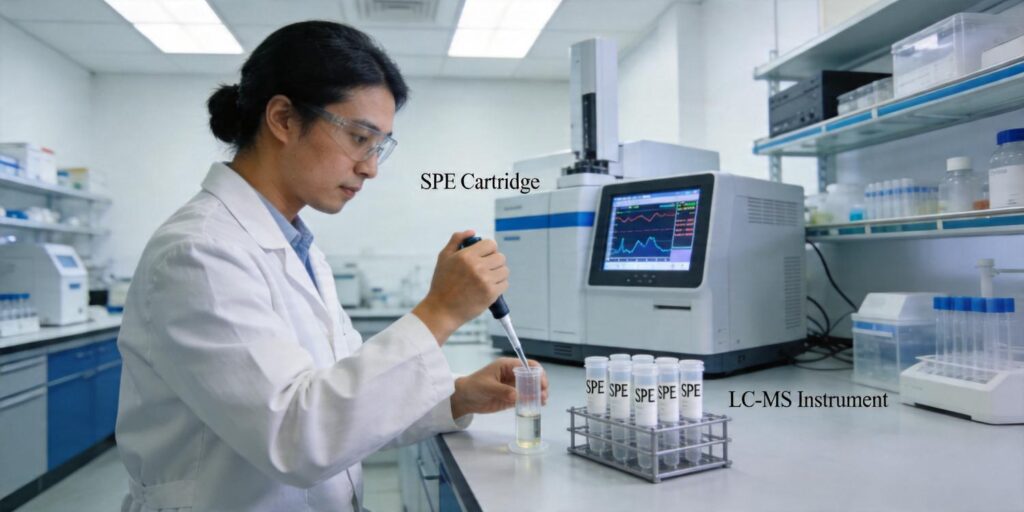
Liquid chromatography coupled with tandem mass spectrometry (LC-MS/MS) provides the sensitivity and selectivity required for EDC analysis at ng/L levels. Electrospray ionization (ESI) in negative or positive mode, depending on analyte properties, generates precursor ions for MS/MS fragmentation. Multiple reaction monitoring (MRM) enhances specificity by monitoring characteristic fragment ions.
Chromatographic separation typically employs C18 or C8 columns with gradient elution using water-methanol or water-acetonitrile mobile phases. Acid or base modifiers improve ionization efficiency and peak shape. For polar EDCs, hydrophilic interaction liquid chromatography (HILIC) provides alternative retention mechanisms. On-line SPE-LC-MS/MS systems automate the entire workflow, combining extraction, concentration, separation, and detection in integrated platforms.
Mass Spectrometry Considerations
Modern triple quadrupole instruments offer detection limits in the low ng/L range for most EDCs. High-resolution mass spectrometry (HRMS) provides additional confirmation through accurate mass measurements. As noted in SPE literature, mass spectroscopy offers selective detection advantages, meaning less emphasis on sample clean-up is required provided co-extracted species don’t interfere with ionization processes or degrade instrument performance.
Monitoring Strategies for Drinking Water Safety
Comprehensive monitoring programs employ both targeted and non-targeted approaches. Targeted analysis quantifies specific EDCs using validated methods with internal standards for correction of matrix effects and recovery variations. Non-targeted screening using high-resolution mass spectrometry identifies emerging contaminants not included in routine monitoring.
Quality control measures include method blanks, laboratory control samples, matrix spikes, and duplicate analyses to ensure data reliability. Proficiency testing programs and inter-laboratory comparisons validate method performance across different laboratories. Automated systems like Waters’ UPLC with on-line SPE technology streamline high-throughput monitoring, combining automated sample handling, chromatographic media, and ultra-sensitive detection into turnkey solutions.
Regulatory Framework and Method Validation
Monitoring programs align with regulatory guidelines such as EPA Method 1694 for pharmaceuticals and personal care products. Method validation establishes performance characteristics including linearity, accuracy, precision, detection limits, and robustness. For trace-level EDC analysis, special attention to background contamination from laboratory materials, reagents, and SPE devices is essential. Waters Oasis Glass Cartridges, tested for absence of bisphenol A and other phenols and phthalates, enable analysis at parts-per-trillion levels without interference from cartridge-derived contaminants.
Continuous method improvement incorporates new sorbent technologies, advanced instrumentation, and evolving scientific understanding of EDC occurrence and behavior. As SPE technology advances, future developments will likely focus on higher throughput, improved selectivity, and integration with emerging analytical platforms to meet growing demands for comprehensive drinking water safety assessment.