Biological Role of Lipid Mediators
Lipid mediators represent a diverse class of bioactive signaling molecules derived from polyunsaturated fatty acids that play crucial roles in inflammation, immunity, and homeostasis. These compounds include eicosanoids (prostaglandins, leukotrienes, thromboxanes), lipoxins, resolvins, and protectins, which collectively regulate physiological and pathological processes at nanomolar to picomolar concentrations.
As Dr. Xu, product manager at Poseidon Scientific, I understand that accurate measurement of these compounds requires sophisticated sample preparation techniques. Lipid mediators function as autocrine and paracrine signaling molecules, mediating cellular responses to injury, infection, and stress. Their transient nature and low abundance in biological matrices necessitate highly sensitive and selective analytical approaches.
Sample Extraction Using Organic Solvents
The initial extraction of lipid mediators from biological samples typically employs organic solvents to disrupt cellular membranes and solubilize lipid components. Common extraction protocols utilize chloroform-methanol mixtures (2:1 v/v) or methyl tert-butyl ether (MTBE) for efficient lipid recovery. For plasma or serum samples, a 1:1 dilution with chloroform followed by vortexing and centrifugation effectively separates lipid-containing organic phases from aqueous protein layers.
Research by Kaluzny et al. (1985) demonstrated that chloroform-based extractions yield excellent recovery of lipid classes from tissues and serum. The choice of extraction solvent significantly impacts both recovery and selectivity, with chloroform-methanol mixtures providing superior extraction efficiency for polar lipid mediators compared to less polar alternatives.
SPE Sorbent Selection for Lipid Enrichment
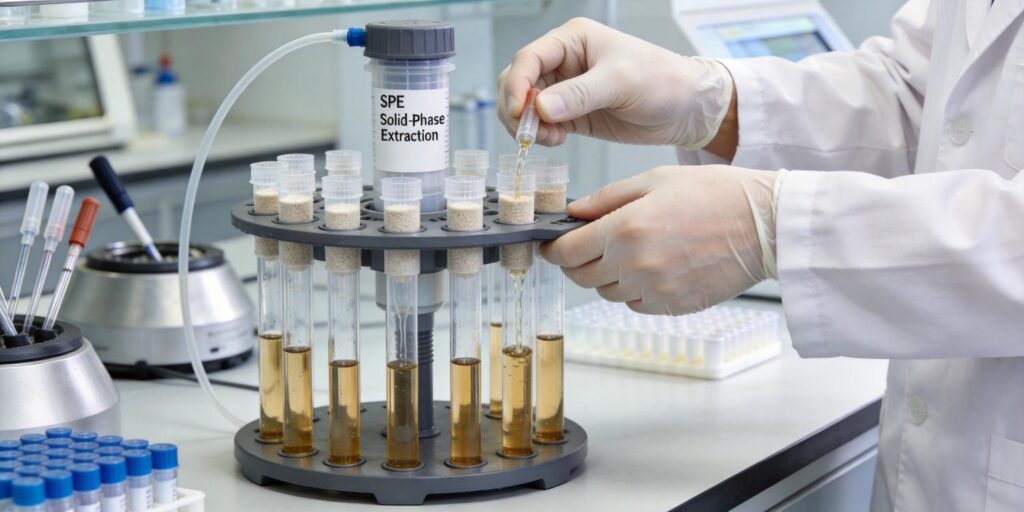
Selecting appropriate SPE sorbents is critical for successful lipid mediator enrichment. Aminopropyl (NH2) bonded silica phases have proven particularly effective for lipid class fractionation, as demonstrated by Kaluzny et al. (1985) and subsequent researchers. These sorbents enable separation of lipid classes based on polarity differences through selective elution schemes.
At Poseidon Scientific, our MAX SPE cartridges offer mixed-mode functionality that can be adapted for lipid mediator extraction. For comprehensive lipid profiling, researchers often employ sequential extraction strategies using different sorbent chemistries to isolate specific mediator classes.
Key Sorbent Considerations:
- Aminopropyl (NH2) phases: Excellent for lipid class separation
- C18 reversed-phase: Effective for hydrophobic lipid retention
- Mixed-mode sorbents: Combine hydrophobic and ionic interactions
- Phenylboronic acid (PBA): Selective for compounds with vicinal diols
Conditioning and Loading Protocols
Proper SPE cartridge conditioning is essential for reproducible lipid mediator recovery. For aminopropyl sorbents, sequential conditioning with methanol, ethyl acetate, dichloromethane, and hexane prepares the sorbent surface for optimal lipid interaction. Sample loading should be performed at controlled flow rates (typically 1-2 mL/min) to ensure adequate contact time between analytes and sorbent.
Biological samples should be diluted with appropriate solvents before loading. For tissue homogenates, chloroform extracts can be applied directly to conditioned SPE columns. Plasma samples require chloroform extraction followed by application of the organic phase to the SPE cartridge.
Washing to Remove Proteins and Salts
Effective washing steps remove interfering proteins, salts, and other matrix components while retaining target lipid mediators. For lipid extractions, initial washes with chloroform or chloroform-isopropanol mixtures (2:1 v/v) effectively remove neutral lipids while retaining more polar mediators. Subsequent washes with acetic acid in diethyl ether (2:98 v/v) can elute free fatty acids while retaining phospholipids.
The washing strategy must be optimized based on the specific lipid mediator classes of interest. For eicosanoid analysis, washing with hexane or low-polarity solvents effectively removes non-polar interferences while retaining target analytes.
Elution Solvents Optimized for Lipid Mediators
Selective elution of lipid mediator classes requires carefully optimized solvent systems. The classic method by Kaluzny et al. (1985) employs a sequential elution scheme:
- Hexane: Elutes cholesterol esters
- Diethyl ether-methylene chloride-hexane (1:10:89): Elutes triglycerides
- Ethyl acetate-hexane (5:95): Elutes cholesterol
- Ethyl acetate-hexane (15:85): Elutes diglycerides
- Chloroform-methanol (2:1): Elutes monoglycerides
- Acetic acid-diethyl ether (2:98): Elutes free fatty acids
- Methanol: Elutes phospholipids
For specific lipid mediators like prostaglandins and leukotrienes, methanol or methanol-acid mixtures often provide optimal elution efficiency. Research by Henden et al. (1993) demonstrated successful leukotriene extraction using SPE followed by HPLC analysis.
LC-MS/MS Detection
Liquid chromatography-tandem mass spectrometry (LC-MS/MS) represents the gold standard for lipid mediator analysis due to its exceptional sensitivity and specificity. Reverse-phase C18 or C8 columns with gradient elution using water-acetonitrile or water-methanol mobile phases containing volatile acids (formic or acetic acid) provide excellent chromatographic separation.
Multiple reaction monitoring (MRM) transitions enable specific detection of lipid mediator isomers and metabolites. Electrospray ionization in negative ion mode is typically employed for acidic lipid mediators (prostaglandins, leukotrienes), while positive ion mode may be used for certain neutral species.
LC-MS/MS Optimization Tips:
- Use stable isotope-labeled internal standards for quantification
- Optimize collision energies for specific MRM transitions
- Employ scheduled MRM for comprehensive profiling
- Consider two-dimensional chromatography for complex samples
Stability Considerations
Lipid mediators exhibit inherent instability due to their reactive functional groups and susceptibility to oxidation. Sample collection and processing should minimize exposure to oxygen, light, and elevated temperatures. Immediate addition of antioxidant mixtures (BHT, EDTA) and rapid freezing at -80°C preserves mediator integrity.
During SPE processing, minimizing solvent evaporation time and working under inert atmosphere reduces oxidative degradation. Eluates should be concentrated under gentle nitrogen stream rather than vacuum evaporation to prevent mediator loss. Reconstitution in appropriate solvents containing antioxidants maintains stability during LC-MS/MS analysis.
Critical Stability Factors:
- Temperature: Store samples at -80°C immediately after collection
- Oxidation: Add antioxidants (0.005% BHT) to extraction solvents
- pH control: Maintain appropriate pH during extraction to prevent degradation
- Light exposure: Process samples under amber light or in low-light conditions
Conclusion
SPE-based isolation of lipid mediators from biological samples represents a powerful approach for studying these critical signaling molecules. The combination of optimized organic solvent extraction, selective SPE sorbent chemistry, and sensitive LC-MS/MS detection enables comprehensive profiling of lipid mediator networks in physiological and pathological contexts.
At Poseidon Scientific, we recognize that successful lipid mediator analysis requires careful attention to each step of the sample preparation workflow. Our 96-well SPE plates and specialized cartridges provide researchers with reliable tools for high-throughput lipid mediator studies. By understanding the principles outlined in this article, researchers can develop robust methods for investigating the complex roles of lipid mediators in health and disease.
For method development assistance or product selection guidance, our technical team at Poseidon Scientific is available to support your lipid mediator research needs with our comprehensive range of HLB, MCX, and specialized SPE products.