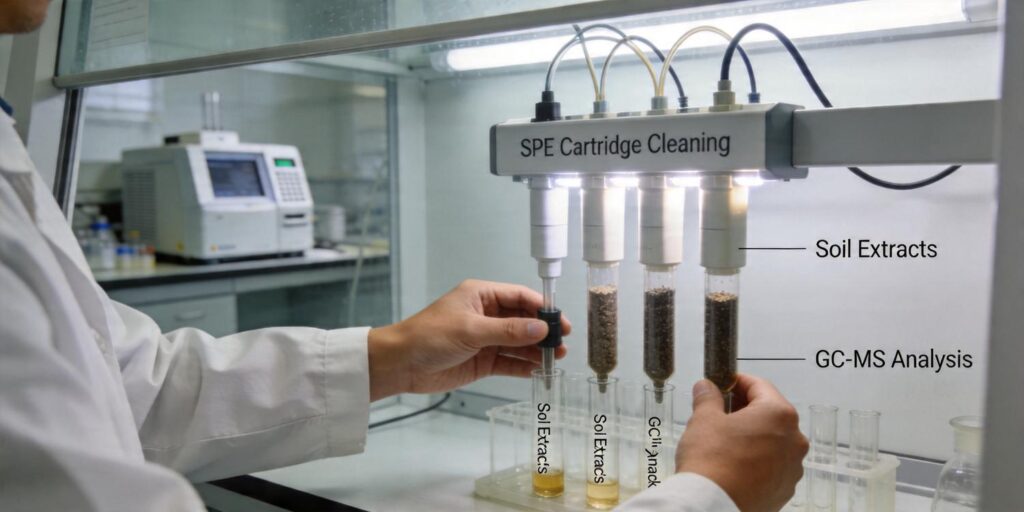
Soil Extraction Methods for Organic Contaminants
Environmental soil analysis begins with effective extraction of organic contaminants from complex soil matrices. The primary challenge lies in liberating analytes from solid matrices into liquid phases suitable for SPE processing. Traditional methods like Soxhlet extraction remain widely used, particularly for chlorinated pesticides and persistent organic pollutants. According to environmental chemistry literature, careful selection of extraction conditions is crucial to minimize co-extraction of biological debris and inorganic matrix components.
Modern approaches often involve homogenization in extraction buffers or water-miscible organic/buffer mixtures. The U.S. Environmental Protection Agency’s Statement of Work for chlorinated pesticides in soil samples specifies Soxhlet extraction, but this approach yields extracts rich in humic and fulvic acids, along with sulfurous compounds and other inorganics. Alternative methods like the Toxicity Characteristic Leaching Procedure (TCLP) simply require tumbling samples in aqueous media or passing water through soil samples, then extracting the resulting leachate using LLE or SPE.
For SPE compatibility, soil extracts are typically diluted with water to reduce eluotropic strength, creating a “water sample” suitable for SPE processing. This dilution step is critical because it adjusts the solvent strength to ensure proper retention of target analytes on SPE sorbents.
Matrix Interferences in Soil Extracts
Soil extracts present some of the most challenging matrices in environmental analysis. The primary interferences include:
Humic and Fulvic Acids
These dissolved organic matter (DOM) components are ubiquitous in soil extracts and can significantly impact SPE recovery. Research by Nakamura et al. (1996) established that analytes with log Pow values above approximately 4 (for alkyl-bonded silicas) or above 3 (for polystyrene sorbents) experience reduced recovery in the presence of humic acids. The mechanism involves formation of analyte-humic acid complexes that may not be efficiently extracted by conventional SPE methods.
Particulate Matter
Soil extracts contain inorganic, organic, and biological particulates that can clog SPE devices. Unlike dissolved organic matter, particulates can often be removed through centrifugation or filtration prior to SPE. Environmental researchers commonly use glass-fiber filters (0.45 μm) without organic binders for pre-filtering, though care must be taken to test analyte adsorption on selected filters.
Sulfurous Compounds and Inorganics
Soil extracts, particularly from certain geological formations, may contain high levels of sulfurous compounds that interfere with GC-MS analysis. These require specific desulfurization steps in addition to SPE cleanup.
SPE Cartridge Selection for Cleanup
Choosing the appropriate SPE sorbent is critical for successful soil extract cleanup. The selection depends on analyte properties and matrix characteristics:
Reversed-Phase Sorbents
C18, C8, and HLB (hydrophilic-lipophilic balance) cartridges are commonly used for non-polar to moderately polar organic contaminants. Our HLB SPE cartridges offer excellent retention for a wide range of compounds with varying polarities, making them ideal for multi-residue methods.
Mixed-Mode Sorbents
For basic or acidic compounds, mixed-mode sorbents like MCX (mixed-mode cation exchange) and MAX (mixed-mode anion exchange) provide additional selectivity. Our MCX cartridges and MAX cartridges combine reversed-phase and ion-exchange mechanisms for superior cleanup of ionizable compounds.
Specialized Sorbents
For specific applications, WAX (weak anion exchange) and WCX (weak cation exchange) cartridges offer targeted cleanup. Our WAX cartridges and WCX cartridges are particularly effective for removing acidic or basic interferences, respectively.
Florisil and Other Normal-Phase Sorbents
Historically, Florisil has been used for pesticide cleanup, though it often provides only partial cleanup in complex soil extracts. Modern approaches frequently combine multiple cleanup steps or use more selective sorbents.
Conditioning and Loading Extracts
Proper SPE conditioning is essential for reproducible results with soil extracts:
Conditioning Protocol
Standard conditioning involves sequential washing with methanol or acetonitrile followed by a weak solvent (water or buffer). This prepares the sorbent surface to accept the sample matrix while ensuring consistent retention characteristics.
Sample Loading Considerations
Soil extracts should be loaded at controlled flow rates (typically 1-3 drops per second) to ensure adequate contact time between analytes and sorbent. For high-throughput applications, our 96-well SPE plates offer efficient processing of multiple samples simultaneously.
pH Adjustment
Sample pH should be adjusted to ensure target analytes are in their neutral form for optimal retention on reversed-phase sorbents, or in their ionized form for ion-exchange mechanisms.
Washing Steps to Remove Humic Acids
Effective removal of humic acids is crucial for successful GC-MS analysis:
Water-Based Washes
Initial washing with water or dilute aqueous buffers can remove water-soluble humic acid fractions without eluting target analytes. Research indicates that humic acids with more neutral character at lower pH may be more effectively removed.
Organic-Water Mixtures
Carefully optimized mixtures of water with methanol or acetonitrile (typically 5-20% organic) can remove moderately retained humic substances while retaining target analytes. The exact composition depends on analyte hydrophobicity.
Specialized Approaches
Some researchers use strongly positively charged graphitized carbon black to permanently retain negatively charged humic substances. Others employ chemical destruction of humic acids prior to SPE using potassium permanganate oxidation followed by hydrogen peroxide reduction.
Flow Rate Optimization
Washing steps should be performed at controlled flow rates to ensure adequate contact time for humic acid removal while minimizing analyte loss.
Elution Solvents for Organic Analytes
Selection of elution solvents depends on analyte properties and sorbent chemistry:
Non-Polar Analytes
For hydrophobic compounds, solvents like hexane, methylene chloride, or ethyl acetate provide efficient elution from reversed-phase sorbents. These solvents are compatible with GC-MS analysis and allow for easy concentration.
Moderately Polar to Polar Analytes
Methanol, acetonitrile, or acetone, often with acid or base modifiers, effectively elute more polar compounds. For ionizable analytes on mixed-mode sorbents, elution solvents must disrupt both hydrophobic and ionic interactions.
Solvent Volume Optimization
Elution should be performed in the smallest possible volume to maximize concentration factors. Typically, 1-2 mL of elution solvent per 100 mg of sorbent provides adequate recovery while maintaining concentration.
Multiple Elution Fractions
For complex mixtures, collecting multiple elution fractions with increasing solvent strength can improve separation of analyte classes and reduce matrix effects in subsequent analysis.
GC-MS Analysis Integration
SPE cleanup directly impacts GC-MS performance and reliability:
Matrix Effect Reduction
Effective SPE cleanup minimizes matrix-induced enhancement or suppression of analyte signals in GC-MS. This is particularly important for quantitative analysis where accurate calibration is essential.
Instrument Protection
Removing humic acids, particulates, and non-volatile matrix components protects GC injectors, columns, and MS ion sources from contamination and degradation, extending instrument lifetime and reducing maintenance.
Chromatographic Performance
Clean extracts yield sharper chromatographic peaks, better baseline separation, and reduced background noise, improving detection limits and quantitative accuracy.
Method Compatibility
SPE eluents must be compatible with GC injection requirements. Solvents should be sufficiently volatile and not interfere with analyte derivatization if required.
Method Performance Evaluation
Comprehensive evaluation ensures method reliability for environmental monitoring:
Recovery Studies
Recovery should be determined using spiked soil extracts that contain representative levels of dissolved organic matter. According to environmental SPE literature, recoveries exceeding 90% are achievable with optimized methods.
Matrix Effect Assessment
Matrix effects should be evaluated by comparing calibration curves in pure solvent versus matrix-matched standards. Signal suppression or enhancement should be quantified and compensated if necessary.
Detection Limits and Linearity
Method detection limits should be established based on signal-to-noise ratios in real soil extracts. Linearity should be demonstrated over the expected concentration range.
Precision and Accuracy
Intra-day and inter-day precision should meet regulatory requirements (typically <15% RSD). Accuracy should be verified using certified reference materials or standard addition methods.
Robustness Testing
Method robustness should be evaluated by testing variations in SPE conditions (flow rates, solvent volumes, pH) to ensure reliable performance under routine laboratory conditions.
Comparison with Reference Methods
Where possible, SPE methods should be compared with established reference methods (such as EPA methods using traditional cleanup approaches) to validate performance.
Properly optimized SPE cleanup of soil extracts before GC-MS analysis provides significant advantages over traditional methods, including reduced solvent consumption, improved throughput, better reproducibility, and enhanced protection of analytical instrumentation. By selecting appropriate sorbents and optimizing each step of the SPE process, environmental laboratories can achieve reliable detection of organic contaminants at trace levels in complex soil matrices.