Analytical Challenges of Pigment-Rich Food Matrices
Pigment-rich food matrices present unique analytical challenges that complicate accurate quantification of target analytes. These matrices, including fruits, vegetables, leafy greens, and certain processed foods, contain high concentrations of natural pigments such as chlorophylls, carotenoids, anthocyanins, and betalains. These colored compounds interfere with analytical methods through multiple mechanisms: they can co-elute with target analytes in chromatography, cause detector saturation, generate matrix effects that suppress or enhance analyte signals, and lead to column fouling that reduces chromatographic performance.
According to Simpson and Wynne (2000), plant materials present particular difficulties due to their complex composition of sugars, acids, and colorants. The presence of these interfering components necessitates careful method design to ensure accurate analyte measurement. The high or variable water and fat contents of citrus fruit, berries, and nuts can present capacity problems for solid-phase extraction (SPE) systems, requiring careful consideration of sorbent selection and loading conditions.
Extraction of Colored Compounds
Effective extraction of colored compounds from food matrices requires careful solvent selection and extraction methodology. Ethanol has emerged as a preferred extractant for many applications due to its relatively low toxicity and effectiveness in extracting both polar and non-polar compounds. Research has shown that ethanol can effectively extract fat-soluble vitamins from complex matrices while maintaining compatibility with subsequent SPE cleanup steps.
In studies of fat-soluble vitamin extraction, researchers found that ethanol provided optimal extraction efficiency without requiring additional antioxidants like butylated hydroxytoluene (BHT) or ascorbic acid. This simplifies the extraction process while maintaining analyte stability. The choice of extraction solvent must balance extraction efficiency with compatibility with subsequent SPE steps, as the solvent composition significantly affects analyte retention on SPE sorbents.
SPE Sorbent Selection for Pigment Removal
Selecting the appropriate SPE sorbent is critical for effective pigment removal from food extracts. Different sorbents offer varying selectivity for different classes of pigments and analytes:
HLB (Hydrophilic-Lipophilic Balanced) Sorbents
HLB sorbents containing poly(divinylbenzene-co-N-vinylpyrrolidone) exhibit both hydrophilic and lipophilic retention characteristics, making them suitable for extracting medium-polar and non-polar organic compounds from mixtures of water and organic solvent. These sorbents play a valid role in the cleanup of feed samples containing both fat- and water-soluble vitamins and are particularly effective for complex food matrices.
C18 and Other Reversed-Phase Sorbents
C18 sorbents have been successfully applied to remove hydrophobic pigments and other interfering compounds from various food matrices. Research by Horie et al. (1990) demonstrated effective cleanup of meat samples using C18 cartridges, where homogenized samples were filtered and evaporated before application to the cartridge. The study compared commercially available C18 sorbents and evaluated the role that bed mass has upon recovery and extract purity.
Mixed-Mode and Ion-Exchange Sorbents
For ionic or ionizable pigments and analytes, mixed-mode or ion-exchange sorbents offer enhanced selectivity. Strong anion exchange (SAX) sorbents have been used to retain acidic pigments while allowing neutral or basic analytes to pass through. Similarly, strong cation exchange (SCX) sorbents can retain basic compounds while removing acidic pigments.
Conditioning and Loading Procedures
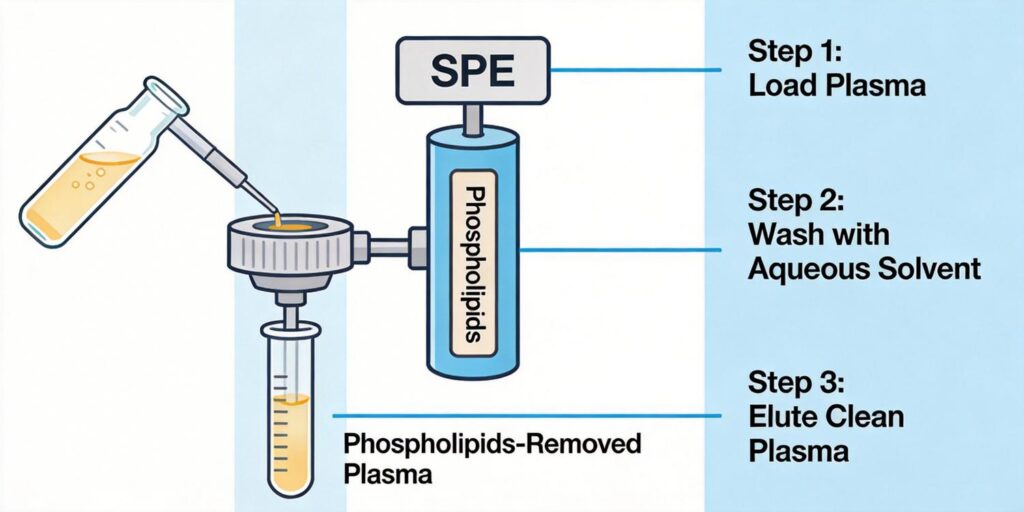
Proper conditioning and loading procedures are essential for optimal SPE performance with pigment-rich extracts. The conditioning process typically involves sequential washing with methanol followed by water or an aqueous buffer. Methanol wets the surface of the sorbent and penetrates bonded alkyl phases, allowing water to wet the silica surface efficiently.
For HLB cartridges, research has shown that conditioning with 1 mL methanol followed by 1 mL water prepares the sorbent effectively for sample loading. The loading solution composition significantly affects analyte retention. Studies with fat-soluble vitamins demonstrated that 65% ethanol-water provided optimal retention of all vitamins on HLB columns, while higher ethanol concentrations led to breakthrough of analytes.
Sample loading rates should be controlled to ensure adequate contact time between the sample and sorbent. For aqueous samples, flow rates of approximately 48-55 drops per minute have been shown to provide effective extraction without compromising recovery.
Washing Solvents for Chlorophyll and Carotenoids
Selective washing steps are crucial for removing chlorophylls and carotenoids while retaining target analytes. The choice of washing solvent depends on the polarity of both the pigments and the analytes of interest:
For Chlorophyll Removal
Chlorophylls, being relatively non-polar, can often be removed using solvents of intermediate polarity. Research has shown that 5% methanol-water effectively removes salts and other organic interferences while retaining fat-soluble vitamins on HLB cartridges. For more challenging applications, mixtures of n-hexane and dichloromethane (7:3, v/v) have been used to wash columns while retaining target compounds.
For Carotenoid Removal
Carotenoids, being highly non-polar, may require different washing strategies. Mildly polar solvents that disrupt carotenoid-sorbent interactions while maintaining analyte retention are typically employed. The specific solvent composition should be optimized based on the particular carotenoids present and the target analytes.
General Washing Considerations
Washing solvents should be stronger than the sample matrix but weaker than needed to remove compounds of interest. This ensures that unwanted, weakly retained materials are removed while maintaining analyte retention. The volume of washing solvent should be sufficient to remove interferences without causing analyte breakthrough.
Elution of Analytes
Efficient elution of target analytes following pigment removal requires careful solvent selection. The elution solvent must be strong enough to disrupt analyte-sorbent interactions while minimizing co-elution of any remaining pigments.
For fat-soluble vitamins on HLB cartridges, research has shown that 1 mL of ethanol provides effective elution with high recovery and minimal solvent volume. Other solvents with different polarities, including tetrahydrofuran, acetonitrile, ethyl acetate, acetone, cyclohexane, and methanol, have been evaluated for various applications. The optimal elution solvent depends on the specific analytes and sorbent chemistry.
Elution volume should be minimized to concentrate analytes while ensuring complete recovery. Typically, 1-3 mL of elution solvent provides adequate recovery for most applications, with the exact volume determined through method optimization.
Chromatographic Analysis Improvements
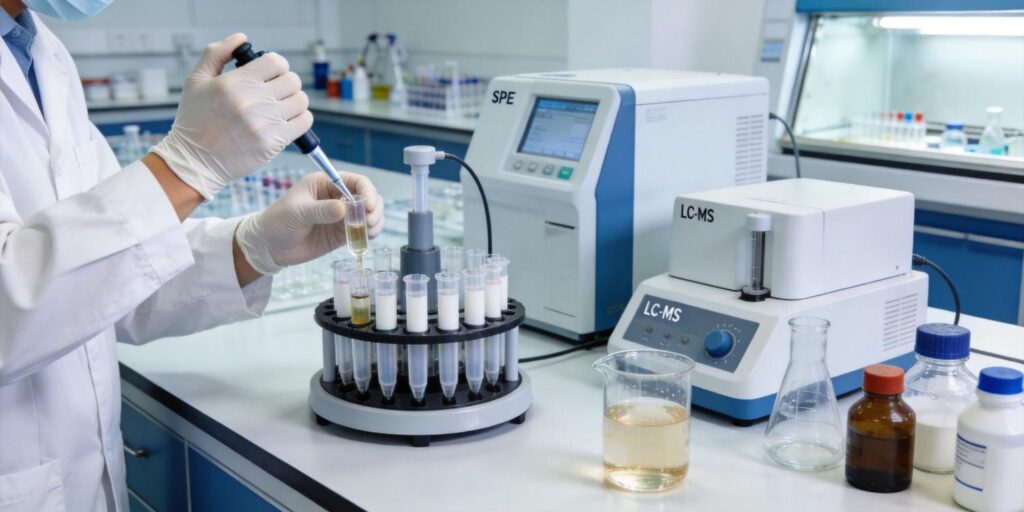
Effective SPE cleanup of pigment-rich extracts leads to significant improvements in chromatographic analysis. Cleaner extracts result in:
- Reduced matrix effects in mass spectrometry
- Improved peak shape and resolution
- Extended column lifetime
- Enhanced detector sensitivity and linearity
- Reduced system maintenance requirements
Comparative chromatograms of feed samples spiked with vitamins clearly demonstrate the importance of SPE cleanup, particularly for compounds like vitamin K3 that are especially susceptible to matrix interference. The cleanup process removes co-extracted compounds that can cause baseline drift, ghost peaks, and other chromatographic artifacts.
Example Applications
Several documented applications demonstrate the effectiveness of SPE for pigment removal from food extracts:
Fat-Soluble Vitamin Analysis in Animal Feed
Research has shown successful cleanup of concentrate feed samples for analysis of vitamins K3, A-acetate, D3, α-tocopherol, and α-tocopherol acetate using Oasis HLB cartridges. The method achieved recoveries ranging from 87.6% to 129.6% with coefficients of variation between 1.0% and 8.8%, demonstrating both accuracy and precision.
Pesticide Residue Analysis in Fruits and Vegetables
The Luke procedure, as described by Simpson and Wynne (2000), employs SPE for matrix removal in the analysis of pesticide residues from various produce. The method uses SAX and PSA sorbents to retain plant sugars and acids while allowing analytes to pass through unretained. This approach has been applied to a wide range of sample types and provides improved sensitivity for pesticide quantitation.
Wine and Beverage Analysis
SPE has been used for class fractionation of wine components, including extraction of pigments (anthocyanins) on C18 bonded phases while leaving sugars in the effluent. This approach allows for separate analysis of different wine components and has been extended to other beverages for removal of interfering compounds.
Meat and Dairy Product Analysis
For samples with high fat and protein content, such as meat and dairy products, SPE provides effective cleanup following appropriate sample preparation. Methods have been developed for various analytes, including sulfamethazine in meat and aflatoxins in milk, demonstrating the versatility of SPE for different food matrices.
These applications highlight the importance of method optimization for specific matrix-analyte combinations. Factors such as sorbent selection, solvent composition, and procedural details must be carefully considered to achieve optimal results. When properly implemented, SPE cleanup of pigment-rich food extracts provides reliable, reproducible results that meet the stringent requirements of modern analytical laboratories.
For laboratories working with challenging food matrices, investing time in SPE method development pays dividends in improved data quality, reduced instrument downtime, and increased confidence in analytical results. The techniques described here provide a foundation for developing robust methods that can be adapted to specific analytical needs while maintaining compliance with regulatory requirements.