1. Role of Organic Acids in Fermentation
Organic acids play a crucial role in fermented products, serving as key indicators of fermentation quality, microbial activity, and product stability. In fermented beverages like wine, beer, and kombucha, as well as foods such as yogurt, sauerkraut, and kimchi, organic acids contribute significantly to flavor profile, pH regulation, and preservation. Common organic acids in fermentation include lactic acid, acetic acid, citric acid, malic acid, tartaric acid, and succinic acid.
These acids are metabolic byproducts of microbial fermentation processes. Lactic acid bacteria produce lactic acid through carbohydrate fermentation, while acetic acid bacteria generate acetic acid through ethanol oxidation. The concentration and ratio of these acids determine the sensory characteristics of the final product, including sourness, tartness, and overall flavor balance. Beyond sensory attributes, organic acids act as natural preservatives by lowering pH and inhibiting spoilage microorganisms, extending shelf life without artificial additives.
For quality control and regulatory compliance, accurate quantification of organic acids is essential. Regulatory bodies often establish maximum allowable concentrations for certain acids, particularly in alcoholic beverages where acetic acid levels must be controlled to prevent vinegar formation. Analytical monitoring ensures product consistency, detects fermentation abnormalities, and verifies compliance with industry standards.
2. Extraction from Fermented Beverages or Foods
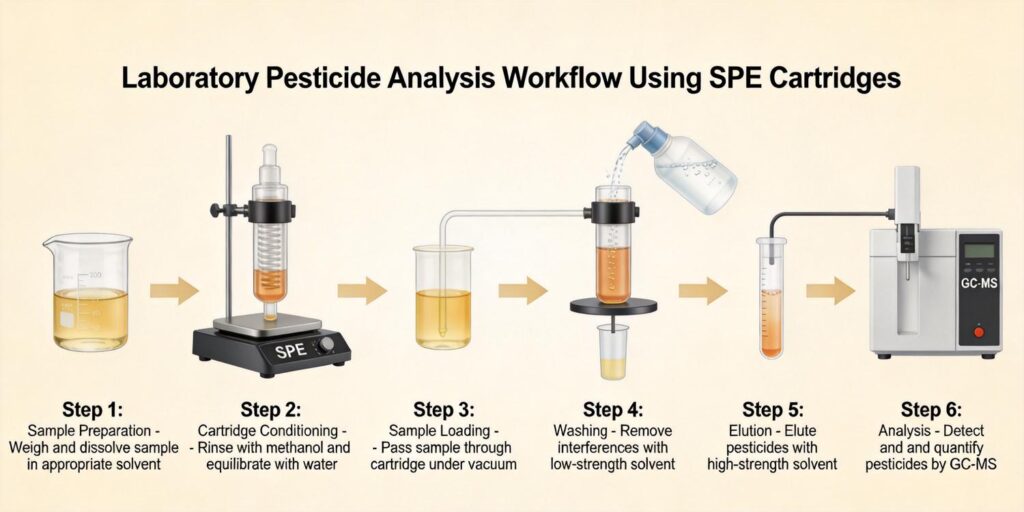
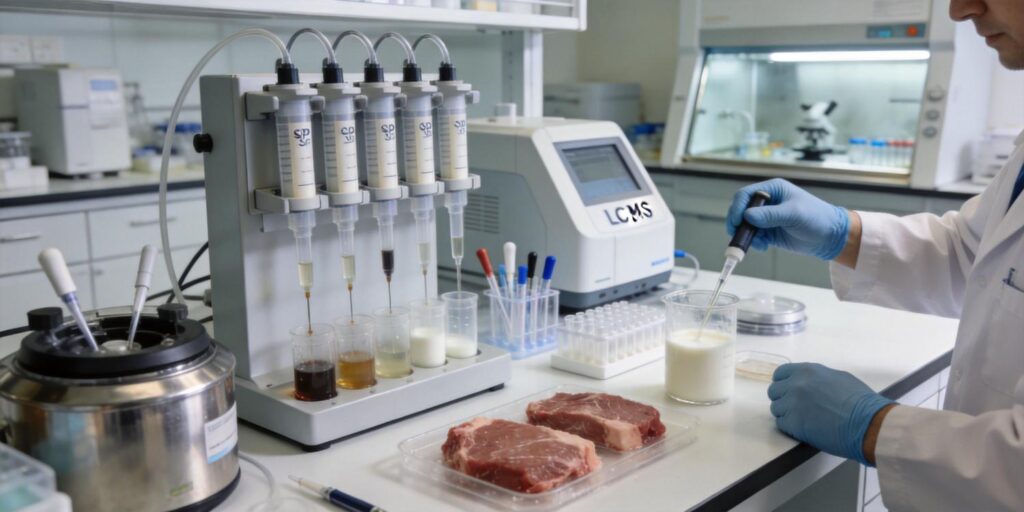
Extracting organic acids from fermented matrices presents unique challenges due to complex sample composition. Fermented products typically contain proteins, carbohydrates, lipids, pigments, and various microbial metabolites that can interfere with analysis. Traditional extraction methods like liquid-liquid extraction (LLE) have been largely superseded by solid-phase extraction (SPE) due to superior recovery, reduced solvent consumption, and better reproducibility.
The extraction process begins with sample preparation. For liquid samples like wine or beer, filtration through 0.45 μm membranes removes particulate matter. For solid or semi-solid fermented foods (cheese, yogurt, kimchi), homogenization with appropriate solvents (water, methanol, or acidified solutions) is necessary to release organic acids from the matrix. Sample pH adjustment is critical at this stage, as organic acids exist in both protonated and deprotonated forms depending on pH.
Research demonstrates that SPE offers significant advantages over LLE for fermented product analysis. As noted in forensic applications, SPE eliminates emulsion problems, reduces operator involvement, and enables multiple simultaneous extractions while minimizing organic solvent usage. For fermented matrices, SPE provides cleaner extracts with fewer interfering compounds, particularly important when analyzing trace organic acids in complex backgrounds.
3. SPE Sorbent Selection for Acidic Compounds
Selecting the appropriate SPE sorbent is paramount for successful organic acid isolation. The choice depends on the target acids’ physicochemical properties, particularly their pKa values and polarity. For weak organic acids (pKa 2-8), mixed-mode sorbents like MAX (Mixed-mode Anion Exchange) cartridges are ideal. These sorbents combine reversed-phase retention with strong anion exchange functionality, providing dual retention mechanisms for enhanced selectivity.
For strong acidic compounds (pKa <1), WAX (Weak Anion Exchange) cartridges offer optimal performance. These sorbents utilize weak anion exchange interactions to retain acidic compounds while allowing neutral and basic interferences to pass through. The Waters Oasis system recommends WAX for strong acids and MAX for weak acids as part of their comprehensive SPE strategy.
For general cleanup where both acidic and neutral compounds need retention, HLB (Hydrophilic-Lipophilic Balanced) cartridges provide excellent recovery across a wide pH range (0-14). HLB sorbents are particularly useful for fermented products containing multiple organic acid classes with varying polarities. The choice between these sorbents should consider the specific organic acid targets, matrix complexity, and required detection limits.
4. Conditioning and Sample Loading
Proper conditioning establishes the sorbent’s optimal retention environment. For anion exchange sorbents like MAX and WAX, conditioning typically involves sequential solvent passes: first with methanol (1-2 mL) to activate the sorbent and wet the hydrophobic surface, followed by water or buffer (1-2 mL) to create the aqueous environment needed for ionic interactions. It’s crucial to prevent sorbent drying between conditioning and sample loading, as this can compromise retention efficiency.
Sample loading conditions significantly impact organic acid recovery. Research indicates that sample pH should be adjusted to ensure target acids exist primarily in their anionic forms for optimal retention on anion exchange sorbents. For most organic acids, pH adjustment to 2-3 units above their pKa values ensures >99% ionization. However, as demonstrated in forensic applications, strongly acidic drugs (and by extension, organic acids) show better retention at lower pH (pH 2.2) where they are less ionized and thus more retained by hydrophobic mechanisms.
The loading flow rate should be controlled at 1-3 drops per second to maximize analyte-sorbent interaction time. For viscous fermented samples, dilution with appropriate buffer may be necessary to maintain consistent flow rates. Sample volume depends on analyte concentration and detection requirements, but typically ranges from 1-10 mL for beverage analysis.
5. Washing Steps to Remove Sugars
Fermented products contain significant amounts of sugars (glucose, fructose, sucrose) that can interfere with organic acid analysis. These polar compounds are poorly retained on reversed-phase sorbents but may co-elute with target analytes if not properly removed. Washing steps must be optimized to eliminate sugars while retaining organic acids.
For anion exchange sorbents, washing with 5% methanol in water effectively removes sugars and other polar neutral compounds. The methanol concentration is low enough to maintain ionic interactions between the sorbent and organic acid anions while disrupting weaker polar interactions with sugars. Some methods incorporate additional washing with acidified water (pH 2-3) to remove weakly retained acidic compounds that might interfere with target analytes.
Research on SPE optimization emphasizes that wash solvent strength should be carefully controlled. As noted in method development literature, “These modifiers may also be thought of as performing like HPLC mobile-phase modifiers since one aspect of a typical non-polar retention is the secondary interaction between sorbent and analyte.” For fermented products, empirical testing with spiked samples is recommended to establish optimal wash conditions that maximize sugar removal while minimizing organic acid loss.
6. Elution Solvents
Elution solvent selection determines both recovery efficiency and extract purity. For anion exchange sorbents, organic acids are typically eluted using solvents containing acid or base to disrupt ionic interactions. Common elution solvents include:
- Acidified methanol: 2% formic acid in methanol effectively protonates the sorbent’s basic sites, releasing organic acid anions
- Ammoniated organic solvents: 2-5% ammonium hydroxide in methanol or acetonitrile neutralizes acidic analytes
- Mixed organic-aqueous systems: Methanol:water or acetonitrile:water mixtures with pH modifiers
Elution volume should be minimized to concentrate analytes while ensuring complete recovery. Typically, 1-2 mL of elution solvent provides >90% recovery for most organic acids. For MCX (Mixed-mode Cation Exchange) cartridges, which might be used for certain organic acid applications, elution typically involves ammoniated organic solvents. However, for purely acidic compounds, MAX or WAX sorbents with acidified elution solvents generally yield better results.
Post-elution, extracts may require evaporation and reconstitution in mobile phase compatible solvents for HPLC analysis. Care must be taken during evaporation to prevent volatile organic acid loss, particularly for short-chain acids like acetic and formic acids.
7. HPLC Analysis of Organic Acids
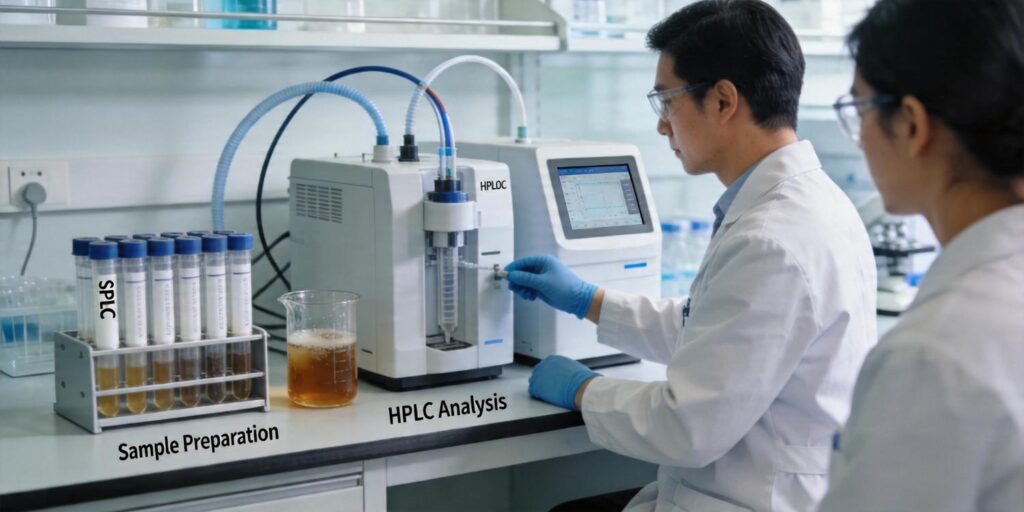
High-performance liquid chromatography (HPLC) is the preferred analytical technique for organic acid quantification in fermented products. Reversed-phase chromatography with C18 columns is commonly employed, though specialized columns like amine-based or ion-exchange columns may offer better separation for certain acid mixtures.
Mobile phase composition typically involves acidified aqueous solutions (phosphoric acid, sulfuric acid, or formic acid at 0.1-1%) with organic modifiers (methanol or acetonitrile). Isocratic elution often suffices for simple acid profiles, while gradient elution provides better separation for complex mixtures. Detection methods include:
- UV detection: Most organic acids absorb at 210-220 nm, though sensitivity varies
- Refractive index detection: Universal but less sensitive, suitable for high-concentration acids
- Mass spectrometry: Provides highest sensitivity and selectivity, essential for trace analysis
Method validation should include linearity, accuracy, precision, limit of detection (LOD), and limit of quantification (LOQ) assessments. Matrix-matched calibration standards are recommended to account for matrix effects, particularly for complex fermented products. As noted in SPE optimization literature, “Having obtained a procedure with acceptable recovery (at least 50%) and purity, it is time to work on final optimization and simplification of the procedure.”
8. Method Optimization for Recovery
Optimizing SPE methods for organic acid recovery requires systematic approach. The educated approach to SPE method development involves organizing attempts at method development while reviewing objectives and preliminary information about analytes of interest. Key optimization parameters include:
- pH optimization: Sample pH dramatically affects organic acid ionization and thus retention. For acidic compounds, lowering pH decreases ionization, increasing hydrophobic retention but potentially decreasing anion exchange retention.
- Ionic strength: High salt concentrations can compete with organic acid anions for exchange sites, reducing recovery.
- Organic modifier content: Small amounts of organic solvent in loading solutions can improve recovery of hydrophobic acids but may decrease retention of polar acids.
- Flow rates: Slower flow rates during loading and washing generally improve recovery by increasing interaction time.
- Sorbent mass: For high-capacity samples, larger sorbent beds (100-500 mg) may be necessary to prevent breakthrough.
Recovery optimization should employ spiked samples at relevant concentrations. As research indicates, “For methods using UV detection, concentrations in the range 1 to 10 μmol/L (0.3-3 μg/mL for a substance with a molecular weight of 300 Daltons) will usually suffice.” Replicate assays (4-6) of spiked samples should be performed to assess precision.
For high-throughput applications, 96-well SPE plates offer significant advantages in efficiency and consistency. These formats enable parallel processing of multiple samples, reducing variability and increasing throughput—particularly valuable for quality control laboratories analyzing large numbers of fermented product samples.
Final method validation should demonstrate robustness across different sample batches and operators. Documentation should include detailed protocols for sorbent conditioning, sample loading, washing, elution, and HPLC analysis parameters to ensure method transferability and regulatory compliance.