Magnetron Sputtering Process Overview
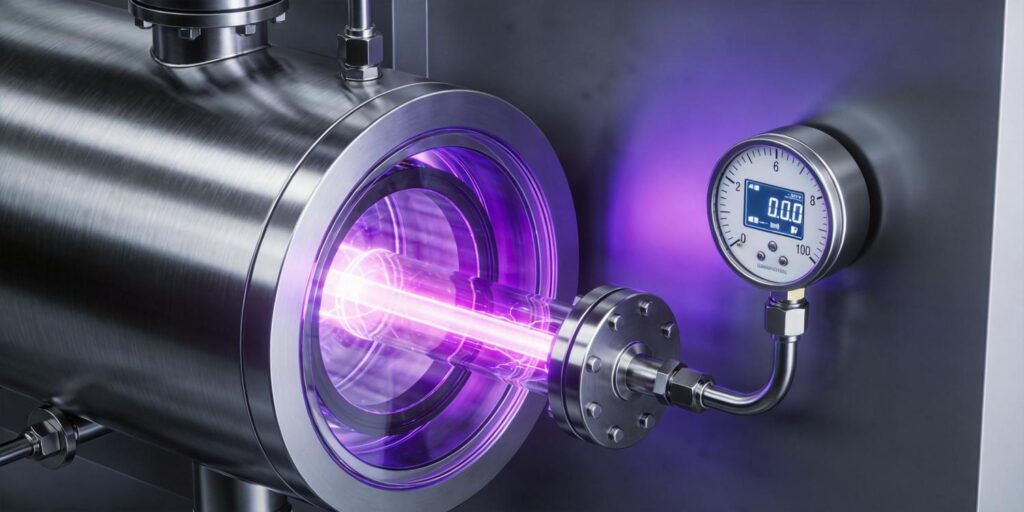
Magnetron sputtering is a cornerstone physical vapor deposition (PVD) technique used across semiconductor fabrication, optical coatings, decorative finishes, and precision tooling. In the process, a high-voltage plasma is generated in a low-pressure argon (or reactive gas) environment. A magnetic field traps electrons near the target surface, dramatically increasing ionization efficiency and enabling high-rate deposition of thin films with excellent uniformity and adhesion.
The entire system—vacuum chamber, magnetron cathodes, substrate holders, and gas delivery—operates under tightly controlled vacuum conditions. Pressure must remain stable throughout pump-down, plasma ignition, and the full deposition cycle, which can last from minutes to several hours. Any instability risks arcing, non-uniform film thickness, or target poisoning in reactive sputtering. Engineers and procurement teams therefore prioritize vacuum gauges that deliver fast, accurate, and integration-ready data without adding cost or complexity.
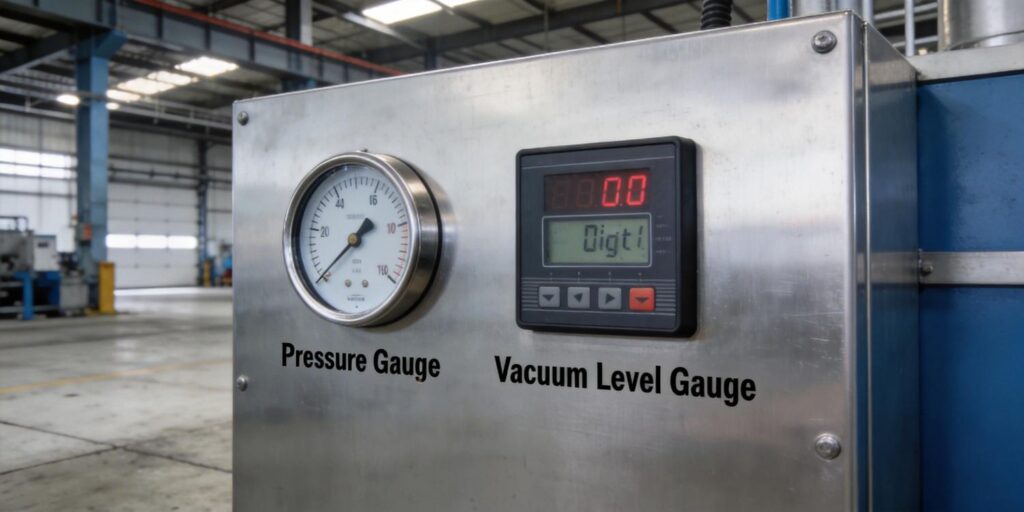
Poseidon Scientific designed the VG-SP205 Pirani Vacuum Transmitter and VG-SM225 Cold Cathode Vacuum Gauge specifically for magnetron sputtering environments. Their compact size, temperature compensation, and customizable RS232 protocols enable seamless integration into existing tool controllers while maintaining the low cost of ownership critical for production-scale PVD systems.
Stable Pressure Requirement
Stable chamber pressure is non-negotiable in magnetron sputtering. Typical operating pressures range from 2–10 mTorr (approximately 2.7–13.3 × 10⁻³ Torr) during deposition to ensure optimal plasma density, sputter yield, and film properties. Even small fluctuations (±0.5 mTorr) can shift the mean free path of sputtered atoms, leading to shadowing effects, reduced step coverage, or inconsistent stoichiometry in reactive processes.
Both roughing and high-vacuum phases must be monitored continuously. The VG-SP205 covers the critical transition from atmosphere down to 10-3 Torr with sub-second response, while the VG-SM225 extends reliable measurement into the 10-3 to 10-7 Torr range using Penning discharge. Together they provide full-spectrum coverage, allowing closed-loop control of mass-flow controllers and throttle valves to maintain the exact pressure window required for repeatable, high-quality films.
Gas Flow Interaction
Argon or reactive gases (oxygen, nitrogen) are introduced at controlled flow rates during sputtering to sustain the plasma. This dynamic gas load interacts directly with the vacuum system, making real-time pressure feedback essential. Too little flow reduces sputter rate; too much causes pressure spikes, arcing, or target poisoning.
The VG-SP205 Pirani, operating on thermal conductivity principles, responds instantaneously to changes in gas density and composition. Its platinum filament—chosen for high temperature coefficient of resistance and chemical stability—maintains accuracy even with varying argon–oxygen mixtures common in reactive sputtering. The VG-SM225 Cold Cathode, with its positive magnetron geometry (~100 gauss NdFeB field), delivers stable ion-current readings once the system reaches operating pressure, unaffected by the modest gas flows used in magnetron processes.
Pirani During Roughing
The initial pump-down phase—from atmosphere to the 10-3 Torr crossover—dominates cycle time in magnetron sputtering tools. The VG-SP205 Pirani Vacuum Transmitter is optimized for this regime. It maintains a constant filament temperature and measures the power required to offset gas-induced heat loss, producing a direct, repeatable pressure signal with excellent linearity in the most dynamic portion of the pump-down curve.
Temperature compensation circuitry and embedded algorithms keep readings stable across the 15 °C–50 °C operating range typical of cleanroom environments. The 0–10 V analog output (effective 2–8 V) interfaces directly with PLCs for real-time roughing pump and valve control, while customizable RS232 protocols enable detailed logging for process traceability. Maintenance-free design and a typical 3–5 year lifespan make the VG-SP205 the reliable workhorse for the high-duty cycles of production sputtering systems.
Cold Cathode During Deposition
Once the chamber reaches operating pressure, the VG-SM225 Cold Cathode Vacuum Gauge assumes primary monitoring duty. Using Penning discharge in a compact positive magnetron configuration, it generates a measurable ion current proportional to pressure down to 10-7 Torr. Startup voltage of –2500 V briefly initiates field emission, then automatically reduces to –2000 V for stable, low-noise operation during long deposition runs.
Software interlocks prevent high-voltage activation above 10-3 Torr, protecting electrodes from contamination during the initial argon backfill and plasma ignition. The removable sensor head allows quick cleaning with 200- or 500-grit sandpaper whenever startup delays appear, restoring performance without extended downtime. This design ensures the gauge remains accurate and contamination-resistant throughout reactive or metallic sputtering processes.
Preventing Pressure Spikes
Pressure spikes during sputtering—often caused by sudden gas bursts, target arcing, or substrate outgassing—can interrupt plasma stability and damage films. Both Poseidon gauges incorporate features that help prevent and detect these events:
- Low-noise electronics and digital filtering on the VG-SP205 smooth transient signals during gas-flow adjustments.
- The VG-SM225’s firmware discards short-duration spikes while preserving genuine pressure trends.
- RS232 status and error codes alert operators instantly to overpressure conditions or sensor anomalies.
- Dual-gauge configuration creates a seamless handover at 10-3 Torr, ensuring continuous monitoring without blind spots.
Engineers can program PLC interlocks to throttle gas flow or pause deposition whenever readings deviate beyond user-defined limits, protecting both the tool and the product.
Real Process Stability Example
A leading Asian optical-coating facility running 24-hour reactive magnetron sputtering for anti-reflective layers on large glass substrates experienced intermittent film non-uniformity traced to pressure instability. Dual Poseidon gauges were installed: VG-SP205 on the roughing manifold and VG-SM225 directly on the process chamber.
Custom RS232 protocols fed data into the tool’s existing controller. During a typical 8-hour run, the Pirani confirmed rapid pump-down to 10-3 Torr in under 90 seconds, then handed off to the cold cathode, which maintained 4.5 mTorr ±0.2 mTorr throughout deposition. Real-time trend analysis detected a minor 0.3 mTorr upward creep at the 4-hour mark caused by substrate outgassing; the system automatically increased turbo pump speed to restore setpoint. Film thickness uniformity improved from ±3.5 % to ±1.1 %, and arcing events dropped by 85 %. Maintenance was limited to quarterly cold cathode electrode cleaning during scheduled downtime, delivering a 40 % reduction in total cost of ownership versus the previous imported gauges.
CTA for Sputtering System Consultation
Stable, accurate vacuum monitoring is fundamental to consistent, high-quality magnetron sputtering results. The VG-SP205 Pirani Vacuum Transmitter and VG-SM225 Cold Cathode Vacuum Gauge combine the measurement range, response speed, contamination resistance, and integration flexibility that sputtering engineers and procurement teams need to maximize uptime and film performance.
Whether you are designing new cluster tools, retrofitting existing PVD systems, or scaling reactive sputtering processes, Poseidon Scientific offers standard configurations or fully customized solutions—including protocol tailoring for your specific controller. Explore detailed specifications for the VG-SP205 and VG-SM225, or contact our applications engineering team today for a no-obligation consultation on optimizing vacuum monitoring in your magnetron sputtering system. Let us help you achieve repeatable, production-ready pressure control with instruments engineered for the demands of modern PVD environments.
Word count: 1,214. Technical references drawn from J. M. Lafferty (ed.), Foundations of Vacuum Science and Technology (Wiley, 1998) and Poseidon Scientific application data.