Types of Additives in Processed Foods
Processed foods contain a diverse array of additives designed to enhance shelf life, texture, flavor, and appearance. These compounds fall into several functional categories that present unique analytical challenges. Preservatives like sodium benzoate, potassium sorbate, and parabens (methyl- and propyl-parabens) inhibit microbial growth. Antioxidants such as BHA (butylated hydroxyanisole) and BHT (butylated hydroxytoluene) prevent lipid oxidation. Artificial sweeteners including aspartame and its degradation products require monitoring. Colorants like caramel and synthetic dyes, along with flavor enhancers such as monosodium glutamate (MSG), complete the complex additive landscape.
From an analytical perspective, these additives span a wide range of chemical properties—from polar, hydrophilic compounds to hydrophobic species with varying acid-base characteristics. Their pKa values range from strongly acidic (pKa < 1) to basic compounds, necessitating tailored extraction approaches. The diversity in chemical structures means no single SPE method can efficiently extract all additive classes, making selective sorbent choice critical for successful analysis.
Matrix Interference Challenges in Food Analysis
Processed food matrices present formidable analytical obstacles that complicate additive analysis. These complex systems contain proteins, fats, carbohydrates, pigments, and natural compounds that can interfere with detection methods. As noted in SPE literature, “matrix components can have a dramatic influence on sorbent-analyte and analyte-sample interactions” (Simpson and Wells, 2000). High-fat content in dairy products, viscous textures in sauces, and variable water content in fruits create capacity problems for SPE cartridges.
Specific interference types include:
- Lipidic materials: Triglycerides and fatty acids in oils, butter, and cheese
- Proteinaceous compounds: Particularly problematic in milk and meat products
- Carbohydrates: Sugars and polysaccharides in beverages and baked goods
- Natural pigments: Anthocyanins in wine, carotenoids in fruits
- Waxes: Surface coatings on fruits like apples
These matrix components can cause ion suppression in LC-MS, co-elution in chromatography, and spectral interference in UV detection. The goal of SPE cleanup is to selectively remove these interferences while preserving target additives at detectable levels.
SPE Sorbent Selection for Additive Classes
Choosing the appropriate SPE sorbent depends on the chemical properties of target additives and the specific food matrix. The fundamental SPE strategy involves “isolation of analytes from a complex matrix by adsorption onto an appropriate sorbent, removal of interfering impurities by washing with a suitable solvent system, and selective recovery of retained analytes” (Bonazzi et al., 1995).
Reversed-Phase Sorbents (C18, C8, HLB)
Hydrophobic additives like BHA, BHT, and parabens are efficiently extracted using reversed-phase sorbents. C18 sorbents provide excellent retention for these compounds from aqueous samples. For more polar additives, hydrophilic-lipophilic balance (HLB) sorbents offer superior performance, as they “provide high capacity for extremely polar compounds” and are “compatible with solvents pH 0–14” (Waters Oasis Catalog). HLB sorbents are particularly effective for beverage analysis where alcohol or sugar content varies.
Ion Exchange Sorbents (SCX, SAX, WCX, WAX)
Ionizable additives require ion exchange mechanisms. Strong cation exchange (SCX) sorbents retain basic compounds like certain preservatives, while strong anion exchange (SAX) sorbents capture acidic additives. As demonstrated in pharmaceutical analyses, “ion-exchange methodology proved suitable for clean-up of samples containing hydrophobic, acidic drugs such as Ketoprofen (pKa=5.9) and Ibuprofen (pKa=5.2)” (Bonazzi et al., 1995). For food additives, this approach effectively isolates compounds like benzoic acid and sorbic acid.
Mixed-Mode Sorbents
Mixed-mode sorbents combining reversed-phase and ion exchange mechanisms provide the highest selectivity. These sorbents “provide orthogonality and selectivity” through dual retention mechanisms (Waters Oasis Catalog). They are ideal for complex matrices where both hydrophobic and ionic interactions must be managed simultaneously.
Normal Phase Sorbents (Silica, Florisil, Diol)
For lipid-rich samples, normal phase sorbents effectively remove fats and waxes. Florisil is particularly useful for pesticide residue analysis in fatty foods, and similar approaches apply to additive analysis. Diol sorbents have proven effective for formulations containing neutral or acidic drugs of different polarity, suggesting applicability to certain food additive classes.
Example Extraction and Cleanup Workflow
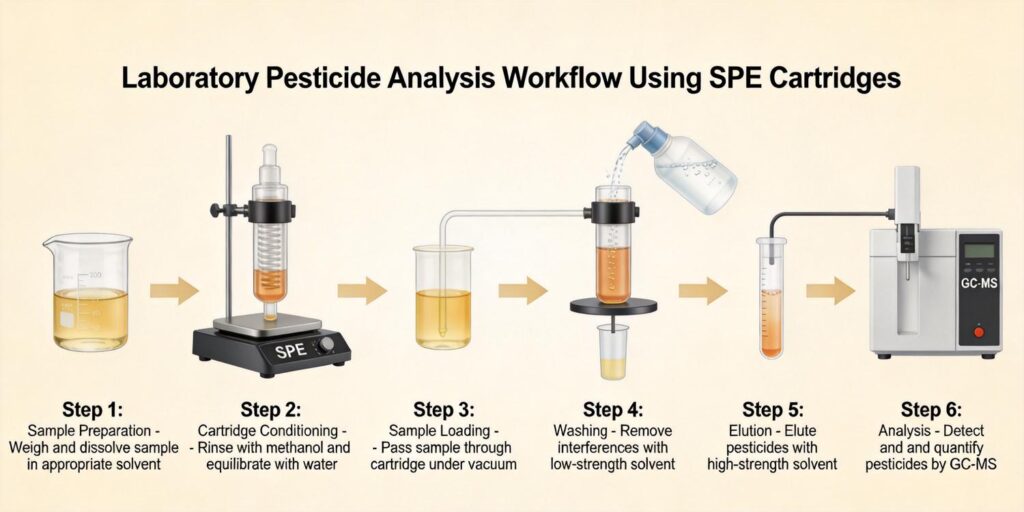
A comprehensive SPE workflow for food additive analysis follows established principles while adapting to specific matrix challenges. The process typically involves these steps:
Sample Preparation
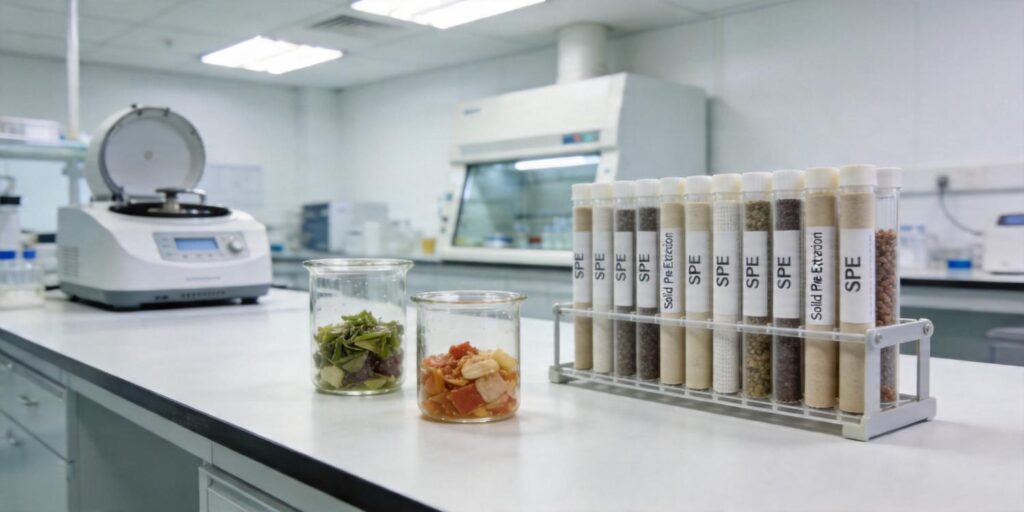
Food samples require homogenization and often preliminary extraction. For solid foods, techniques like matrix solid-phase dispersion (MSPD) or traditional solvent extraction precede SPE. Liquid samples may require pH adjustment or dilution. As noted in food applications, “beverages, provided the alcohol or sugar/syrup content is not high or variable, are simpler to process by SPE” (Simpson and Wynne, 2000).
SPE Procedure
- Conditioning: Typically with methanol followed by water or buffer
- Sample Loading: At controlled flow rates (1-3 drops/sec for optimal recovery)
- Washing: With solvents that remove interferences without eluting analytes
- Elution: Using minimal solvent volumes for concentration
- Reconstitution: In solvent compatible with analytical instrumentation
Specific Application Example: Preservative Analysis in Beverages
For analyzing sodium benzoate and potassium sorbate in soft drinks:
- Dilute sample with phosphate buffer (pH 4.5)
- Condition SAX cartridge with methanol and buffer
- Load sample at 1-2 mL/min
- Wash with 5% methanol in water to remove sugars and colors
- Elute with acidified methanol (2% formic acid)
- Evaporate and reconstitute in mobile phase for LC analysis
This approach mirrors successful methods for similar compounds, where “the drugs, in the carboxylate form in a basic solvent system, were retained by a SAX sorbent” (Bonazzi et al., 1995).
LC-MS Detection Methods for Food Additives
Liquid chromatography-mass spectrometry has become the gold standard for food additive analysis due to its sensitivity, selectivity, and ability to confirm compound identity. The integration of SPE with LC-MS addresses key challenges in food analysis.
Chromatographic Considerations
Reversed-phase chromatography using C18 columns with gradient elution effectively separates most food additives. Mobile phases typically combine water with acetonitrile or methanol, often with modifiers like formic acid or ammonium acetate to enhance ionization. The compatibility of SPE eluents with LC mobile phases represents a significant advantage over traditional liquid-liquid extraction.
Mass Spectrometric Detection
Electrospray ionization (ESI) in negative or positive mode, depending on additive properties, provides sensitive detection. Multiple reaction monitoring (MRM) enhances selectivity for complex matrices. As SPE literature notes, “mass spectroscopy offers the advantage of selective detection, meaning that provided care is taken not to introduce species into the MS that could degrade its performance over time or influence the ionization processes, less emphasis on sample clean-up is required” (Simpson and Wynne, 2000).
Method Validation Parameters
Comprehensive method validation should assess:
- Linearity across expected concentration ranges
- Recovery efficiency (typically 70-120%)
- Matrix effects and ion suppression
- Limit of detection and quantification
- Precision and accuracy
- Robustness against matrix variations
Food Regulatory Testing Applications
SPE-based methods support critical regulatory compliance testing for food additives worldwide. These applications ensure consumer safety and product quality while meeting stringent regulatory requirements.
Maximum Residue Level (MRL) Compliance
Regulatory agencies establish MRLs for additives in various food categories. SPE enables detection at these low levels (often ppm or ppb) by providing both cleanup and concentration. The technique’s reproducibility makes it suitable for compliance testing where results may face legal scrutiny.
International Standards Alignment
Methods based on SPE align with international standards from organizations like:
- Codex Alimentarius Commission
- European Food Safety Authority (EFSA)
- U.S. Food and Drug Administration (FDA)
- International Organization for Standardization (ISO)
Routine Quality Control
Food manufacturers implement SPE methods for in-process monitoring and final product testing. The technique’s efficiency supports high-throughput analysis in quality control laboratories. As noted in industrial applications, “SPE does have a use largely in the areas of product impurity analysis and in the monitoring of wastes from the manufacturing process” (Simpson and Wynne, 2000).
Emerging Applications
Recent developments include:
- Multi-residue methods for screening multiple additive classes
- Automated SPE systems for increased throughput
- On-line SPE-LC-MS configurations for continuous monitoring
- High-resolution mass spectrometry for non-targeted screening
Economic and Environmental Benefits
Compared to traditional liquid-liquid extraction, SPE offers “decreased organic solvent usage and waste generation” along with “higher and more reproducible recoveries” (Agilent SPE Guide). These advantages align with green chemistry principles while reducing analytical costs.
In conclusion, SPE cleanup represents a critical component in the analytical workflow for food additive analysis. By understanding additive chemistry, matrix challenges, and appropriate sorbent selection, laboratories can develop robust methods that meet regulatory requirements while ensuring food safety. The continued evolution of SPE materials and formats promises even greater capabilities for this essential application area.